 Moz
Moz
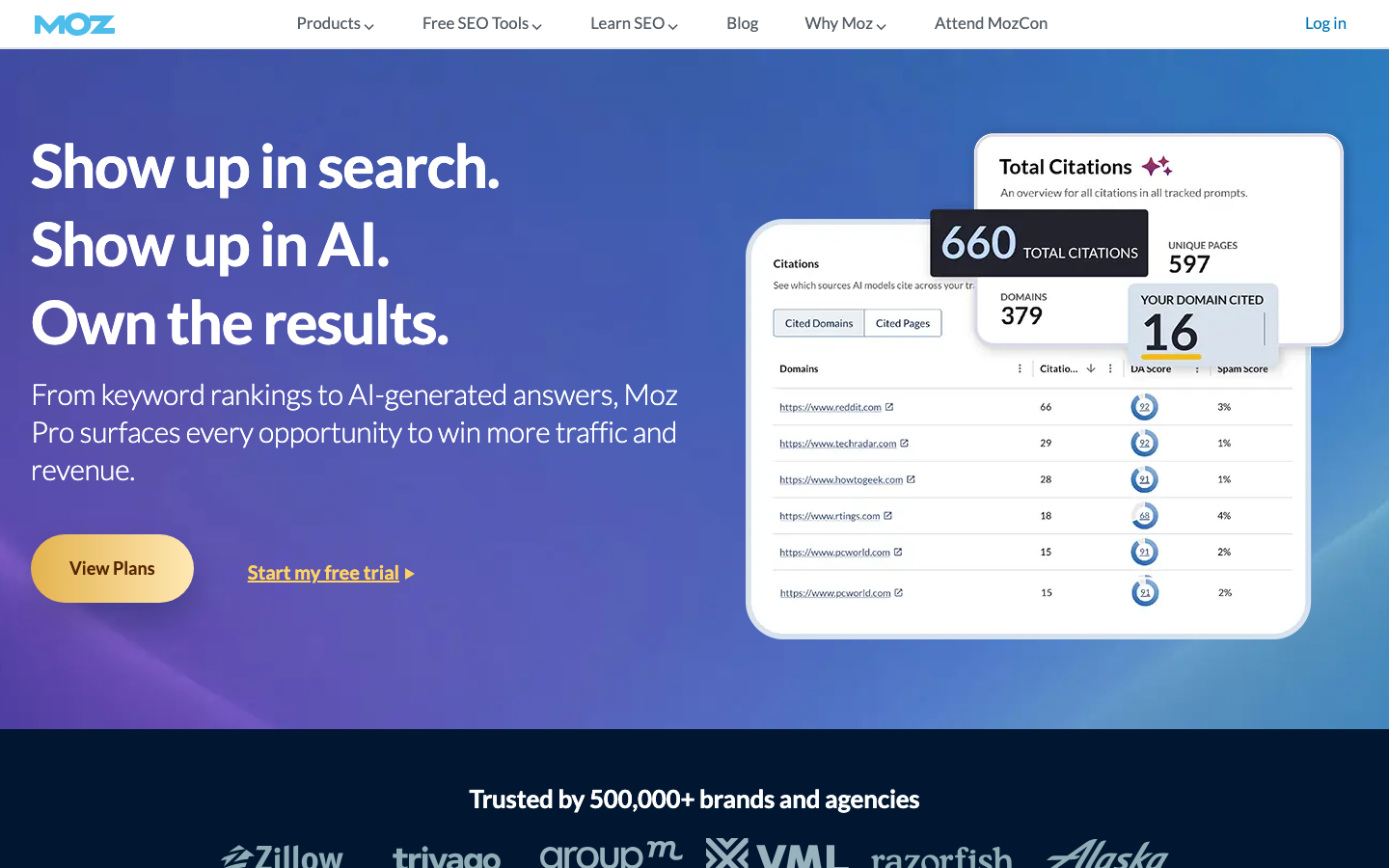
Moz is an established platform in the SEO industry, famous for its Domain Authority (DA) scoring system. Trusted by SMBs and marketing agencies, it provides keyword research, link analysis, website auditing, and local SEO management capabilities.
Moz
Moz’s core parameters and statistics
Moz is a one-stop analysis and domain authority evaluation platform for SEO professionals and marketing teams. It is officially positioned as one of the pioneers in the field of SEO analysis. Its core asset Domain Authority (DA) score has been accumulated for more than ten years and has become the most widely cited domain name quality reference indicator in the industry.
| Projects | Public Information |
|---|---|
| Official positioning | One-stop SEO analysis and domain name authority evaluation platform |
| Core form | SaaS web client + browser plug-in |
| Database scale | External link index 40T+, page index 754B+ |
| Index update frequency | Every 2–4 weeks (Link Explorer) |
| Established | 2004 |
| Headquarters | Seattle, USA |
| Latest version | 2026.07 (continuous monthly updates) |
| Pricing model | Subscription system, 4 packages |
| Free Plan | MozBar Browser Add-on + 30-Day Pro Free Trial |
| Supported platforms | Web, Chrome/Firefox browser plug-in |
Database size and update rhythm: Moz’s Link Explorer index size is in the first echelon among external link analysis tools, but the update frequency (every 2–4 weeks) is lower than Ahrefs (every 15–30 minutes) and Semrush (daily updates). This means that when using Moz for external link monitoring, it may take several weeks for new links to be included in the database, and there is a risk of lag in time-sensitive scenarios (such as monitoring new external links for competitive products and rapid discovery of deleted links).
Industry status of DA/PA rating: Domain Authority (DA) is Moz’s core asset and has been embedded in a large number of third-party SEO tools, browser plug-ins and content management systems as reference indicators. The DA score itself is not an official indicator of search engines, but after more than ten years of accumulation, it has formed a de facto reference standard in the SEO community, and is especially widely cited in external link procurement, media cooperation, and domain name transactions.
Breadth of Product Coverage: Moz’s functional lines cover keyword research, external link analysis, technical audit, ranking tracking and local SEO management. It is a relatively comprehensive SEO suite. However, in terms of the depth of each individual item - especially the real-time performance of external link database and AI function integration - there is a gap with leading competitive products.
Moz’s users and market recognition
User Scale and Customer Portraits: Moz has more than 500,000 registered users (including free MozBar users), and its customers are mainly small and medium-sized enterprises, marketing agencies and freelance SEO consultants. The majority of paying customers are companies with annual revenue of less than $5 million, indicating that its pricing and feature depth are more suitable for growing companies rather than the full-stack SEO needs of large enterprises. Moz's customer retention rate is affected by the lock-in effect of the DA scoring ecosystem - once the team is accustomed to using DA as a reference standard for domain name quality, switching to other tools requires rebuilding the scoring cognitive system, and the switching cost is high.
Industry Penetration of DA Scores: According to industry estimates, more than 70% of SEO tool users around the world have been exposed to DA scores in their daily work. In addition to MozBar, tools such as Ahrefs, Majestic, SEOquake, Neil Patel’s Ubersuggest, and others have DA/PA displays built into their interfaces. This "cross-tool citation" makes Moz's brand influence far beyond its paying user base - even non-subscribers continue to consume Moz's rating data.
Community & Educational Assets: The Moz Blog and Whiteboard Friday video series are one of the oldest and most widely-reached educational resources in SEO, delivering high-quality SEO content every week since 2007. The Moz Community (Q&A Forum) has accumulated a large amount of SEO knowledge questions and answers and has become an important reference library for self-study SEO. This content asset has established a solid foundation of trust among the “no-budget entry-level SEO” community and continues to drive traffic to Moz Pro.
Competitive Landscape: Moz’s direct competitors have different focus on functional coverage and data scale:
| Competing products | Core advantages | Monthly entry fee | Main shortcomings |
|---|---|---|---|
| Ahrefs | Largest external link database, fastest update (15–30 minutes) | $129/month | High price, medium learning curve |
| Semrush | Omni-channel marketing suite (SEO + PPC + social media + content) | $139.95/month | Redundant functions, too expensive for pure SEO teams |
| BrightLocal | The most specialized in local SEO (GMB management + evaluation + ranking) | Starting from $33/month | Lack of global SEO and external link analysis capabilities |
| Google Search Console | Free and the data comes from Google official | Free | Does not provide DA scoring, batch external link analysis and keyword research |
Market Volume: According to the third-party SEO tool usage survey (2025–2026), Moz ranks third or fourth in the ranking of "most commonly used SEO tools", lagging behind Semrush, Ahrefs and Google Search Console, but still maintains a high share in the local SEO segment. Moz has deep penetration into the small and medium-sized enterprise market in North America, and its market share in Europe and Asia-Pacific is relatively low.
Moz’s Cost Advantage
- C-side/Individual: Usually a free version is provided to experience the core functions, and high-frequency use requires a paid package subscription.
- API/Developer: Billed by call volume, suitable for development teams that can be flexibly integrated into their own systems.
- Enterprise/Privatized: Contact the business owner for customized quotation and deployment plan. The specific price is subject to the official real-time pricing page.
Moz’s main features
Moz's functional system revolves around the five major sections of SEO workflow: keyword research, external link analysis, technical audit, ranking monitoring and local SEO. The modules are connected in series through the DA scoring system.
-
Keyword Explorer: Entering a seed keyword returns search volume, difficulty score (KD %), organic click-through rate (CTR) estimates, and keyword suggestion groups. Expert View: The keyword suggestion list includes "SERP feature" categories (such as Featured Snippet, People Also Ask, and Video Results) to help content creators quickly determine whether they need to optimize for specific SERP elements instead of just focusing on search volume to make decisions; the keyword list can be exported to CSV with one click, seamlessly integrating with the SEO content briefing workflow. Implementation Tips: During the trial period, you should verify whether your core keywords have search volume data in the Moz database - some medium and long-tail keywords may have data coverage gaps in non-US markets.
-
Link Explorer: Analyze the total number of external links of the target domain name, referring domain names (RD), anchor text distribution Spam Score (anti-spam score) and Linking Domains growth trend chart. Expert View: The real value of Link Explorer is not in the data level (smaller than Ahrefs), but in the Spam Score - it quantifies the quality of external links to 1-17 points, allowing external link cleaning and rejection (disavow) priorities to be sorted; the disadvantage is that the index update window is as long as 2-4 weeks, newly released links cannot be reflected in time, and there is a blind spot in external link loss monitoring. Implementation Tips: For websites in the period of rapid growth of external links, it is recommended to manually refresh Link Explorer once a week and compare the data of the previous week to confirm whether any important links have been deleted or rejected.
-
Site Crawl (site crawler): Covers 100+ technical SEO check items (broken links, duplicate titles, missing meta description canonical error H1 duplication, etc.), arranged by Error/Warning/Notice severity, and provides repair suggestions and Schema markup detection. Expert View: The real advantage of Site Crawl is "importing GSC + GA data for correlation analysis" - for example, comparing the 404 pages discovered by the crawler with the GSC ranked pages, and prioritizing the repair of missing pages with traffic value. However, for large sites (>100,000 URLs), its crawler coverage and custom crawling rules are not as flexible as Screaming Frog or DeepCrawl, and are more suitable for daily inspections of small and medium-sized sites (under 50,000 URLs).
-
Rank Tracking: Supports keyword ranking monitoring in multiple locations (city/zip code/region) and multiple devices (desktop/mobile). The True Metrics module correlates Google Search Console data to automatically calculate visibility trends, estimated traffic, and ranking distribution (Top 3 / Top 10 / Top 50). Expert View: True Metrics’ ranking distribution view allows the team to intuitively see the overall SEO health trend, not just the ranking fluctuations of individual keywords. It is especially effective for scenarios where SEO progress is regularly reported to management. Implementation Tips: During initial configuration, it is recommended to add the most core 20–30 keywords to verify the accuracy of ranking tracking, and then gradually expand to the entire keyword list.
-
Local SEO: Manage Google Business Profile (GBP) list information, track Local Pack rankings, monitor the number of reviews and score changes, and support batch management of multiple stores. Expert View: This is Moz’s most differentiated feature line among competing products – Semrush and Ahrefs’ local SEO modules are relatively weak, while BrightLocal, although more specialized, lacks global SEO capabilities such as DA scoring. Moz’s local SEO is suitable for mixed scenarios “with both national SEO needs and dozens of store management.” Implementation Tip: GBP data coverage in non-US markets may have integrity issues, and the trial period should be to test data synchronization latency and ranking accuracy in your main target markets.
-
MozBar browser plug-in: A free plug-in that instantly displays DA, PA, number of external links, tags H1/H2, structured data type meta tags, image alt missing and other SEO elements on any web page. Expert View: MozBar is the "traffic entrance" and "word-of-mouth amplifier" of the Moz ecosystem - it is free and ready to use, allowing even non-paying users to continue to be exposed to DA scores in daily browsing, forming cognitive dependence. For content creators and media editors, MozBar is almost the number one choice for checking the SEO health of a target website.
Moz’s model and version evolution
Moz's product iterations are mainly SaaS monthly updates, with stable core business logic, focusing on database scale expansion, interface optimization and module capability enhancement.
Mainline release
- Version 2026.07 (~2026-07): Added AI-assisted keyword clustering (using NLP to automatically group keyword lists to reduce manual sorting time) and automated ranking reports (regularly generate PDF/CSV and push to designated mailboxes). This is Moz’s first clear product launch in the direction of AI functionality.
- Version 2025.06 (~2025-06): The Link Explorer database index has been fully updated, significantly improving URL coverage and index freshness; the Site Crawl crawler optimizes the URL discovery rate; the interface navigation structure is adjusted to a three-level classification of "Dashboard → Tools → Reports".
- Version 2024.01 (~2024-01): Introduces the True Metrics ranking tracking module, integrates Google Search Console data, and supports customized reporting dashboards; the local SEO module adds a batch evaluation monitoring function.
- 2023 Annual Update (~2023): Launched Listings local list management function to support batch unified management of multi-store GMB information; Site Crawl enhanced JavaScript rendering capabilities to improve crawl coverage of SPA sites.
- 2022 Annual Update (~2022): The Keyword Explorer interface is redesigned and SERP feature categories (Featured Snippet, People Also Ask, etc.) are added; Spam Score is upgraded to 2.0, and a machine learning model is introduced to assist in external link quality assessment.
- 2021 Annual Update (~2021): Link Explorer migrates to new indexing infrastructure, increasing database size by approximately 40%; launches updated version of Moz API to support more flexible query parameters.
Evolution trend judgment
Moz’s version evolution has three characteristics:
- AI implementation started late: AI auxiliary functions did not appear until the July 2026 version. Compared with Semrush’s AI Writing Assistant (launched in 2023) and Ahrefs’ AI Content Helper (launched in 2024), Moz is at least 2–3 years behind in the AI direction. This means that teams with clear needs for AI capabilities should not consider Moz as their main consideration in the short term.
- Database updates are stable but conservative: The index update frequency has been maintained at 2-4 weeks for a long time, and there is no acceleration trend to catch up with competing products, indicating that Moz adopts a steady strategy rather than radical expansion in infrastructure investment. For SEO in mature industries with low data timeliness requirements, this pace is acceptable; but for industries with fierce competition and frequent changes in external links (such as finance, e-commerce, online education), the 2-4 week window period may miss key competitive signals.
- Continuous deepening of local SEO: Local SEO functions will be enhanced every year from 2022, reflecting Moz’s clear strategy of differentiated competition in niche areas. This is the core battlefield of Moz’s misaligned competition with Ahrefs and Semrush.
Moz’s technical advantages
The technical advantage of Moz is not in "large and comprehensive", but in the causal chain design of "standardized scoring → data comparison → lowering the threshold for decision-making".
DA/PA scoring mechanism: Domain Authority and Page Authority are composite scores trained through machine learning models (based on dozens of external links and page-level signals, including the number of referring domain names, external link quality distribution, page content relevance, social signals, etc.), with a score range of 1–100. Mechanism → Effect: Compress multi-dimensional backlink quality signals into a single comparable number, allowing non-technical roles (editors, marketing managers, customers) to understand the relative quality level of a domain name in seconds - this is the fundamental reason why DA scores are widely adopted and the technical basis for Moz's brand moat. Applicable scenarios: Preliminary screening of external link procurement, media cooperation evaluation, domain name transaction pricing, reference to SEO concept education and communication to customers.
Spam Score anti-spam score: Based on 27 negative signals in the external link data captured by Moz (such as the link proportion of low-quality domain names, link farm ecology, abnormal international distribution of domain names, the proportion of excessively precise matching anchor texts, etc.), calculated using a hybrid method of rule models and machine learning. Mechanism → Effect: Quantify the fuzzy judgment "Are the external links of this domain name clean?", which requires several hours of manual analysis, into 1-17 points - 0-2 points indicating extremely low risk, and 15-17 points indicating a very high probability of being penalized by search engines. Applicable scenarios: Prioritization of external link audit cleanup, assessment of the risk level of potential link purchase objects, and preventive self-examination before Google's manual operations.
True Metrics ranking correlation capability: It is not a simple ranking query tool, but cross-validates GSC click data Google Maps local package rankings and Moz's own tracking rankings. Mechanism → Effect: Significantly reduce the bias of a single ranking tracking tool through multi-data source comparison - because the ranking data of any single SEO tool may fluctuate due to IP, device and geographical location, True Metrics' cross-validation provides a more reliable trend signal. Applicable scenarios: SEO performance review, monthly management reports, attribution analysis of cross-channel traffic changes.
Indexing infrastructure: Moz’s Link Explorer indexes about 40T external link data and 754B pages. Mechanism → Effect: In daily SEO work, more than 95% of external link query needs (such as analyzing the external link patterns of major competitors, discovering high-quality link opportunities, and evaluating potential cooperative media) can be completed within Moz’s index coverage. Supplementary tools are only needed for very low-frequency long-tail queries or for new links that have just been published. Engineering Limitations: Index update delay is the biggest shortcoming, which directly affects external link loss monitoring and news-driven fast link acquisition scenarios.
Project Limitation Summary:
- Index update delay: The 2-4 week window is Moz’s biggest technical shortcoming. In a world where competing product external link data has been updated at the minute level, this gap directly affects users’ tool selection.
- SPA site crawling capability: Although Site Crawl already supports JavaScript rendering, it still lacks coverage for heavy single-page applications or Infinite Scroll sites. Large sites need to cooperate with Screaming Frog for supplementary auditing.
- API concurrency limit: The concurrency limit and query complexity limit of the Link Explorer API may affect teams that require batch external link analysis. They should apply for a test quota to verify the actual throughput before formal purchase.
How to use Moz
Moz's product form is mainly SaaS web-based, supplemented by browser plug-ins and API interfaces, covering the needs of different usage depths.
| How to use | Suitable for people | Features | Cost |
|---|---|---|---|
| Web client (Moz Pro) | SEO professionals, agencies | Complete feature set, including keyword exploration, backlink analysis, site crawler, ranking tracking, local SEO | $99–$599/month |
| MozBar browser plug-in | All SEO practitioners, content creators | Free to use out of the box, query DA/PA/H tags/structured data on any page | Free |
| Link Explorer API | Developers, data team | RESTful interface, supports batch external link query and custom data integration | Pay-per-volume billing, business confirmation required |
| Mobile viewing | Remote manager/business travel scenario | Limited functionality, mainly viewing ranking data and dashboard summary | Included in Moz Pro subscription |
Typical steps:
- Registration and Trial: Visit moz.com to register an account. New users can receive a 30-day free trial of Pro full functionality without binding a credit card.
- Project Creation: Create a new project in the Moz Pro console, enter the target domain name, and the system automatically triggers the first Site Crawl and Link Explorer data pull (the first indexing may take several hours).
- Keyword Research: Enter Keyword Explorer, enter seed keywords, analyze search volume, difficulty score and SERP feature distribution, and export a keyword list for content planning.
- External link audit: Use Link Explorer to enter competitor domain names or potential partner domain names, and view the spam score distribution of external link portraits and the growth trend of Linking Domains.
- Rank Monitoring Configuration: Add the tracking keyword list, target URL and device type (desktop/mobile) in Rank Tracking, and configure True Metrics to associate with GSC.
- Periodic Inspection: Check the Error/Warning items in the Site Crawl report every week, prioritize fixing technical problems with ranking pages, and re-crawl for verification after fixing.
- Report Generation: Use the custom report dashboard to select the modules and indicators to be displayed, set up periodic automatic sending (daily/week/month), and support PDF and CSV formats.
30 Day Trial Period Checklist:
- Whether the core keywords have search volume data in Keyword Explorer (especially in non-US markets)
- Whether the external link data of major competitors or commonly used cooperative domain names is complete in Link Explorer
- Whether Site Crawl can cover all key pages of the website
- Whether the deviation between ranking tracking data and actual GSC data is within an acceptable range
Moz Product Pricing
The pricing model is subject to the official real-time page. Usually a freemium or subscription system is used, and basic functions can be used for free. Advanced functions or high-frequency use require paid subscriptions, and users are advised to evaluate the optimal solution based on actual usage.
Moz application scenarios
-
Domain name authority evaluation and external link procurement: Quickly screen the domain name quality of potential cooperative media through DA/PA scores, and combine with Spam Score to eliminate high-risk link sources. Efficiency Deduction: The external link procurement team can reduce the evaluation process from "manually checking the content quality + traffic data + external link portrait for each domain name, about 10-15 minutes" to "directly checking DA + Spam Score + the number of cited domain names, about 2-3 minutes", and the efficiency is increased by about 70%. Human-machine collaboration boundary: DA scoring can be 100% automated for preliminary screening and elimination, but the final purchasing decision must be made manually - DA does not reflect unquantifiable factors such as content originality, audience quality and commercial conversion value. The recommended collaboration process is: automated filtering of DA scores (removing domain names with DA < 30) → manual assessment of content relevance and audience matching → confirmation of purchase.
-
Technical SEO Diagnosis and Website Migration Escort: Use Site Crawl to perform a full-site audit before and after website revision, domain name migration, or CMS switching to quickly discover common problems such as broken links, lost metadata, incorrect canonical tags, and duplicate content. Efficiency deduction: Technical SEO audit has been reduced from "manual page-by-page inspection + manual summary of problem list, which takes about 2-3 days/site" to "automated crawler + repair by priority, which takes about 0.5 days of analysis + 1-2 days of repair". The effect is particularly significant for sites with less than 50,000 URLs. Human-machine collaboration boundary: Issues discovered by crawlers can be automatically classified and sorted, but which issues are fixed first (depending on the business impact), how the repair plan is designed (involving development and content teams), and QA verification after repair must be performed by humans.
-
Local SEO management and multi-store optimization: Centrally manage the Google Business Profile information consistency of multiple stores through the Local SEO module, and track local package ranking changes and evaluation data. Efficiency Deduction: The multi-store operation team has reduced from "logging in to different Gmails for each store to check rankings + manually recording score changes, which takes about 30 minutes/week for each store" to "viewing all store rankings on a unified dashboard + exporting a consolidated report, which takes about 15 minutes/week to cover all stores." Human-machine collaboration boundary: Ranking monitoring and review quantity statistics can be 100% automated, but the content generation of review responses (especially negative reviews involving brand reputation) must be written and reviewed by humans, and any unreviewed automatic response strategies should not be used.
-
Keyword Strategy and Content Planning: Keyword Explorer provides the content team with search volume, difficulty assessment and SERP feature analysis to assist in determining content topic selection and optimization direction. Efficiency deduction: Content topic selection research has been reduced from "manually inputting Google search + viewing Suggest and related searches + third-party tools to estimate difficulty, completing 1 topic in about half a day" to "exporting keyword groups with one click + KD score + CTR estimation, completing the preliminary screening of 3-5 topics in about 30-45 minutes." Human-computer collaboration boundary: Keyword data can assist in prioritizing topic selection, but judging the direction of content strategy, Topic Cluster hierarchical structure design and final content quality review must be completed by humans.
-
Competitive Product SEO Analysis and Market Share Tracking: Use Link Explorer and Rank Tracking to monitor changes in competitors' external link strategies and ranking migration trends to assist in adjusting your own strategies. Note: This scenario requires high data freshness. Moz's 2-4 week update cycle may miss short-term key actions of competing products (such as being suddenly cited by high-weight media or losing external links in batches). It is recommended to use Ahrefs or Semrush for cross-validation, and use Moz as a "trend reference" rather than a "real-time tracking" tool.
Who is Moz suitable for?
-
Freelance SEO Consultants and Micro-Teams: Price-sensitive and need a tool with comprehensive functionality but not necessarily the strongest tool in every aspect. Moz’s Standard package of $99/month is one of the lowest entry-level options among Professional-level tools. The clear interface design and DA rating system also make communication with customers more efficient. Not suitable for the boundary: If the workflow highly relies on real-time external link data (such as checking whether newly obtained links are recognized by search engines every day), or requires in-depth PPC/social media functions, Moz cannot be used as the main tool and is more suitable as an auxiliary solution for DA scoring reference. Prerequisite: Basic SEO knowledge is required (understanding the meaning and limitations of DA, PA, and Spam Score). Users with absolutely zero SEO experience may encounter bottlenecks in interpreting the report.
-
Small and Medium Enterprises and Internal Marketing Teams: Teams that need to simultaneously manage brand keyword rankings, link building progress, technical health, and local SEO presence. Moz's "one package, all functions" strategy (unlike Semrush, which charges separately for each module) makes the budget more controllable. Unsuitable Boundary: When the large-scale website (100,000+ URLs) managed by the team requires in-depth technical audit, or it is in a highly competitive industry (such as finance, legal services, online education) and requires daily external link monitoring, Moz's capability boundary will be obviously touched. Prerequisite: The team needs at least 1 dedicated SEO person who can independently interpret Site Crawl reports and True Metrics data.
-
Marketing Agency (SMB side): Managing multiple client projects requires unified report templates and batch management capabilities. Moz’s True Metrics and custom reporting capabilities are great for showing monthly SEO progress to clients, and the DA score itself often becomes a communication tool for agencies to explain the value of SEO to clients. Not suitable for the boundary: When an agency manages a large number of customers in highly competitive industries and needs to frequently compare the external link dynamics of competing products, Moz's data update frequency and shortcomings in AI functions will become competitive disadvantages - at this time, it is more likely to choose Semrush or Ahrefs as the main tool, and Moz will retreat to the secondary reference.
-
Content Creators and Bloggers: Use MozBar to check the DA and Spam Score of the websites you cite to evaluate the domain quality of partner media. Prerequisite: A basic understanding of the meaning of DA and PA is enough, no in-depth SEO skills are required. MozBar’s free nature makes it the most accessible SEO assessment tool for content creators.
Not applicable to the crowd:
- SEO teams who need real-time backlink data: Moz’s 2–4 week update cycle doesn’t meet the needs for link churn monitoring and news-driven rapid backlink reconnaissance. This type of scenario is better suited to Ahrefs (15–30 minute updates) or Majestic (more complete historical index).
- Full-stack SEO team for large enterprises: Database scale AI functionality depth and custom dimensions are insufficient. Enterprise-level solutions are more likely to choose Semrush’s Business solution, Ahrefs’ Enterprise solution or a customized data platform.
- AI feature-first early adopters: Moz started late on AI features, launching its first AI-assisted keyword clustering feature in July 2026. Teams with clear demands for AI-native SEO tools should consider other options.
- Purely free users with extremely limited budgets: Although MozBar is free, the minimum annual cost to fully use Moz Pro is about $948/year. For individual bloggers or start-up teams with strictly limited budgets, the free combination of Google Search Console + Google Analytics + Google Keyword Planner may be more practical.
Summary and outlook of Moz
Moz has established deep cognitive barriers and brand lock-in effects in the SEO industry with its DA/PA rating system - even users of competing products cannot completely ignore Moz's rating reference. Its products cover five major modules: keyword research, external link analysis, technical audit, ranking tracking and local SEO. It has maintained a stable share in the SMB market for more than ten years with mid-range pricing and a clear and easy-to-use interface. The local SEO module is Moz’s core advantage in differentiated competition and is suitable for hybrid teams that “have both global SEO needs and multi-store management scenarios.”
Current Limitations and Uncertainties:
- Data update frequency lags behind industry benchmarks: The 2-4 week external link index update cycle is Moz’s biggest technical shortcoming. In a context where external link data has become a minute-level update for competing products, this gap directly affects user retention and new customer acquisition.
- AI functional layout is obviously lagging behind: The first AI auxiliary function was launched in 2026, while competing products have completed the productization of AI writing, AI content analysis and AI keyword clustering in 2023-2024. Moz’s pace and roadmap to catch up on this line is yet to be determined.
- Insufficient audit capabilities for large sites: Site Crawl’s coverage of very large-scale websites (100,000+ URLs) and the flexibility of custom crawling rules are not as good as professional audit tools. Enterprise-level users may need additional tools to supplement it.
- Non-US market data coverage: The completeness of keyword search volume data and external link index coverage of non-English markets has not been publicly confirmed. Non-US teams should focus on testing the data quality of the target market before purchasing.
- API Ecosystem and Integration Capabilities: Compared with Semrush’s rich API endpoints and third-party integration ecosystem, Moz’s connection capabilities are relatively closed and have limitations on workflows that require deep data integration.
Procurement/Adoption Risk Warning:
- If the team's current external link workflow already relies heavily on DA scoring and the client/supervisor has a cognitive habit of DA, the integration cost of switching to Moz is extremely low and the risk is controllable; however, relying entirely on Moz as the only SEO data source will cause data blind spots. It is recommended to use it with GSC, Ahrefs or Semrush if the budget allows.
- Enterprises need to focus on verifying three terms before purchasing: (1) Whether the price is locked during the annual contract period and whether the package is allowed to be upgraded midway; (2) whether there is a hard monthly cap on API query volume and the billing method after the excess; (3) whether the local SEO module fully covers the Google regional version of the target market - non-US markets may have problems with GMB data synchronization delays and incomplete ranking coverage.
- It is recommended that the first purchase follow the path of "30-day free trial → 3-month Standard package verification → upgrade on demand" to avoid directly signing the annual Premium package and then discovering that key data items (such as external link coverage of the target market, ranking tracking accuracy) do not meet the needs. At least one person in the team regularly pays attention to the announcements and update logs of Moz Blog, because Moz does not have a unified push notification mechanism for index refresh and feature iteration, and relies on users to actively understand.
Related tools:  Notion AI, google-workspace
Moz How to use
- Web client: You can use it by visiting the official website and registering an account. Most functions do not require installation.
- API access: Provides RESTful API, developers can obtain the API Key and integrate it into their own applications.
Version Info
- Moz Pro July 2026 Update :Added AI-assisted keyword clustering and automated ranking reports
- Moz Pro 2025 Refresh :Update Link Explorer database index and optimize site audit crawler
- Moz Pro 2024 Release :Introducing True Metrics ranking tracking and custom reporting dashboards
User Reviews