 Mubert
Mubert provides AI real-time music generation to generate unique copyright-free background music for creators and enterprises.
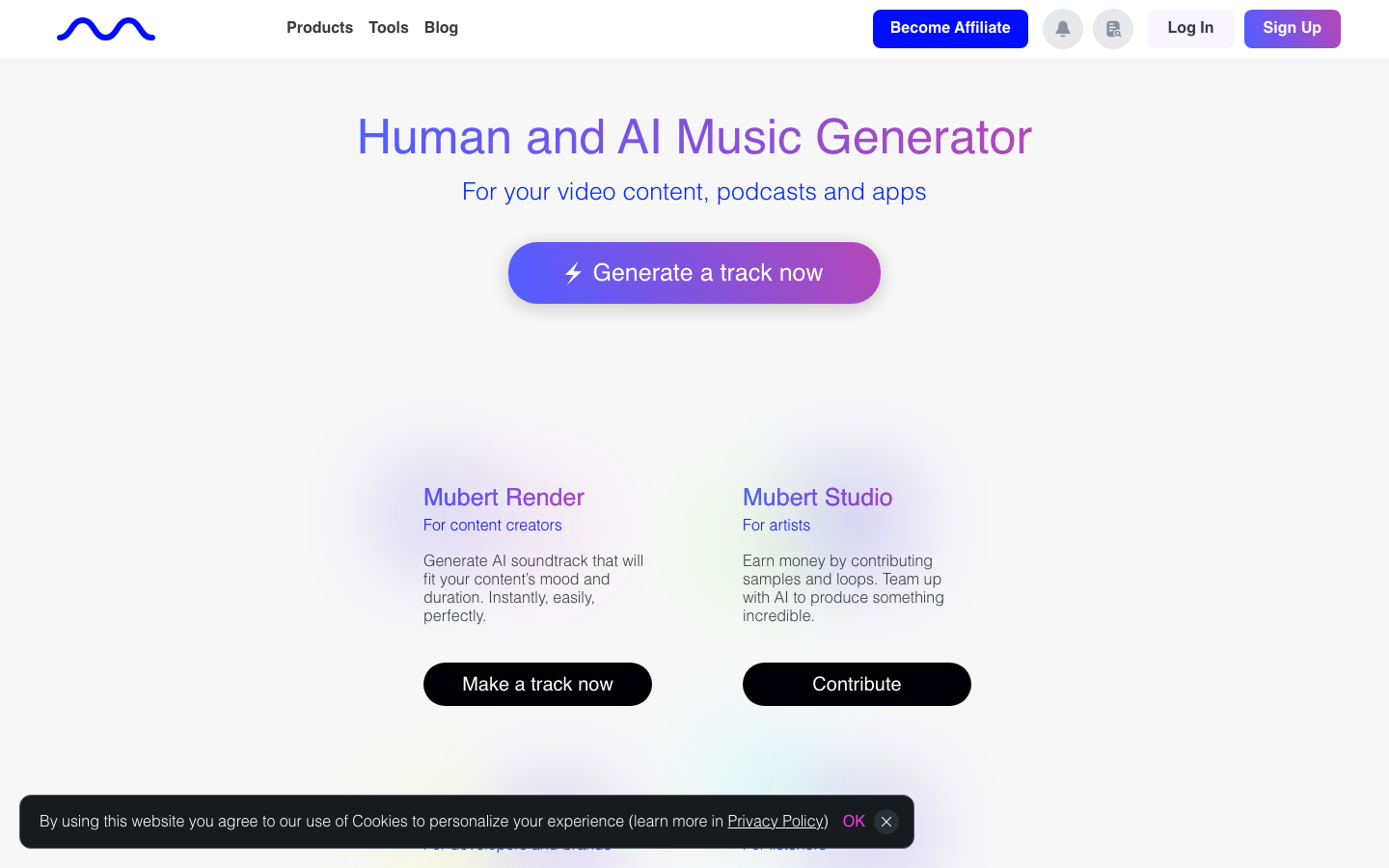
Mubert
Mubert’s core parameters and statistics
Mubert is not a traditional music production tool that "generates a song and ends", but a multi-layered AI music platform covering "real-time generation stream + text/image conversion to music + API embedding + commercial venue background music + creator ecology". The core difference is that music is not a splicing of pre-recorded clips, but a real-time combination and arrangement of music element clips by AI to form a continuous audio stream that never repeats.
| Core Parameters | Mubert Indicator |
|---|---|
| Product positioning | AI real-time music generation platform + royalty-free music licensing market |
| Product Line | Render (content creator), Play (listener), API (developer), Studio (creator ecology), Streamers (host), Business (commercial place) |
| Supported styles | 150+ music styles, 50+ moods/themes, dozens of instrument classifications |
| Music library size | 1M+ sample clips from 4,000+ musicians |
| Generation method | Text prompts, image upload, style/mood/BPM selection, reference track |
| Output format | WAV (lossless)/MP3, sample rate 44.1kHz |
| Maximum generation | Single maximum 25 minutes (Enterprise version can be extended to longer) |
| Platform form | Web application + iOS/Android App + REST API + WebRTC real-time streaming |
| Company establishment | 2016 |
| Headquarters Address | Dover, Delaware, USA (Mubert Inc) |
| Cumulative generation | 200 million+ AI audio tracks |
The essential difference between real-time generation of streams and pre-recorded tracks: Traditional royalty-free music libraries (such as Epidemic Sound, Artlist) provide fixed recording files, and multiple users may use the same track; each generation of Mubert is a unique product of real-time arrangement, and theoretically there are no two identical outputs. This is especially important for live broadcast scenarios - live broadcasts that last for several hours do not need to play the same background music repeatedly, but always keep it fresh.
Mubert’s users and market recognition
Mubert's voice is focused on the two directions of creator economy and commercial music in the "AI music generation" segment, rather than on chat products for mass consumers.
Media and Industry Recognition: Mubert has been featured in international technology media such as Forbes, TNW (The Next Web), VentureBeat, Wired and other international technology media, establishing brand recognition in the field of AI music. As of 2026, officials have disclosed that more than 200 million audio tracks have been generated, reflecting the high frequency of usage by C-side creators.
B-side partners: Mubert API has been integrated with Restream (live broadcast multi-platform distribution tool) to provide real-time AI background music for broadcasters; its API has also been accessed by creative tool platforms such as Picsart and Canva for UGC video soundtracks. These integration cases verify the usability of the API in productized embedding scenarios.
Creator Ecosystem: Mubert Studio has attracted 4,000+ musicians and contributed more than 1 million sample clips. This "human-machine collaboration" supply model is different from the pure AI generation route - musicians provide high-quality materials, AI is responsible for real-time arrangement and combination, and the lower limit of output quality is covered by professional materials.
Division of market positioning: The competition between Mubert and traditional royalty-free music platforms (such as Epidemic Sound, Artlist) is not "whose music sounds better", but "whose copyright risk is lower + usage scenarios are more flexible". Mubert's AI generation model naturally avoids the problem of "multiple users using the same piece of music resulting in similar content." However, the artistic depth of AI-generated music is still not as good as the careful creation of professional composers in some scenarios, which is also a controversial point in its market perception.
Mubert’s cost advantage
Mubert's cost structure needs to be broken down into three layers: "content creators/developers/commercial venues". The pricing logic of each layer is different from that of competing products.
C-side/Individual Creator: The free version provides 25 generated 5 MP3 downloads per month (signature required), which is enough for light users to evaluate the quality. The Personal Creator Edition is $14/month (annual payment is about $11.69/month) and provides 500 builds and unlimited downloads, comparable to Epidemic Sound’s personal subscription of about $15/month. But the core difference is: Epidemic Sound provides access to a fixed library of music, while Mubert provides access to "unique" tracks for each build. The Pro version costs $39/month (annual payment is approximately $32.49/month) and unlocks commercial licenses, suitable for YouTube channel owners and podcasters. Similar commercial licenses for competing products usually cost $20-50/month.
Developers/API users: Mubert API adopts tiered subscription rather than pay-per-use billing, which is different from the token billing model of most AI audio APIs.
| API package | Monthly fee | Monthly generation times | Monthly streaming minutes | Applicable stages |
|---|---|---|---|---|
| Trial | $49 | 100 | 100 | Proof of Concept and Testing |
| Startup | $199 | 5,000 | 5,000 | Small Product/Application |
| Startup+ | $499 | 30,000 | 30,000 | Large-Scale Application |
| Custom | Business pricing | No limit | No limit | Enterprise exclusive needs |
The $49/month threshold of the Trial version is high for independent developers, but the $199/month Startup version includes 5,000 generations, and a single production costs about $0.04. For scenarios where AI music is embedded into products (such as fitness apps, game engines, video editing tools), it has obvious cost advantages over hiring composers or purchasing volume licenses.
Business venues: Mubert Business pricing starts at $9.99/month, covering cafes, gyms, retail stores and other scenarios. Traditional commercial background music services (such as Mood Media) usually cost $25-100+ per month and have a limited music library. Mubert's real-time generation mode creates a gradient suppression in terms of cost, but requires the venue to maintain a stable network connection - in situations where the network is unstable, the music stream may be interrupted.
Hidden Cost Tip: Audio tracks generated by the free version must be marked with "Powered by Mubert"; this requirement is removed in Pro and higher versions. API plans are not refundable after purchase (industry practice for digitally delivered products). The audio tracks generated by all packages cannot be used for Content ID registration, independent music platform distribution (such as Spotify/Apple Music), or resale to music material sites, which means that there are limits to the commercial scope of musicians.
Mubert’s main features
Mubert's functional matrix covers the entire link from "music consumption" to "music creation" to "music embedding", and each sub-product solves specific problems for different roles.
-
Mubert Render (text/image to music): core creation entrance. Enter a text description (like "lo-fi hip-hop beat with soft keys") or upload an image, and AI generates a matching track in seconds. This is the most direct form of Mubert's "productivity tool" - new media operators need to soundtrack short videos and describe the atmosphere of the video to get a matching audio track without any music production skills. Render also supports fine adjustments by BPM, key, and instrument classification, providing granular control for creators with certain musical knowledge.
-
Mubert Play (Unlimited Streaming Music): App for listeners that provides never-repeating AI music streaming by scenario (meditation, exercise, work, party, etc.). This is not "generating a song" but "generating a context" - similar to Spotify's scene playlist, but the music library is not a fixed list but is generated in real time. Play is recommended as "Today's App" by the Apple App Store in 170+ countries and is Mubert's traffic portal for mass consumers.
-
Mubert API (Developer Embed): REST API + WebRTC real-time streaming, allowing third-party products to embed AI music generation capabilities. Supports text-to-music, image-to-music, adaptive intensity switching, and real-time WebRTC streaming (sub-second latency). Integration with Restream, Picsart, and Canva shows that this API has been commercially verified in the "in-product music generation" scenario. Key capabilities: Support sub-licensing, that is, API customers can provide music generation functions for their end users and allow commercial use, which is crucial for the UGC platform.
-
Mubert Studio (Musician Monetization Ecosystem): This is the key difference between Mubert and pure AI generation tools. 4,000+ musicians have uploaded samples and loops, and Mubert uses these professional materials for AI arrangement. The quality of the generated tracks is guaranteed by the material library of professional musicians. Musicians receive a share based on usage, forming a relationship of "material supply → AI arrangement → creator use → income return". This ecosystem solves two problems: the criticism that AI-generated music is "lack of humanity" can be alleviated through professional material libraries; musicians can obtain passive income channels.
-
Copyright and Compliance Toolchain: Mubert provides a series of free auxiliary tools - YouTube Copyright Checker Twitch DMCA Checker TikTok Soundtrack Checker Instagram Reels Checker. These tools themselves are lightweight applications, but they play a front-end role of "reducing users' copyright anxiety" - when users check content copyright, they are naturally exposed to Mubert's generation services.
-
Mubert Fuse: A tool in the form of a browser plug-in that allows users to generate AI soundtracks directly in the timeline when editing videos, reducing context switching between "browser ↔ DAW". This "embedded" experience is more efficient than the workflow of opening a web page to generate and then import it separately.
Synergy between functions: The most valuable design of Mubert is not a single function, but the combination of "multiple portals + compliance protection + ecological closure" - creators can generate soundtracks from Fuse with one click (shortening the workflow), use the copyright checker to check compliance risks (reduce legal costs), the generated soundtracks are naturally licensed for commercial use (eliminating licensing negotiations), and professional musicians continue to provide materials through Studio (guaranteeing the lowest quality limit). This set of links changes "music copyright", the most troublesome issue for content creators, from "requiring confirmation one by one" to "compliance upon generation".
Mubert’s model and version evolution
Mubert's version iterations mainly advance along the three lines of "functional expansion + API capability enhancement + ecological product expansion", rather than large version jumps of the underlying model.
-
Mubert 1.0 (~2023-11): Initial version, providing basic AI music generation capabilities. The core logic is a real-time arrangement engine based on the preset sample library. The user selects the style and mood to generate the corresponding music flow. The mobile app was launched and recommended by Apple's "Today's App" in 170+ countries.
-
Mubert 2.0 (~2025-04): Important capability expansion. A new REST API service has been added, allowing developers to embed AI music generation in applications; the venue music package (Mubert Business) has been launched to enter the commercial background music market; the text-to-music function has been launched, allowing users to generate audio tracks through natural language descriptions; the number of creators has increased from hundreds to thousands.
-
Mubert 3.0 (~2026-03): Current trunk version. The AI generation engine is upgraded to support more complex music structures (such as complete Intro-Break-Drop-Outro music forms) and multi-style fusion; the image-to-music function is launched, and image colors and textures are mapped into music parameters through computer vision analysis; WebRTC real-time streaming capability is added to the API, and the delay is reduced to sub-seconds; Mubert Studio ecosystem is expanded to 4,000+ musicians; Mubert Fuse (browser plug-in) is released to realize embedded AI soundtrack for video editing.
Version Release Features: Mubert does not adopt the AI model release model of "large version number + frequent hot fixes", but uses the maturity of product functional modules as the basis for version division. The official disclosure of the precise release date is incomplete. The above time marking is based on the milestone information on the public page, and some dates are estimated values (marked with ~YYYY-MM).
Mubert’s technical advantages
Mubert's technology stack is not a single "Wensheng Music" model, but a combined architecture of "professional material library + AI orchestration engine + real-time streaming protocol".
How the AI orchestration engine works: When the user enters a text prompt, the system first encodes the text into the latent space vector of the Transformer neural network, then matches the closest tag vector, and finally sends the corresponding tag to the music generation API. For image input, the system uses computer vision to analyze key visual elements (color, contrast, texture) and map them into musical parameters (timbre, rhythm, harmony). The whole process is not "generating waveforms from scratch", but "real-time combination and arrangement from 1M+ professional sample libraries". This is the key to Mubert's ability to generate quickly while maintaining output quality - the generation process is more like AI DJ filtering and mixing, rather than pure synthesis.
Real-time streaming architecture: Mubert's real-time generated stream adopts a 3-second pre-buffering mechanism to ensure the immediacy of playback on the Web and App. The API layer supports the WebRTC protocol, providing real-time streaming with sub-second latency - critical for live broadcast scenarios (hosts embedding AI music in OBS) and in-game dynamic soundtrack scenarios. The Adaptive Intensity function allows the streamer to adjust the energy level of the music in real time according to the needs of the scene, smoothly switching from the background to the climax.
Technical guarantee of royalty-free licensing system: Mubert's copyright statement emphasizes that its training data comes from "licensed and partner content" (licensed and partner content), not web crawling. This means that the copyright ownership of its output is clearer from a legal perspective than some "AI music generators trained with Internet data". Coupled with the sub-authorization capability of the API layer, it allows B-side customers to provide their users with a "generate and commercial" experience, solving the core pain point of uncertainty in AI music commercial authorization.
Technical Boundaries and Limitations: Mubert's arrangement engine is limited by the style range of its material library - for unpopular instruments, regional music styles or experimental sound designs not covered by the material library, the output quality will decrease. There is still a gap between the complexity of the track structure and the finesse of arrangement in the real-time generation mode and the careful arrangement in DAW by professional music producers. In scenes that require extremely precise musical expression (such as specific emotional turning points in film and television soundtracks), AI generation still requires manual post-adjustment.
How to use Mubert
Mubert provides a multi-level usage path "from zero-threshold web page generation to deeply integrated API calls", and different roles choose different entrances.
| How to use | Entrance | Suitable for the crowd | Core restrictions |
|---|---|---|---|
| Web page Render | mubert.com/render | Content creator, new media operation | Free version generates 25 times a day |
| Mobile App (Play) | iOS/Android App Store | Listeners, lightweight creators | Mainly streaming |
| Mubert Fuse Plugin | Browser Extension Store | Video Editor | Requires Chromium browser |
| Mubert API | music-api.mubert.com | Developers, Product Team | Subscription starting at $49/month |
| Mubert Business | business.mubert.com | Commercial venue operator | Stable network connection required |
| Mubert Studio | beta.mubert.com | Musician/sample provider | Requires review to enter |
Get started quickly on the web: Open mubert.com/render, enter a text description (such as "upbeat electronic music for vlog") in the "Generate track" panel, select the track type (Track/Loop) and duration, click Generate, and you can listen and download it as MP3 or WAV in a few seconds. The maximum time limit is 30 seconds for free users and 25 minutes for Pro users and above. Advanced options include granular control over drum machine generation, guitar generation, specific instrument orchestration, and more.
API quick start (based on official documentation):
curl -X POST "https://music-api.mubert.com/api/v3/public/tracks" \
  -H "customer-id: CUSTOMER_ID" \
  -H "access-token: ACCESS_TOKEN" \
  -H "Content-Type: application/json" \
  -d '{
    "playlist_index": "1.0.0",
    "duration": 60,
    "bitrate": 128,
    "format": "wav",
    "intensity": "high",
    "mode": "track"
  }'
Key parameters: duration controls the generation length (15 seconds-25 minutes); bitrate is optional 128/320; format supports wav/mp3; mode is optional track (independent track) or loop (loop with fragments). The streaming media endpoint supports WebRTC real-time streaming and requires additional streaming token. For the complete parameter list and authentication method, please refer to mubert.com/api/docs.
Commercial venue access: Register through business.mubert.com, select the venue type (cafe, gym, retail store, etc.), and the system automatically generates matching background music streams. It supports advanced functions such as scheduled playback plans (different styles at different times), multi-region independent sound control, and pricing starts at $9.99/month.
Mubert’s Product Pricing
Mubert's pricing system is divided into three lines: "content creation subscription/API developer package/commercial venue monthly fee". The billing logic and target users of each line are significantly different.
Render Subscription (Individual/Creator):
| Level | Monthly fee | Annual fee (average monthly) | Number of monthly generation | Number of monthly downloads | Commercial license |
|---|---|---|---|---|---|
| Free | $0 | - | 25 | 5 (MP3) | Non-commercial use only, signature required |
| Creator | $14 | $11.69 | 500 | Unlimited | Non-Commercial |
| Pro | $39 | $32.49 | 500 | Unlimited | Limited commercial use (YouTube/Podcasts/Social Media) |
| Business | $199 | $149.29 | 1,000 | Unlimited | Full commercial use (including customer works/institutional use) |
Free to Creator Edition has the biggest jump (from 25 to 500), making it suitable for the transition from evaluation to light use. The Pro version is the "dessert cut" for content creators - it unlocks commercial licenses and is affordable. The Business version is intended for institutions and scenarios that require full commercial authorization. The 1,000 times/month generation quota may still require usage control for high-frequency video production teams.
API Plans (Developer/Enterprise): $49/month (Trial, 100 builds), $199/month (Startup, 5,000 builds), $499/month (Startup+, 30,000 builds), Custom (Business pricing). The key points of difference in API pricing are the number of streaming minutes and sub-licensing capabilities supported - the higher the Tier, the wider the commercial scope and integration scenarios. The Custom package supports advanced needs such as vocal generation, custom music splitting, and audio brand customization.
Venue Music (Business): Starting at $9.99/month, priced according to venue type. Includes multi-region music management, timing plans, adaptive intensity switching and other functions. Compared with traditional commercial background music services, which usually cost $25-100+/month, Mubert's cost-effectiveness advantage is obvious, but the feature depth and professional audio cabling services may not be as good as traditional suppliers.
Hidden Costs and Terms Risk: All packages are non-refundable after purchase (digital delivery practice). Audio tracks generated by the free version must be signed "Powered by Mubert". All planned audio tracks are not allowed to be registered with Content ID, distributed on independent music platforms, or resold to music material sites. When using audio tracks generated by Mubert on platforms such as YouTube, some platforms may still need to pass their copyright detection system (non-Content ID type), and users need to keep the authorization certificate for reference.
Mubert application scenarios
Mubert's scenarios cover everything from "instant soundtracks for individual creators" to "background music systems for large commercial venues". The following four categories of scenarios have clear use case support on the official page:
-
Video Content and Social Media Soundtrack: This is Mubert’s most straightforward productivity scene. YouTube channel owners, TikTok creators, Instagram Reels producers need to frequently compose music for videos. Traditional solutions either use popular music that may be copyrighted, or pay $15-50/month to subscribe to a royalty-free music library but face the same problem of "using the same music as other creators." Mubert's solution is to "generate the soundtrack" - enter "beauty vlog gentle piano" or upload a screenshot of the video scene, and AI will generate a matching and unique audio track. Cost reduction and efficiency improvement: The traditional soundtrack process (search → audition → confirm authorization → download → edit) takes an average of 10-20 minutes per video; Mubert’s generated soundtrack (enter description → generate → download) takes about 1-3 minutes per video. Based on 10 videos per week, this saves 1.5-3 hours per week.
-
Live Broadcasting and Live Streaming: Twitch anchors and game live broadcasters need background music that lasts for hours, and must avoid the risk of DMCA copyright removal. Mubert's real-time stream generation solution solves the pain points of live broadcasters in two dimensions: "no copyright risk" and "music never repeats". Integration with Restream brings this scene to a wider livestreaming audience. Human-machine collaboration boundary: Live music selection is suitable for 100% automation - the host only needs to preset the music style and mood, and AI will automatically generate and continue to play during the live broadcast, without manual intervention in music switching. However, the overall arrangement of live content (when to switch topics, when to interact with the audience) is still the core decision-making of the anchor.
-
In-product AI soundtrack: The fitness app needs to automatically switch the soundtrack according to the user's exercise intensity; the game engine needs to adjust the background music in real time according to the scene (combat/exploration/conversation); the video editing tool needs to allow the user to generate the soundtrack with one click. The Mubert API covers these scenarios, and WebRTC streaming supports sub-second latency to accommodate real-time interactions. Cost reduction and efficiency improvement: Traditional solutions require game audio designers or composers to write multiple pieces of music for each scene, which small and medium-sized teams usually cannot afford. With the Mubert API, the cost of producing a single track drops to approximately $0.04 (with the Startup plan), and no copyright negotiations are required. However, you need to pay attention to the upper limit of the number of times the API package is generated - for high-frequency scenarios, you need to choose the Startup+ or Custom package.
-
Background Music in Commercial Places: Cafes, retail stores, gyms, and hotel lobbies need to continuously play background music to create an atmosphere. Traditional solutions rely on satellite radio or pre-recorded playlists, with fixed music libraries and slow updates. Mubert Business provides a combined solution of "real-time generation + automatic time period switching + multi-region independent control", and the entry price of $9.99/month is far lower than traditional commercial music licensing services. Unsuitable Boundary: In scenes such as high-end restaurants and luxury retail stores that have extremely high requirements for music taste and atmosphere, AI-generated music may not be able to meet the needs in terms of artistic depth and arrangement refinement. Such scenes are more suitable for hiring professional music consultants or using carefully planned high-end music libraries.
Mubert’s applicable groups
-
Content Creators and New Media Operations: Creators who need to produce multiple pieces of video content every week and require frequent soundtracks. Mubert's core values are "compressing the soundtrack time from 15 minutes to 2 minutes" and "no longer worrying about copyright removal". The Pro version at $39/month is recommended for this group of people. Prerequisite: Basic ability to write prompt words in English is required (the current interface and prompt word optimization use English as the best language), and a basic understanding of music style to describe the desired sound effect.
-
Twitch/YouTube anchors: anchors who live broadcast for more than 2 hours per session, the core group facing the risk of DMCA removal. The real-time generated streams of Mubert for Streamers and Render directly solve the pain point of "playing for 4 hours but being muted for 2 hours". Unsuitable Boundary: If the live content itself is centered on music appreciation or DJ performance (such as a music anchor DJ live broadcast), AI-generated music cannot artistically replace the live expression of professional musicians and human DJs.
-
Independent Developers and Product Team: A product team that is building video editing tools, fitness apps, and game UGC platforms. The sub-authorization capability of the Mubert API is key - it allows the product to provide users with a "one-click soundtrack generation" function, and the generated soundtrack can be commercially used. Prerequisites: You need to pay an API subscription fee of $49-199/month; you need to perform API integration development (experience in REST API calls); you need to evaluate whether the upper limit of generation times meets the user scale.
-
Commercial Venue Operators: Operators of cafes, gyms, retail stores, and hotels who hope to obtain continuous playing music solutions at a lower cost than traditional background music services. Mubert Business’ pricing starting at $9.99/month is a core driver for this demographic. Prerequisites: The venue needs to have a stable Internet connection; music streaming will be interrupted in situations where there is no network or the network is unstable; venues that have extremely high customization requirements for music styles may not be able to meet this requirement.
-
Musicians and Sound Designers: Musicians who list samples and loops on Mubert Studio and earn passive income through material usage. This is an attractive supplementary income source for musicians who have large amounts of recorded material but lack the means to monetize it. However, the scale of income depends on the frequency of use of the material. When the supply of material exceeds demand, the income of an individual musician may be limited.
Summary and Outlook
It provides competitive solutions in its field, and its core value lies in lowering the threshold for AI use in this field.
Current limitations: Some advanced features require paid subscription, and the free version has function or usage restrictions; specific technical details and performance benchmarks have not yet been fully disclosed.
Related tools:  ElevenLabs, udio
Mubert's How to use
- Web client: You can use it by visiting the official website and registering an account. Most functions do not require installation.
- API access: Provides RESTful API, developers can obtain the API Key and integrate it into their own applications.
Version Info
- Mubert 3.0 :Introducing AI generation engine upgrades to support more complex music structures and multi-style fusion.
- Mubert 2.0 :Added API services and venue music packages to support enterprise batch authorization.
- Mubert 1.0 :The initial version provides basic AI music generation and a free usage model.
User Reviews