 myStylus AI
Free
myStylus AI
Free
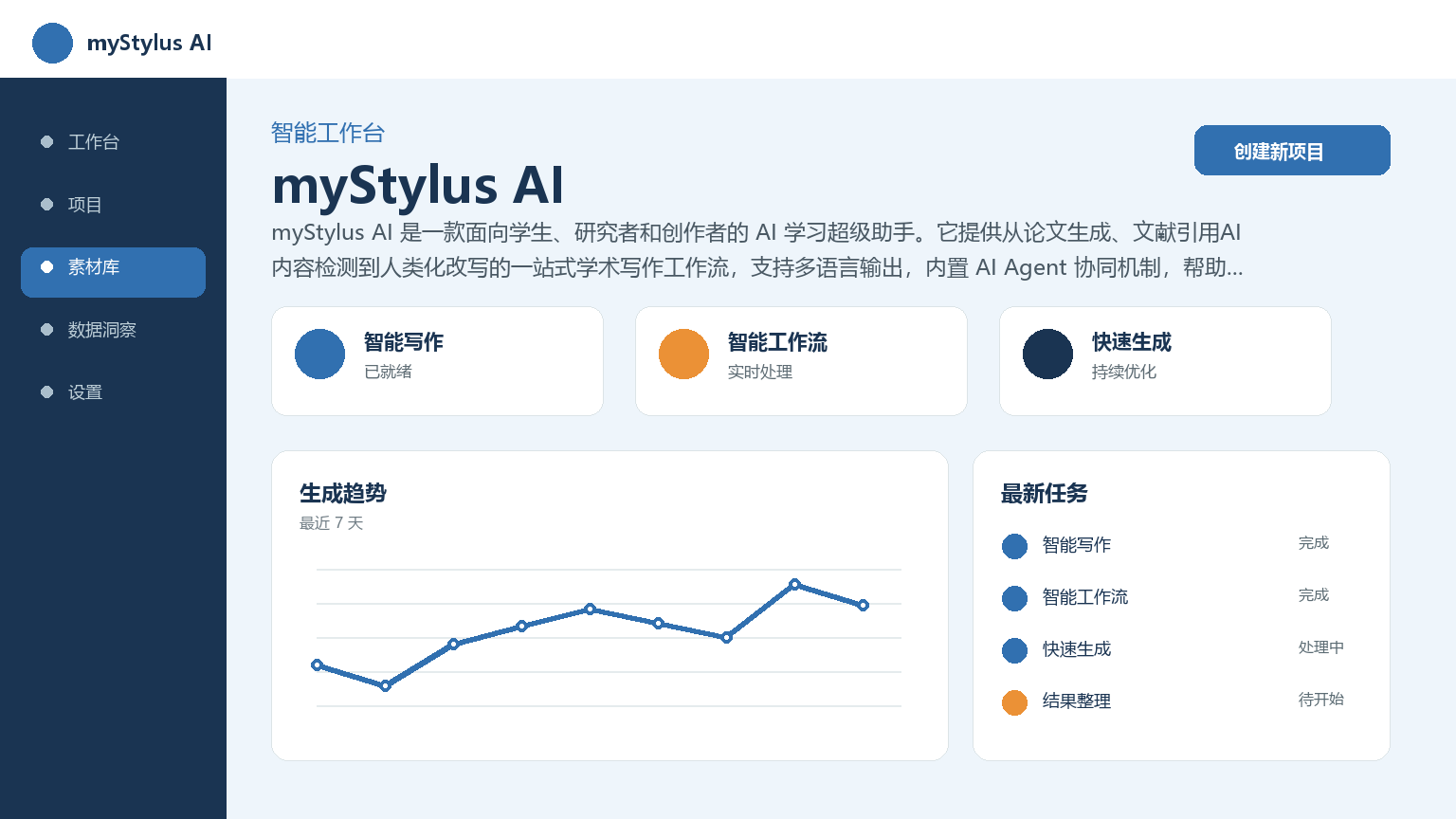
myStylus AI is an AI learning super assistant for students, researchers and creators. It provides a one-stop academic writing workflow from paper generation, document citation AI content detection to humanized rewriting. It supports multi-language output and has a built-in AI Agent collaboration mechanism to help users save a lot of time in academic writing.
In-depth review and usage guide of myStylus AI
Core parameters and statistics of myStylus AI
| Parameters | Data |
|---|---|
| Product positioning | AI learning super assistant (PhD-Grade Super Agent) for academics and creators |
| Product Form | Web Application (SaaS) |
| Developer | MyStylus, Inc. (Delaware, USA) |
| Establishment/launch time | Approximately September 2024 |
| User scale | Serving more than 40,000 users |
| Number of sources processed | Over 25,000 academic/trusted sources |
| Core AI mechanism | Multi-GPT Agent collaboration (dozens of Agents working together) |
| Supported languages | English, Spanish, German, Portuguese, French, Hindi, Arabic, Chinese and other languages |
| Access method | Web browser (desktop preferred) |
| Latest version | v2.0 (approx. Q3 2025) |
| Free mode | Provides free quota (free to use a certain number of times per day) |
| Starting point of payment | Quarterly/annual subscription (new users enjoy 25% discount on first order) |
The core deliverable of myStylus AI is not a separate conversational robot, but an "academic writing workshop": it integrates paper generation, literature citation AI detection, humanized rewriting, scoring feedback, etc. into one workbench, eliminating the need for users to repeatedly switch between different tools. This integrated positioning sets it apart from single-point tools such as Grammarly (partial grammar proofreading), Jenni AI (partial citation assistance), and QuillBot (partial paraphrasing).
Users and market recognition of myStylus AI
User Base: According to official disclosures, myStylus AI has served more than 40,000 users, and the AI system has processed and utilized more than 25,000 academic sources. Although these numbers are not huge, for a vertical academic writing tool that has only been online for about a year, it shows that it has initially established a reputation among the target user group.
User Satisfaction: Official user surveys show that up to 75% of learners achieved high scores on essays generated using myStylus. It should be noted that this data comes from official self-reporting and has not been audited by a third party, but it can be used as a reference signal for user satisfaction.
Market positioning: myStylus AI’s direct competitors include academic writing tools such as Jenni AI, Charley AI, Textero, and Paperpal. Its differentiated advantage lies in the "one-stop" experience - writing, citing, checking, and rewriting are connected in series instead of providing a single function. In addition, its multi-language support (especially Spanish, German, Arabic and other non-English languages) has certain competitiveness in the global education technology market.
Affiliate Marketing Ecosystem: Official affiliate program data can be used as an indirect indicator of product market popularity - the average monthly income of affiliate partners is about $3,000, the conversion rate is as high as 45%, and the revenue share is as high as 80%. This shows that the product has strong paid conversion capabilities and user stickiness.
The cost advantage of myStylus AI
- C-side/Individual: Usually a free version is provided to experience the core functions, and high-frequency use requires a paid package subscription.
- API/Developer: Billed by call volume, suitable for development teams that can be flexibly integrated into their own systems.
- Enterprise/Privatization: Contact the business owner to obtain customized quotation and deployment plan. The specific price is subject to the official real-time pricing page.
Main features of myStylus AI
The function matrix of myStylus AI covers the complete link of "topic selection → research → writing → testing → polishing → scoring" of academic writing.
-
AI Essay Generator (AI Essay/Paper/Dissertation Writer): Automatically generates academic papers with a complete structure based on parameters such as topic, length, academic level, etc. input by the user. Supports a variety of lengths from single short articles to full-length dissertations. Linked value: Citations from trusted sources are automatically embedded during the generation process instead of adding them afterwards, reducing the user's switching cost between writing and citing.
-
AI Detector + AI Humanizer: After generating text, the built-in detection module can evaluate the probability of the text being recognized by mainstream AI detection tools (such as GPTZero, Turnitin, etc.); then the "humanization" rewriting module can adjust wording, sentence rhythm, and vocabulary diversity to reduce AI traces and make the text closer to human writing style. Invisible linkage: Detection and rewriting are completed within the same interface. There is no need to copy the text to an external detection tool and then come back to modify it, saving time when switching between tools.
-
Literature Citation and Source Finder: Supports retrieving and citing academic sources during the writing process. AI will recommend relevant references based on context and generate a formatted citation list in the final output. According to officials, its AI model is better than competing products in terms of citation accuracy - it can point to specific sentences in references instead of just listing page numbers.
-
Rewriting and summarizing tool set (Paraphrase/Summarizer/Rewriter): Provides functions such as paragraph rewriting, sentence rewriting, article summary, and paper expansion. Scenario value: Quickly summarize multiple documents during the research stage, rewrite expressions during the writing stage to avoid suspicion of plagiarism, and expand weak paragraphs during the finalization stage—without leaving the editing interface during the entire process.
-
Grading and Feedback (AI Essay Grader): Users can submit their completed essays to AI for scoring and receive multi-dimensional feedback scores based on structure, argument, citation, grammar, etc. This positioning makes it not only a "writing generator" but also a "writing coach", suitable for self-learners and users who need to revise repeatedly.
-
Multi-format output (Flashcards/Slides/Documents): In addition to plain text, it also supports converting content into learning cards (Flashcards), slides (Slides) and formatted documents (Documents), covering all scenario needs from learning to presentation.
-
Multi-language and multi-lingual writing: In addition to English, it supports the generation and rewriting of papers in Spanish, German, Portuguese, French, Hindi, Arabic and other languages. An important plus for non-native English writers.
myStylus AI model and version evolution
The version information of myStylus AI is rarely disclosed to the public. The following is compiled based on the public information that can be collected:
Mainline release
v1.0 (approximately September 2024): The initial version of myStylus AI is online, providing core AI paper writing, rewriting, content detection and other functions. Supports multiple languages. Establish basic web application architecture and user systems.
v2.0 — Super Agent (approximately Q3, 2025): Major architecture upgrade, introducing a "multi-agent collaboration" mechanism - dozens of GPT Agents work together in the background, responsible for topic analysis, literature retrieval, outline generation, paragraph writing, citation verification, language polishing and other sub-tasks, and finally converge into complete output. Officials claim that this mechanism significantly reduces the hallucination rate and improves the accuracy of citations.
Capability Milestones
- Breakthrough in citation mechanism: According to CPO, myStylus’ AI model can point to specific sentences in references (instead of just citing page numbers), which is a differentiated capability among academic writing tools.
- Detection/Rewriting Closure: v2.0 strengthens the collaboration between AI Detector and AI Humanizer. Users can complete the iterative cycle of "generate → detect → humanize → re-detect" in one interface.
- 25,000+ Source Library: The system has accumulated more than 25,000 trusted academic sources as a citation knowledge base.
myStylus AI’s technical advantages
Multi-Agent collaborative architecture: The technical core of myStylus AI is not a single LLM call, but a collaborative network composed of dozens of GPT Agents. Each Agent is responsible for a specific section in the academic writing pipeline - topic selection analysis, literature retrieval, structure planning, paragraph writing, citation verification, language polishing, etc. The advantages of this architecture are: ① Each Agent can focus on sub-tasks, reducing the attention attenuation of a single model in extremely long contexts; ② The reference verification Agent can independently verify the accuracy of each reference, reducing the overall hallucination rate; ③ Each Agent can work in parallel to increase the generation speed.
Citation accuracy optimization: The official emphasizes that its AI model is superior to competing products in terms of citation capabilities - it can not only cite the author and page number of the document, but also cite the specific sentences in the document that are most relevant to the current argument. This requires fine-grained annotation of reference data during the training phase and semantic-level reference matching during the inference phase.
Illusion Suppression Strategy: Through the "source-based generation" mechanism, AI prioritizes extracting factual basis from retrieved trusted sources when writing each piece of content, rather than relying entirely on model parameterized memory. Officials listed "reliance on sources and minimizing illusions" as one of the core research and development goals.
Balance of speed and depth: Despite the use of multi-agent collaboration, a computationally intensive architecture, the official claims that the generation speed is still relatively fast. This implies that there may be efficient Agent scheduling and parallel reasoning optimization behind it.
How to use myStylus AI
myStylus AI currently only provides web access and does not have a standalone desktop application or mobile app.
Usage steps:
- Registration and Login: Visit
https://mystylus.ai/, register via email or start the trial directly. No credit card is required to use the free credit. - Select task type: Select the task type in the left panel - Student Essay, Flashcards, Slides, Documents, Rewriter, Research, Grader, AI Detect/Humanize, etc.
- Enter writing instructions: Describe the writing topic, length requirements, academic level (high school/undergraduate/graduate), citation style (APA/MLA/Chicago, etc.) and other parameters in the chat interface. The more detailed the instructions, the higher the quality of the output.
- AI generation and iteration: The system calls the first draft of multi-Agent network generation. Users can proceed with conversational revisions—requesting additional paragraphs, adjustments to arguments, additional quotes, or an overall rewrite.
- Detection and Humanization: After the generation is completed, use the built-in AI Detector to evaluate the AI traces, and then use the AI Humanizer to adjust the wording until it passes the detection.
- Export: Supports exporting the produced papers/cards/slides, etc. to standard formats.
Usage Tips:
- The free account has a limit on the number of times it can be used every day (the specific number of times is not disclosed). If it is exceeded, you will need to upgrade and pay.
- High-value academic tasks (such as dissertations, submitted papers) are recommended to be completed under a paid subscription to take full advantage of the full functionality.
- The built-in AI Detector is mainly aimed at mainstream detection tools, but different schools/journals use different detection tools. It is recommended to do cross-validation by yourself before submitting.
Product Pricing for myStylus AI
The pricing model is subject to the official real-time page. Usually a freemium or subscription system is used, and basic functions can be used for free. Advanced functions or high-frequency use require paid subscriptions, and users are advised to evaluate the optimal solution based on actual usage.
myStylus AI application scenarios
-
Academic Writing in Higher Education: Course papers, term papers, literature reviews and thesis writing for undergraduate and graduate students. Key points of verification: Reference format accuracy, AI test pass rate, and degree of adaptation in different disciplines (liberal arts/science/engineering). Deductions show that using myStylus can reduce the time from topic selection to finalization of a 3,000-word course paper from about 8 hours to 2-3 hours (including manual review), but the final quality still depends on the user's revision input.
-
International Publishing for Non-native English Writers: Non-native English-speaking researchers who need to publish papers in English can use its multi-language support and humanized rewriting functions to improve the quality of their English writing. Key points of verification: Accuracy and naturalness of academic English expression, and acceptance by target journals. Deductions show that ESL writers can combine the three-step process of "writing → translating → polishing" in the first draft stage into two steps of "writing → proofreading", saving about 40% of writing time.
-
Self-study and exam preparation: Students use AI to generate flashcards and slides to assist in review, or to quickly transform textbook content into structured learning materials. Key points of verification: Accuracy and completeness of knowledge point coverage and reusability of card format. Exercises have shown that content development time for a standard university course can be reduced from 6-10 hours to 1-2 hours.
-
Creative Writing and Content Creation: Writing assistance for non-academic scenarios such as blog posts, book reviews, and story generation. Although the product focuses on academic scenarios, its AI Article Writer and AI Story Generator can also cover some creative writing needs. Key points to verify: Originality and readability of creative output.
Applicable groups of myStylus AI
-
College students and graduate students: the core target group. A large number of academic writing tasks (papers, reports, literature reviews) need to be completed, and there is a clear need to avoid citation standard AI detection. Prerequisites: Have basic knowledge of academic writing standards and be able to judge the quality of AI-generated content and make targeted modifications. Unsuitable scenarios: For users who have extreme requirements for 100% originality (such as the final draft of a doctoral thesis) and whose schools use the most stringent detection tools, it is not recommended to rely entirely on AI generation.
-
International students and scholars whose native language is not English: Users who have insufficient English writing skills but need to produce high-quality English papers. myStylus' multi-language support, human-friendly paraphrasing and grammar polishing features significantly reduce language barriers. Prerequisites: Have academic ability in the subject and only need language assistance. Unsuitable scenarios: Scenarios that require purely native-level literary expression (such as creative writing master's program).
-
Self-learners and lifelong learners: Learners who need AI assistance to understand and organize complex knowledge. Features like Flashcards, Slides, and Summarizer are great for quickly turning long-form material into structured notes. Prerequisites: Have certain information screening capabilities and do not blindly accept AI output.
-
Content Creators and Bloggers: Bloggers and social media content creators who need high-frequency output. Although this is not the main battlefield of the product, its multi-tool integration feature can replace the scattered writing assistance tool chain to a certain extent. Unsuitable scenarios: For content that requires highly original visual design (such as infographics, video scripts), it is recommended to use professional design tools.
-
Educational Institutions and Tutoring Centers: Theoretically, it can provide standardized writing assistance tools for tutoring centers, but currently there is no enterprise version purchasing solution. Institutions need to contact the business team to confirm compliance and batch authorization conditions before adopting it.
Summary and Outlook of myStylus AI
The core competitiveness of myStylus AI lies in integrating the "generation-citation-detection-rewriting-scoring" links of academic writing into a single workbench, and creating differentiation in citation accuracy and illusion control through a multi-agent collaboration mechanism. For target users—especially college students and non-native English writers—this one-stop experience can indeed significantly reduce the time wasted switching between tools.
Current Limitations:
- Version information is opaque: Officials have not disclosed detailed version history and roadmap, making it difficult for users to track the pace of product iterations.
- Opaque pricing: Standard pricing requires registration to see, which is not conducive to price comparison evaluation before purchasing.
- Lack of API and team collaboration functions: limits its penetration in institutional scenarios and developer ecosystems.
- Coverage of the citation library: Although 25,000+ sources are claimed, the coverage for specific niche subjects or recent research areas is still unknown.
- AI detection reliability: The built-in detector’s accuracy and consistency with mainstream tools (Turnitin, GPTZero) have not been verified by third parties.
Procurement/Adoption Risk Assessment: For individual users, the free quota is sufficient for initial experience. It is recommended to try it out with low-risk papers and cross-verify the AI detection pass rate before deciding whether to pay. For educational institutions, there is currently a lack of enterprise-level contract terms (SLA, data privacy compliance RBAC, etc.), and data use policies and refund terms must be confirmed with the official before large-scale purchases. For developers, it is currently impossible to embed their capabilities into their own systems as there is no API. Overall, myStylus AI is a tool with good user experience in vertical scenarios, but its commercialization maturity is still in its early stages, and purchasing decisions require sufficient trial and verification.
Related tools:  Notion AI,
  Jasper
How to use myStylus AI
- Web client: You can use it by visiting the official website and registering an account. Most functions do not require installation.
- API access: Provides RESTful API, developers can obtain the API Key and integrate it into their own applications.
Version Info
- myStylus AI Super Agent :Introducing a multi-agent collaborative architecture to support dozens of GPT Agents to work together to complete complex academic tasks, enhancing citation accuracy and generation speed.
- myStylus AI Launch :The initial release provides basic functions such as AI paper writing, rewriting, and content detection, and supports multiple languages. There is no official precise date yet.
User Reviews