 n8n
Free
n8n
Free
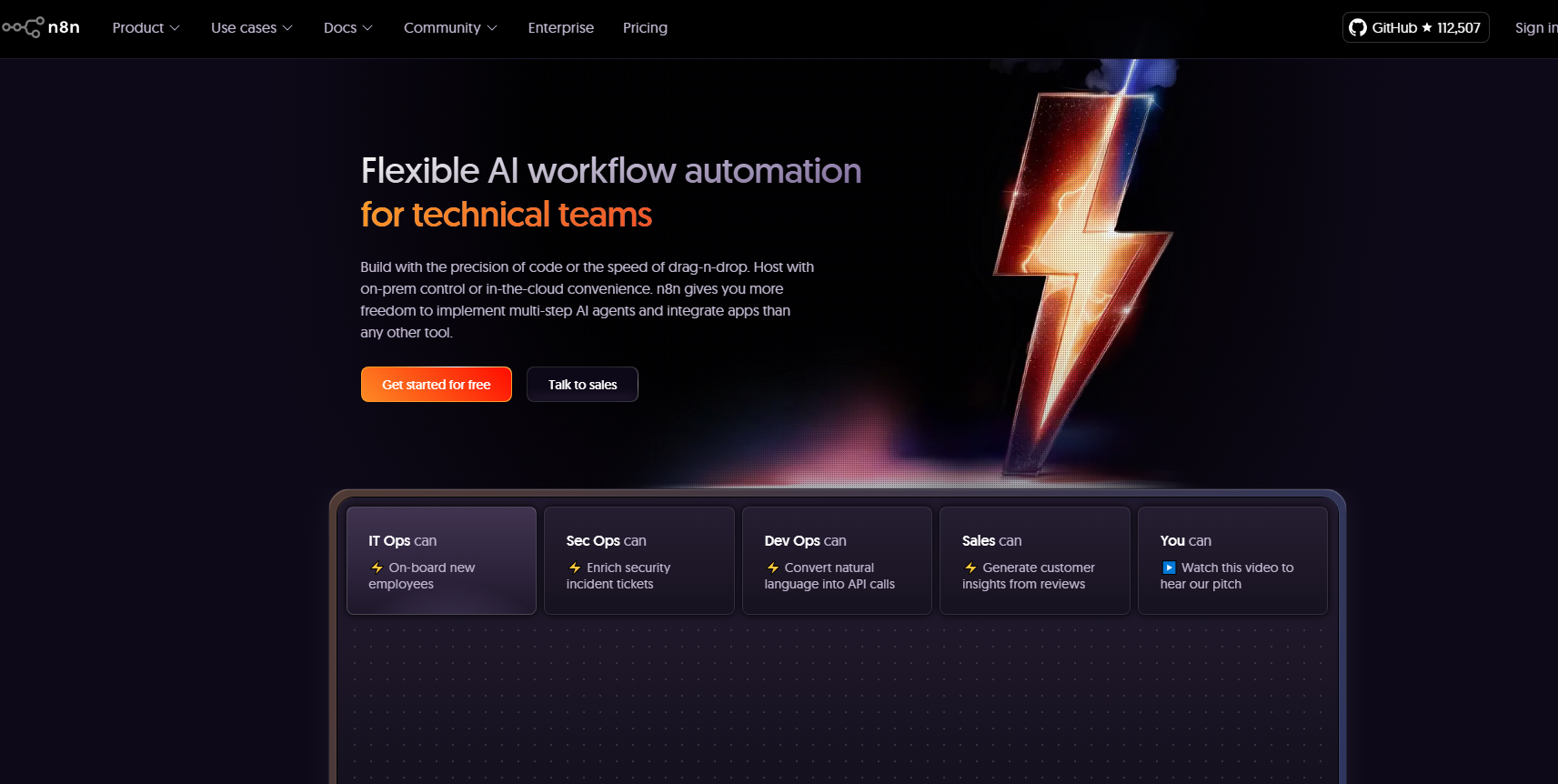
n8n is a AI Office and Efficiency workflow automation platform for teams and developers. It adopts fair-code license and supports self-hosting, node orchestration and AI Agent nodes. It is suitable for scenarios that require high data controllability.
n8n
n8n’s core parameters and statistics
n8n's official positioning has been upgraded from "Open Source Workflow Automation Platform" to "The Platform for AI Agents and Workflow Automation". The core difference is that AI Agent orchestration has been changed from an optional plug-in to a mainline product. It runs both a self-hosted community version and a cloud-based commercial version, covering deployment granularities from individual developers to multinational enterprises.
| Projects | Public Information |
|---|---|
| Official Positioning | AI Agent and Workflow Automation Platform |
| Deployment form | Self-hosted community edition / Cloud hosting / Enterprise privatization |
| Licensing model | fair-code (Sustainable Use License + Enterprise License) |
| Connection Ecosystem | 1500+ integration nodes, 9000+ workflow templates |
| Community Size | ~197k GitHub Stars, 59.4k Forks, 771 Contributors |
| Latest version | n8n@2.30.6 (2026-07) |
| Latest release patterns | 722 GitHub Releases |
| Core technology stack | TypeScript (91.6%), Vue (6.9%), Node.js |
| Support Platform | Web, API, Desktop (CLI) |
Community Density: ~197k Stars makes n8n one of the top 50 open source projects in the world on GitHub, leading the number of Stars in its category (Zapier/Make/n8n). 59.4k Forks means that the density of external contributions of connectors and templates is higher, and ready-made nodes are more likely to be found when new systems are integrated.
Version Rhythm: 722 Releases reflect that the project maintains high-frequency iterations, and there are still multiple commits from 2026-07-16 (including functions such as telemetry events, MCP workflow evals, Excel SharePoint nodes, etc.), indicating that the mainline development is active and is not a cold maintenance project.
Ecological Thickness: 1500+ integrated nodes + 9000+ community workflow templates, which has formed a significant network effect in the open source automation category - the marginal cost of new user access is reduced due to ready-made templates.
n8n’s users and market recognition
n8n’s market recognition is reflected in scale-level adoption by the open source community and benchmark enterprise cases.
Open Source Impact: GitHub ~197k Stars making it one of the highest-starred workflow automation projects in the world. G2 score 4.7/5, 200k+ community members, active technical Q&A and template contributions. These numbers illustrate that n8n has moved beyond the early adoption stage and into the mainstream technology team's scope of choice.
Enterprise Benchmark Cases: Officially disclosed cases include Huel (saving 1,000 hours of manual work) and Vodafone (threat intelligence automation saving £2.2M), both of which involve AI workflow and cross-system orchestration. The credibility of these cases lies in the fact that the official provided specific quantified benefits (hours/amount) rather than vague "efficiency improvement" statements.
Adoption Features: n8n's core user base is biased towards "technical teams with self-hosting capabilities", which is different from the pure cloud model of Zapier/Make. Industries that are sensitive to data sovereignty (finance, government affairs, medical care) tend to choose n8n's self-hosting path, which means that its market penetration rate is positively related to the enterprise's willingness to self-host.
The cost advantage of n8n
n8n's cost model is not an "absolute free alternative", but lowers the entry barrier through open source self-hosting, and reduces the marginal cost after scale through "pay per execution" rather than "per step/user" pricing.
C-side/individual developers: The community version is completely free and can be run locally through Docker or npx. The explicit cost is zero, and the implicit cost includes operation and maintenance infrastructure (servers, storage, backup) and learning curve. For individuals, this is one of the most cost-effective ways to build personal automation and AI Agents.
Developer/Team (Cloud): The official Cloud provides three levels: Starter (€20/month, 2.5k execution), Pro (€50/month, 10k execution), and Business (€667/month, 40k execution). Unlike Zapier, which charges by task/step, n8n charges by "full workflow execution" - a workflow counts as one execution regardless of the number of steps. For complex multi-step processes, this billing method can significantly reduce unit process costs. All business plans include unlimited users and unlimited workflows, which is friendly to team collaboration scenarios.
Enterprise/Private: Enterprise plan needs to contact sales, supports self-hosting or Cloud deployment, provides SSO/SAML/LDAP, audit log Log Streaming, external Secret Store, 200+ concurrent execution, 365-day insight retention SLA support, etc. The price has not been disclosed and needs to be confirmed by the business.
Hidden costs: The real cost of the self-hosted path is not in the subscription fee, but in the operation and maintenance-database maintenance, version upgrades, high-availability configuration, and monitoring and alarming. For teams lacking DevOps support, these hidden costs can exceed cloud subscription fees. It is recommended to include operation and maintenance labor costs into TCO calculations when evaluating.
Main functions of n8n
n8n's functional system revolves around the four lines of "visual orchestration + code extension + AI embedding + connector ecology". The core difference lies in turning the AI Agent from an independent module into a first-class citizen in the workflow.
- Visual Node Arrangement: Build a multi-step workflow by dragging nodes, supporting triggers (Webhook, Schedule, Polling), action nodes, conditional branches, loops, and error handling. Different from Zapier's linear design, n8n supports complex branches and sub-workflow calls, which is suitable for orchestrating non-linear business logic.
- AI Agent and LangChain Node: Embed LLM calls (OpenAI, Anthropic, Google, open source models) in the workflow, supporting multi-Agent collaborative RAG retrieval, tool calling, and structured output. Synergy: The output of the AI node can be directly passed to subsequent business nodes (CRM writing, work order creation, email notification), without the need to manually transfer data between AI conversations and business systems.
- Code Node (JavaScript/Python): Embed custom scripts in the visual process, support npm package import. Expert view: The combination of code nodes and visualization nodes is the key to distinguishing n8n from pure low-code platforms - simple processes rely on drag and drop, and complex conversions rely on code to avoid the "low-code ceiling" problem.
- MCP protocol support: n8n has joined the MCP ecosystem and can serve as an MCP Client to call external MCP Servers or expose its own nodes as MCP Servers. This is especially critical for scenarios that require interoperability with AI clients such as Claude Desktop and Cursor.
- Human-in-the-Loop Approval: Insert a human confirmation node into the workflow, and manual approval is required before AI generates content or performs irreversible operations. This is a necessary capability for business scenarios that require compliance auditing (work order closing, payment confirmation, content release).
Functional boundaries: n8n is not suitable for real-time stream processing that requires ultra-high throughput (such as tens of millions of events per second). It is positioned as "business orchestration" rather than "data pipeline". For real-time stream processing scenarios, dedicated solutions such as Kafka + Flink should be evaluated.
n8n model and version evolution
n8n's version evolution can be divided into three main lines: core engine iteration, AI capability line, and connector ecological expansion.
Mainline release
- n8n Launch (2019-06): Released as a GitHub open source project, positioned as "nodemation" - a visual workflow automation tool based on Node.js, with an initial focus on HTTP node Webhook triggers and basic connectors.
- n8n@1.x (2021-2023): After entering 1.x, a formal expression engine, error handling, sub-workflow, queue mode and multi-instance support are added, evolving from a personal tool to a team-level automation platform.
- n8n@2.x (2024-present): Current mainline version. The biggest change is the addition of AI Agent nodes integrated with LangChain, officially entering the AI workflow track. Since then, it has been rapidly iterated (722 Releases), and has been advanced to v2.30.6 in 2026-07, with an average of 2-3 commits per day, maintaining high-density delivery.
AI ability line
- 2024-04: AI Agent node released. For the first time, LLM chat and tool call Agent loops are introduced into the workflow, marking n8n's transformation from a pure automation platform to an AI automation platform.
- 2025-2026: MCP support, multi-model switching Human-in-the-Loop, Eval evaluation. Gradually form a complete "AI Agent development and operation" link.
Connector Ecosystem
- 2019-2021: Nodes for dozens of popular applications.
- 2022-2024: Community contribution explodes, and the number of nodes increases from hundreds to 1500+.
- 2025-2026: Add MCP protocol support, and the connection capability is expanded from "preset node" to "protocol-level interoperability".
n8n’s technical advantages
n8n's technical advantages are rooted in the three-layer architecture design of "visual orchestration + code expansion + AI embedding", rather than a single algorithm breakthrough.
Architecture mechanism: n8n adopts Node.js event-driven architecture. Each workflow node runs as an independent micro-task and naturally supports asynchronous I/O and concurrent execution. n8n's webhook triggering mode reduces latency from seconds to milliseconds compared to polling-based automation platforms. Effect: For scenarios such as work order synchronization and real-time alarms, the user-perceived response speed is significantly better than the polling solution.
AI Workflow Engine: n8n's AI Agent node implements model-independent scheduling through the LangChain abstraction layer - developers do not need to modify the upstream and downstream node configurations when switching OpenAI to Anthropic or local models in the same workflow. Mechanism to effect: The model abstraction layer solves the most common "vendor lock-in" problem in AI integration and reduces the cost of AI process reconstruction.
Expression and data conversion: The built-in expression engine supports Luxon date processing, complex JSON transformation, data aggregation and looping. Code node supports both JS/Python runtimes. Mechanism to effect: The combination of expression engine + code nodes covers more than 95% of data conversion scenarios, reducing the hidden cost of "requiring additional middleware due to data type mismatch".
Self-hosted architecture: Docker images run with just one command and support both SQLite (quick start) and PostgreSQL (production-grade) database backends. The queue mode uses Redis + Bull to implement distributed execution. Applicable scenarios: In financial and government affairs scenarios that are sensitive to data sovereignty, this architectural path is the core decision-making factor.
Guide to engineering pitfalls:
- Dead-end loop and Token inflation control: AI Agent nodes may produce infinite reasoning steps in the LLM loop. Solution: Limit the maximum number of iterations through the maxIterations parameter, and cooperate with timeout and repeated action detection to prevent a single Agent call from consuming excessive Tokens.
- DOM/Context Overload: When HTTP nodes crawl web pages, the complete HTML may overwhelm the context. Solution: Use HTML to extract nodes or customize extract logic to only retain the target data area in a structured manner to avoid passing the entire DOM into the AI node.
- Irreversible Operation Security Governance: Tool calls of AI Agent may trigger dangerous actions such as deletion, payment, and release. Solution: Enable Human-in-the-Loop ("Waiting for Approval" mode) on key operation nodes, or insert a condition check node into the workflow for secondary confirmation.
How to use n8n
n8n provides three main usage paths, suitable for different technical backgrounds and compliance needs:
| Entrance | Suitable for the crowd | Startup method | Operation and maintenance cost |
|---|---|---|---|
| Self-hosted community version | Developer/team with operation and maintenance capabilities | Docker / npx / source code compilation | Medium (requires management of database and server) |
| Cloud hosting | Teams who want out-of-the-box | Sign up and use | Zero operations |
| Enterprise privatization | Compliance-sensitive large organizations | Business docking | Medium to high (including SLA) |
Get started quickly in 3 minutes (self-hosted):
# Docker method (recommended)
docker volume create n8n_data
docker run -it --rm --name n8n -p 5678:5678 \
  -v n8n_data:/home/node/.n8n \
  docker.n8n.io/n8nio/n8n

# or npm method (requires Node.js)
npx
After startup, visit http://localhost:5678 to enter the visual editor. Choose a template or start from an empty canvas, add nodes, connect the service, set triggers and run.
Cloud method: Visit https://app.n8n.cloud/register to register an account, and you can use it directly in the browser without installation.
Typical implementation steps:
- Pilot: Select 1-2 highly repetitive, low-risk processes (such as form data synchronization, alarm notification), and use templates to quickly build verification.
- Contrast: Run in parallel with manual processing or the old solution for 1-2 weeks, and quantify the changes in time consumption and error rate of each process.
- Extension: After confirming that the basic connector is stable, introduce AI nodes (customer service automatic reply, lead screening), and configure Human-in-the-Loop approval nodes.
- Governance: Enable audit log RBAC permissions, version control (Git), and enter formal operation.
n8n product pricing
n8n's pricing structure is divided into three layers: "community free + cloud subscription + enterprise commerce", and the pricing dimension is based on "monthly workflow execution times".
| Plan | Price (annual payment) | Monthly execution volume | Number of concurrency | Number of projects | Insight retention | AI construction quota |
|---|---|---|---|---|---|---|
| Community Edition | Free | Unlimited (self-hosted) | Self-hosted limits | Self-hosted limits | Self-hosted limits | Self-hosted limits |
| Starter | €20/month | 2,500/month | 5 | 1 share | 7 days | 50 credits/month |
| Pro | €50/month | 10,000/month | 20 | 3 shares | 30 days | 150 credits/month |
| Business | €667/month | 40,000/month | 20+ | 6 shares | 30 days | Undisclosed |
| Enterprise | Business Confirmation | Customization | 200+ | Unlimited | 365 days | 1,000 quota/month (Cloud) |
Billing Logic: n8n bills by "complete workflow execution", not Zapier/Make's per-step or per-task billing. A complex 50-step workflow that counts as one execution may be counted as 50 operations on a competing product. For multi-step AI Agent processes, this billing method directly reduces the unit process cost by 10-50 times.
FREE CREDIT: The Starter plan offers a free trial period, no credit card required. The Community Edition is self-hosted with no usage restrictions, but you are responsible for your own infrastructure costs.
Startup Plan: Startups with <20 employees can apply for a 50% discount on the Business plan, subject to the latest official policy.
Application scenarios of n8n
The applicable scenarios of n8n focus on "cross-system, standardizable AI embeddable" digital processes, rather than real-time data processing or graphics-intensive tasks.
- IT operation and maintenance and work order automation: monitor alarms, automatically create Jira/ServiceNow work orders, notify on-duty personnel, and synchronize status. Benefits: Ticket responses dropped from hours to minutes, with the 1,000 hours of labor savings reported in the Huel case coming in part from this process.
- Lead distribution synced with CRM: form submission to lead scoring (AI node) to assigning sales by rules to creating HubSpot/Salesforce records to triggering follow-up emails. Benefits: Reduce manual transcription and distribution delays. Threat intelligence automation in the Vodafone case (saving £2.2M) reflects the scale effect of cross-system automation.
- AI Customer Service and Knowledge Base RAG: User questions are retrieved from the knowledge base, the LLM generates a reply, and the reply is sent to human-in-the-Loop for human approval (Human-in-the-Loop). Benefits: AI initial screening reduces 60-80% of repetitive problem handling for front-line customer service, and humans only need to focus on complex and escalation cases.
- Internal Approval and Compliance Process: reimbursement application to invoice OCR to budget comparison to multi-level approval routing to accounting system. Benefits: The approval cycle is shortened from 3-5 days to a few hours, and traces are left throughout the process to meet audit requirements.
- Content production and social media publishing: from topic selection confirmation to AI generation of the first draft to manual editing to scheduled publishing to multiple platforms. Benefits: The content output frequency is increased by 2-3 times, and the model of AI preliminary generation + manual final review has been verified by many content teams.
n8n Applicable people
n8n’s multi-path strategy enables it to serve three types of roles, each of which has different concerns and adaptation conditions:
- Developers and DevOps Teams: Core user base. Value the freedom of self-hosting, code node scalability, Git version control and CI/CD integration capabilities. Prerequisite: Node.js/Docker basic operation and maintenance capabilities are required. If the team does not have DevOps manpower, the Cloud solution is more suitable.
- IT and Platform Architect: Focus on data sovereignty, security compliance (SSO, audit RBAC), and multi-system integration governance. Premise: The organization already has a certain basis for process standardization. If cross-department processes have not been sorted out, platform governance capabilities may become a burden.
- Business Operations and Automation Leader: Build daily processes independently through templates and visual orchestration to reduce dependence on the development team. Premise: Accept that "low code does not equal zero code" - complex business logic still requires code nodes or expressions, and pure business personnel may need the assistance of developers.
Not suitable for the crowd:
- For business people who need pure zero-code and no scripting requirements, it is recommended to evaluate purely visual platforms such as Make or Zapier.
- Teams that require ultra-high throughput real-time data pipelines (tens of millions of events/second), n8n's event-driven architecture is not designed for this.
- For users who only need personal-level script automation and no team collaboration requirements, GitHub Actions or shell scripts may be a lighter solution.
n8n Summary and Outlook
n8n's core competitiveness lies in entering the market with "fair-code license + open source self-hosting", and finding a balance between data controllability and flexible expansion that is difficult for other commercial automation platforms to copy. It has evolved from a personal tool in 2019 to an AI Agent automation platform in 2026. The community size (~197k Stars), integrated ecosystem (1500+ nodes) and version density (722 Releases) all indicate that the project is in a healthy and rapid growth period.
Current limitations: The maturity of AI Agent functions is still lower than that of the core orchestration engine - the cost control of LLM calls, the persistence of multi-Agent session states, and the E2E evaluation system are still in rapid iteration, and version locking and regression testing are required for production. The AI construction quota of the Business plan has not been clearly disclosed, and enterprises need to confirm with sales before purchasing. In addition, high availability and multi-region deployment in self-hosted scenarios still need to be implemented by the team themselves.
Procurement/Adoption Risk Assessment: For organizations where data compliance is a priority, n8n’s self-hosted path is one of the most mature options on the market today. It is recommended to use the community version to pilot 1-2 edge processes to verify the connector stability and operation and maintenance costs, and then decide whether to upgrade to the Business or Enterprise plan. Before purchasing, the enterprise must confirm with sales the execution volume billing over-limit policy (whether there is a hard limit/whether over-capacity can be billed on demand), the SSO configuration scope SLA terms (availability, response time), and the retention granularity and export format of the audit log. Future evolution directions worthy of attention include: deep integration of the MCP protocol (currently supported), native multi-agent orchestration, and differentiated capability verification of the enterprise version in GDPR compliance scenarios.
Related tools:
Version Info
- AI Agent node :Extended LangChain and AI Agent nodes to support the orchestration of LLM and tool calls in the workflow; please refer to the latest official page for the specific version.
- n8n open source release :Released as open source as a self-hosted node-based workflow automation platform.
User Reviews