 Navan AI
Navan AI is an intelligent platform integrating corporate travel, expense management and payment, formerly known as TripActions. AI technology is used to realize travel booking optimization, automatic expense classification, invoice data extraction, approval policy execution and real-time expenditure insights, covering the entire link from travel application to reimbursement reconciliation. It is suitable for medium and large enterprises with cross-border travel and dispersed team expenditure management needs.
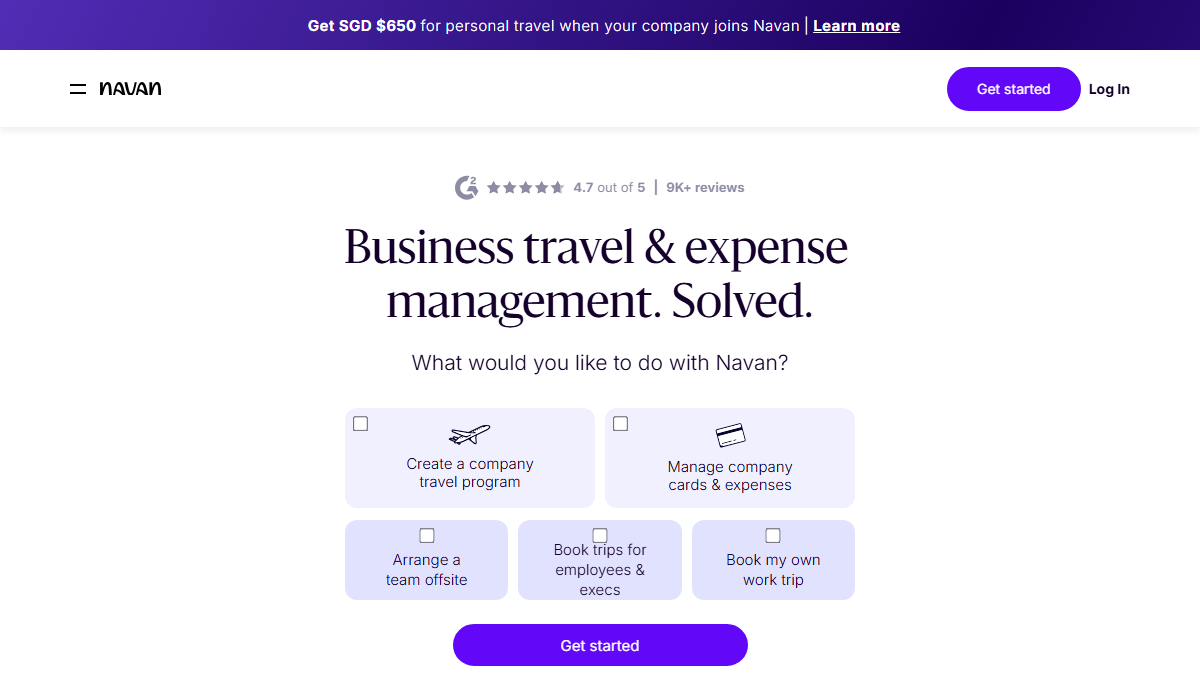
NavanAI
Core parameters and statistics
Navan AI is the intelligence layer in the integrated enterprise travel, expense management and payments platform launched by Navan (formerly TripActions). It is not sold independently, but is embedded in Navan's three major modules: travel booking, corporate card and expense management. It uses AI models to realize automatic collection, classification, compliance detection and decision-making suggestions of expenditure data.
| Projects | Public Information |
|---|---|
| Product Positioning | All-in-one travel, expense, and corporate card management |
| AI capability form | AI Travel Agent, Expense Policy Copilot, AI OCR invoice extraction, intelligent expense classification |
| Deployment Path | Cloud SaaS (no self-hosted option) |
| Customer scale | Thousands of enterprise customers, covering SMB to Fortune 500 |
| Company Valuation | Approximately $12 billion (post Series G 2024) |
| Cumulative financing | Over $1.2 billion |
| Supported platforms | Web, iOS, Android, API |
| Covered areas | 100+ countries around the world |
| Supported languages | Multi-language interface (including Chinese) |
| Latest version | 2026.07 July Release (2026-07-01) |
Product form: Navan AI is not an independent application, but an intelligent enhancement layer attached to the three business lines of travel booking, corporate cards, and expense reimbursement. This means that businesses do not need to procure “AI capabilities” separately, but must use Navan’s core spend management module to activate AI capabilities.
Market position: Navan's predecessor, TripActions, was founded in 2015. It initially entered the market as a travel booking platform. Later, it acquired and integrated expense management and corporate card capabilities, becoming a direct competitor of SAP Concur, Expensify, Brex, and Ramp. A $12 billion valuation puts it in the first tier of enterprise spend management.
Iteration Rhythm: Navan adopts a monthly release system and pushes feature updates at the beginning of each month. AI-related features will be integrated at an accelerated pace starting from the end of 2025, and new or enhanced AI functions will be included in the monthly release notes in 2026.
User and market recognition
Navan's market recognition mainly comes from the size of enterprise customers, financing history and industry evaluation rankings, rather than the number of public active users or the GitHub community (the product is closed source SaaS).
Enterprise customer base: Official public information shows that Navan serves thousands of enterprise customers, covering multiple industries such as technology, finance, professional services and manufacturing. The customer list includes well-known technology companies such as Notion, Intercom, Doordash and many Fortune 500 companies. Enterprises with distributed teams and frequent international travel are its main customer profiles.
Financing and Valuation: As of the Series G round of financing in 2024, Navan has raised more than US$1.2 billion in total, with a valuation of approximately US$12 billion. Investors include top institutions such as Andreessen Horowitz, Lightspeed Venture Partners, and Greenoaks Capital. This funding volume ranks among the highest in the industry among enterprise spend management SaaS, behind only SAP Concur (acquired by SAP for $8.3 billion in 2014) and Brex (valued at approximately $12.3 billion).
Industry Evaluation: Navan is often ranked at the top in the corporate travel management and expense management categories of third-party evaluation platforms such as G2 and Capterra. In multiple evaluation reports from 2025 to 2026, Navan scored significantly higher than Concur and Expensify in the "AI functional innovation" dimension, but there is still a gap in "integration depth" and "third-party application ecosystem".
Two sides of market recognition: The source of Navan's customer stickiness is the integrated experience of "travel + expense + card" - employees complete booking, consumption and reimbursement on the same platform, and finance manages budget, approval and reconciliation in the same backend. But this kind of integration is also risky: once companies are deeply bound, switching costs are extremely high. Therefore, both functional integrity and the feasibility of the exit path should be paid attention to when evaluating.
Cost advantage
Navan’s cost structure adopts a hybrid model of SaaS subscription + transaction fees, which is similar but not identical to competing products such as Ramp and Brex. The following is broken down into three layers: C-side/individual, enterprise/team API/developer.
C-side/Personal: Navan does not provide a standalone version for individuals. Individual users cannot register separately and must activate through the Navan account of their company. The cost of using Navan is zero for individuals (borne by businesses), but there is no option for individuals.
Enterprise/Team Cost: Navan’s pricing is divided into two parts – the travel SaaS subscription fee and the enterprise card transaction fee, which can be selected separately or purchased together.
- SaaS Subscription Fee: Billed monthly per active user. The official standard unit price has not been disclosed. Public information shows that the starting price is about $9-$19/person/month, with tiered pricing based on package features. Advanced plans include more complex approval rules, global budget strategies, and advanced analytical reports.
- Business Card Fee: Navan’s virtual and physical business cards generally do not charge an annual fee, but rather a per-transaction fee (usually 1%–2.5% swipe fee). The card can set rules such as single consumption limit, merchant category whitelist, and budget attribution.
- Travel booking surcharge: Navan does not charge additional travel service fees to corporate customers for travel bookings such as air tickets, hotels, car rentals, etc. Its revenue comes from supplier commissions, which is consistent with other TMC (travel management company) business models.
- Hidden costs: The actual total cost of implementation also includes - employee behavior change costs (switching from traditional reimbursement processes to automatic card reconciliation), historical data migration costs, ERP/financial system (such as NetSuite, SAP, QuickBooks) integration implementation costs. Third-party integrations may require additional fees or development effort.
API/Developer Cost: Navan provides REST APIs and webhooks for integration with third-party systems, but access to APIs is typically per enterprise plan tier and does not offer a standalone API pricing plan. Plans below the enterprise level may not be able to obtain API certificates or may be subject to frequency control restrictions.
Compare competing product pricing structures:
| Comparative Dimensions | Navan AI | Brex | Ramp | SAP Concur |
|---|---|---|---|---|
| Core Form | Travel + Expense + Card Integration | Corporate Card + Expense Management | Corporate Card + Expense Automation | Travel + Expense Management (No Card) |
| SaaS monthly fee | Approximately $9–$19/person/month (undisclosed exact) | Free/paid plans | Free basic version available | $8–$15/person/month |
| Business Card Processing Fee | 1%–2.5% Transaction Fee | No Transaction Fee (Interest Earned) | No Transaction Fee | No Card Offered |
| AI capability integration | Built-in AI layer, no additional charges | Expense AI module add-on | Automatic expense classification built-in | Concur Detect required add-on |
| Travel Booking | Native Integration | None | None | Native Integration |
| Minimum contract | Undisclosed | Monthly payment available | Monthly payment available | Yearly contract |
| Self-hosted options | None (Pure SaaS) | None (Pure SaaS) | None (Pure SaaS) | On-premises deployment supported (Enterprise Edition) |
From a cost perspective, Navan is suitable for companies that have a large proportion of travel budgets and have or plan to unify travel and expense management. If the company's main needs are only expense management and corporate cards (travel demand is weak), the free basic package of Ramp or Brex may be more cost-effective; if the company mainly focuses on domestic travel and needs in-depth reimbursement management, SAP Concur's ecological maturity is higher.
Main functions
Navan AI’s capabilities unfold along three product lines – Travel Booking, Expense Management and Payments – with AI delivering enhancements across each line. Core functions can be summarized into six categories:
-
AI Travel Agent (Intelligent Travel Assistant): Users can describe their travel needs in natural language (such as "Fly from San Francisco to New York next Wednesday, stay in Midtown Manhattan, budget $300/night"), and AI automatically searches for flight and hotel options and generates combined recommendations. Compared with non-AI search experience, AI Travel Agent supports multi-condition combination query, preference learning (such as users often choose aisle seats, specific airline preferences) and reuse of historical itineraries, reducing manual filtering steps.
-
Intelligent expense classification and OCR invoice extraction: After uploading the invoice or receipt, the AI model automatically extracts key fields such as invoice amount, date, supplier, tax, etc., and matches it to the correct expense account (such as "travel expenses - accommodation" "office supplies - software subscription"). The classification accuracy is officially claimed to be over 92%, but high accuracy depends on the quality of the invoices - blurry photos, mixed documents in multiple currencies, and non-English invoices will have a lower classification accuracy.
-
Expense Policy Copilot: When employees submit expense reports, AI scans each expense in real time to see if it complies with the company's preset travel policy (such as accommodation limits, meal standards, and whether pre-approval is required). Violations are automatically flagged when detected, and revision suggestions are sent to both employees and approvers simultaneously, rather than being blocked manually by approvers only as in traditional systems.
-
Full-link Approval Automation: Rule-based automatic approval - low-risk, policy-compliant expenses are automatically passed (without manual review), and high-risk or abnormal expenses are automatically escalated to designated approvers. The rules engine supports multi-level approval chains (employee → manager → finance → VP), department budget exhaustion warnings and real-time compliance detection.
-
Virtual card batch management and dynamic rules: IT or finance issues virtual cards in batches in the background. Each card can be bound to specific consumption limits, merchant category (MCC) restrictions, budget attribution and validity period. Cards are associated at the order level - for example, a dedicated virtual card is created for Google Ads delivery, spend is deducted directly from the marketing budget, and invoices are automatically matched to the corresponding ad account.
-
Real-time Expenditure Dashboard and Budget Alert: Finance leaders can view company-wide real-time expenditure data on a unified dashboard and drill down by departments, projects, cost centers, suppliers and other dimensions. The AI model performs predictive analysis on spending trends—for example, if travel spending in the current quarter has exceeded the budget by 60%, the system sends an early warning to the CFO instead of waiting until the end of the month to discover the overspending.
Synergy between functions: The real value of Navan AI is not in a single function, but in the full link of "travel booking → virtual card payment → automatic invoice matching → automatic expense classification → real-time policy alert → real-time budget deduction". Employees can stay on the Navan platform from booking to reimbursement; finance does not need to manually reconcile between multiple systems. This kind of closure cannot be realized under the traditional "Concur (travel/reimbursement) + Brex (corporate card) + Excel (budget management)" multi-system integration model.
Model and version evolution
Navan does not release separate “AI model versions” but instead pushes AI capabilities into the product in the form of monthly feature updates. Here are verifiable AI-related feature milestones starting in early 2026:
| Version | Date | AI related changes |
|---|---|---|
| 2026.07 | 2026-07-01 | AI Expense Categorization enhancement, multi-currency compliance rule engine upgrade, business travel carbon emission report |
| 2026.06 | 2026-06-01 | Invoice OCR extraction (supports multilingual invoices), virtual card batch issuance and approval chain automation |
| 2026.05 | 2026-05-01 | AI Travel Agent function enhancement (natural language search, intelligent itinerary recommendation) |
| 2026.04 | 2026-04-01 | Expense Policy Copilot goes online (real-time compliance detection and revision suggestions) |
| 2026.03 | 2026-03-01 | Automatic expense classification accuracy upgrade, multi-level approval chain rule engine enhancement |
| 2026.02 | ~2026-02-01 | No official precise date yet; budget forecast AI model is online |
| 2026.01 | ~2026-01-01 | No official precise date yet; the initial version of AI Travel Agent is online |
Version Feature Interpretation: Navan’s AI capabilities are transitioning from “single point functions” (such as expense classification) to “full-link AI”. 2026 Q1 is mainly about building basic AI functions (expense classification, budget forecasting), Q2 starts to launch AI functions that directly interact with users (Travel Agent, Policy Copilot), and Q3 promotes depth and coverage dimensions (multi-currency, carbon emission OCR multi-lingual). This is not a competition of model parameters, but an engineering process of deep integration of AI and business rules.
Limitations: Navan does not disclose the architectural details, training data sources, or benchmark results of its AI models. Users can only evaluate the accuracy and reliability of AI capabilities through product experience. For financial compliance scenarios, AI assistance cannot replace the final responsibility of manual approval.
Technical advantages
The technical advantage of Navan AI lies not in "having a stronger language model", but in the system effect produced by the deep coupling of AI capabilities and business data.
Full-link data relationship: Navan’s natural “booking → consumption → reimbursement → reconciliation” relationship provides companies with data quality that is difficult to replicate with other tools. In the traditional integration model, travel data is in TMC, consumption data is in bank statements, and reimbursement data is in ERP. There are time differences, format differences, and classification caliber differences between the three. Navan’s AI model learns spending patterns across modules within a single platform—for example, the AI can correlate the average price of an employee’s accommodation in New York over the past three months to determine whether a new stay of $450/night is reasonable. This kind of cross-module reasoning is almost impossible to achieve in other systems.
Redundant verification of rule engine and AI: Navan’s expense compliance detection adopts a “rule engine + AI model” dual-channel design. The rules engine handles hard constraints that can be directly coded (such as "the upper limit of accommodation is $400/night" and "business trips must be approved 48 hours in advance"), and the AI model handles soft judgments with fuzzy boundaries (such as "whether the meal cost of $380 is reasonable - the number of people traveling with you, the type of restaurant, the average price in the city"). The two channels run in parallel. Only when both the rules and AI are passed, can the expense enter the automatic approval channel; any abnormality marked by any channel will trigger manual review.
Progressive training of AI models: Navan’s AI fee classification model is continuously fine-tuned based on training data voluntarily shared by customers. This means that for an enterprise that has been in use for a longer period of time, its classifier will gradually become more adaptable to the enterprise's account structure, vendor name abbreviation, and special expense types (such as "AWS cloud services" being classified as IT infrastructure rather than office supplies). However, this model also brings about the cold start problem-it takes 2–4 weeks of data accumulation for a new enterprise to achieve stable classification accuracy in the initial stage of launch.
Architectural Limitations: Navan is a pure cloud SaaS and may not be applicable in scenarios where data sovereignty is sensitive. It does not offer a self-hosted option, nor does it support hybrid deployments. For industries such as finance and government that are subject to strict data residency regulations, additional confirmation is required to ensure that the hosting area meets local compliance requirements.
How to use
Relevant information has not been made public, please refer to the official real-time page.
Product Pricing
Navan's pricing system has not been fully disclosed on the official page. The following information is synthesized from public channels and industry informed reports. The specific official real-time quotation shall prevail.
SaaS Subscription Fee: Billed based on the number of active users. The standard package is priced at approximately $9–$19/person/month.
- Basic version: travel booking + basic expense management, about $9/person/month.
- Professional version: Adds advanced approval rules, budget strategy API access, and multi-level approval chain, about $15/person/month.
- Enterprise Edition: Includes all the above features + enterprise-level SSO, customized compliance rules, dedicated customer success manager, priority support, business confirmation required.
- Travel module: Some packages price travel booking and expense management separately, and the official quotation shall prevail.
Corporate Card Transaction Fee: Navan virtual card/physical card charges a 1%–2.5% processing fee based on the transaction value. The handling fee is positively related to the overall transaction volume of the enterprise, and customers with higher monthly turnover have greater bargaining room.
Free Tier: Navan does not offer a permanent free tier. New customers typically have a 14–30 day free trial, after which they must choose a paid plan.
Hidden Fees:
- If custom development is required for third-party integration, a one-time or annual implementation fee will be incurred.
- Any excess over the API call volume within the package may incur additional charges.
- In the price of travel bookings, Navan earns a supplier commission, which is built into the list price and is not a separate charge.
Compare competing product cost structures: Unlike Brex and Ramp’s “free basic package + corporate card transaction revenue” model, Navan sticks to a hybrid model of SaaS subscription fees + transaction fees. This means that even if the business does not swipe the card for consumption, the SaaS subscription fee will still be incurred on a monthly basis. For enterprises with large monthly transaction volume, Navan's total net cost may be close to or slightly lower than Brex/Ramp (because the SaaS fee is high but the transaction fee is negotiable); for enterprises with small transaction volume, Navan's SaaS threshold will be higher than Ramp's free tier.
Application scenarios
Typical applications of Navan AI focus on companies with cross-border travel, distributed teams, and high-frequency small expenses:
-
Full-process management of cross-border travel: Enterprises with employees located in different countries and regions can use Navan to digitize the entire process from travel application, air ticket and hotel booking, corporate card payment to return home reimbursement. AI Travel Agent handles multilingual searches and time zone conversions, and expense classification AI automatically handles multi-currency exchange rate conversion and localized account matching. Applicable industries: multinational consulting companies, technology companies expanding globally, and professional service companies with a large concentration of foreign employees. Implementation benefits: employee travel booking time is shortened from an average of 30 minutes to 5–8 minutes, and the reimbursement cycle is compressed from 7–10 days to 1–2 days.
-
Distributed Team Expense Control: Enterprises have offices in multiple locations or a large number of remote/hybrid office employees, and the types of expenses are complex and scattered (travel, office supplies, customer entertainment, Internet service SaaS subscriptions, etc.). Navan's corporate card module supports the batch issuance of virtual cards for different purposes, different people, and different budget sources, and uses AI expense classification to aggregate them into corresponding accounts and cost centers in real time. Finance does not need to wait for employees to reimburse, but passively obtains a complete picture of expenditures through card transaction data. Implementation benefits: The monthly reconciliation work that originally required 2 full-time financial staff was reduced to 1–2 hours of spot checks per week.
-
Compliance automation for organizations with strict budget control: Non-profit organizations, government-funded projects, and R&D grant-based institutions have extremely high requirements for expense compliance and fine-grained budget management (a single expenditure needs to be associated with a specific grant/project/budget line). Navan's Expense Policy Copilot and approval chain automation can do this: expenses that do not comply with the project budget framework are directly rejected, expenses that comply with the policy are automatically released, and all operation traces are auditable. Implementation benefits: Compliance inspection is reduced from 100% coverage of manual review one by one to 90% AI automatic verification + 10% manual spot check, and audit preparation time is reduced by 60%.
-
Real-time tracking of sales team expenses: The sales team frequently goes out to visit customers - taking taxis, treating guests to meals, travel, and exhibition expenses are staggered. Under the traditional model, sales are paid in advance and then reimbursed, and finance is processed once at the end of the month. Navan's corporate card + AI real-time expense classification model changes sales expenses from "post-event reimbursement" to "on-the-spot management": the moment the sales card is swiped, the expenses have been classified into the corresponding customers, projects or sales activities, and managers can see the visit cost ROI of each customer in real time. Implementation benefits: Monthly sales expense statistics are reduced from T+15 days to T+0 days, providing real-time data support for sales managers’ budget allocation.
Unsuitable Scenarios: Navan AI is not suitable for the following scenarios - ① For small and micro enterprises that only need pure expense reimbursement and have no travel needs at all, the free tier of Ramp or Expensify is more economical at this time; ② In highly regulated industries (such as government agencies, military industry, national laboratories), financial data cannot be placed on overseas cloud SaaS; ③ For enterprises that have been deeply bound to SAP Concur + custom development, the switching cost is too high to be worth it; ④ With a team that operates entirely in a single country and has no card payment needs, Navan’s core value of corporate cards cannot be realized.
Applicable people
The value of Navan AI is unevenly distributed among different roles. Here are three categories of roles that are most likely to benefit, and two categories of roles that may not feel applicable.
-
Finance and Accounting Team: the most direct beneficiaries. AI automatic classification and policy assistance liberates finance from the repetitive work of "reviewing expense reports one by one" to the high-value work of "analyzing expenditure trends and optimizing budget strategies." Navan’s real-time dashboards eliminate the need for finance to manually merge data from multiple systems to answer “how much did each department spend this month?” Prerequisites for benefit: Enterprises already have or are willing to integrate travel management.
-
Middle and senior managers and approvers: Under the traditional expense approval model, managers need to confirm back and forth between fragmented expense reports every day. Navan's automatic approval + exception warning mechanism allows managers to only pay attention to abnormal items marked by AI, instead of signing off for a large number of regular expenses one by one. Full-link data-driven means that managers can see the basis for AI flag anomalies (policy reference + historical comparison), reducing the hesitation time of "approval or not".
-
Employees who frequently travel for business: AI Travel Agent reduces the mental burden of business travel search and booking - natural language input, one-click booking, direct payment with corporate card, no advance payment required. But this is not the preference of all employees – some employees are used to comparing prices on their own or hope to accumulate membership benefits on platforms such as Booking.com/Ctrip. Navan’s closed ecosystem will limit their choices.
-
Not applicable to one of the groups: low-frequency travel employees (such as R&D teams that work purely remotely). If an employee travels no more than 1–2 times a year, Navan is just an “occasional reimbursement tool” for them, and its travel booking and card advantages are completely unavailable. The experience of this group of people may not be as smooth as the traditional reimbursement process.
-
Not applicable to the second group of people: Financial geeks with strong customization needs. Navan is a SaaS product and does not provide code-level scalability. For teams that want to embed custom scripts, customize reporting engines, or do in-depth API joint debugging with the Legacy system in the expense management system, Navan’s openness may be lower than open source solutions or Concur’s enterprise-level customization capabilities.
Summary and Outlook
The core value of Navan AI does not lie in the advancement of the AI model itself, but in putting the three things of travel booking, corporate card payment and expense management on one platform. AI serves as an enhancement layer throughout the entire link, transforming the traditional "advance first and then reimburse" model into a "real-time control, data first" expenditure management paradigm.
Current advantages: The data quality of the entire link is better than the multi-system stitching solution; the iteration speed of AI capabilities (monthly release) is the fastest among similar products; the integrated experience has a perceptible efficiency improvement for employees and finance.
Current limitations: Closure is also synonymous with lock-in - the switching cost after deep binding to Navan is extremely high; AI capabilities are dependent on enterprise data accumulation, and the cold start period experience is not ideal; the pure SaaS architecture has hard boundaries in data residency and customization scenarios; pricing transparency is insufficient, and cost benchmarking before procurement requires business quotes.
Adoption risk assessment: Before purchasing Navan AI, it is recommended that enterprises complete acceptance at the following nodes - ① Actual measurement of AI accuracy in core scenarios (run a round of OCR + automatic classification using the enterprise's own historical expense data to confirm whether the classification results are acceptable); ② Integration compatibility with existing ERP/financial systems (API endpoints, data synchronization frequency, field mapping conflicts); ③ Export historical data from the enterprise's existing expense management system and switch to Navan Migration plan and switching cost estimation; ④ Compliance clause review - data storage area, data transmission encryption standard SLA guarantee, data export and migration support.
For companies that have a high proportion of travel budgets, have cross-border operational needs, and are transitioning from "multi-system integration" to a "unified expense management platform", Navan AI is worth including as a PoC candidate. For companies with weak travel needs, strong data sovereignty control, or deep integration with competing products, it is recommended to postpone the evaluation and wait for clearer policies and functional rollback plans to be disclosed before making decisions.
Related tools:  Notion AI, google-workspace
How to use Navan AI
Navan AI does not provide an independent entrance, and all AI functions are embedded in each business module of the Navan platform. The following are the usage paths for different roles:
| Role | Main entrance | AI interaction method | Prerequisites |
|---|---|---|---|
| Employees/travel users | Navan Web / Mobile App | AI Travel Agent: Natural language description of travel needs, AI return itinerary recommendation | The company has opened the business travel module |
| Reimburser | Navan Expense module | Upload invoice photos → AI automatically extracts and categorizes → Submit for approval | The company has opened the Expense module |
| Finance/Approver | Navan Admin backend | View abnormal expenses marked by AI → Manually confirm or reject | Configure approval rules and chart of accounts |
| Finance/IT Administrator | Navan Admin → Cards | Issuing virtual cards in batches and setting AI budget warning rules | The enterprise has activated the Card module |
| Developer | Navan API | REST API + Webhook integration with ERP/accounting system | API access (with package level) |
Typical steps:
-
Business travel booking process: The employee enters "Departure from Shanghai to Singapore next Tuesday, stay for 3 nights, budget $500/night" in Navan Web/App → AI Travel Agent searches for flights and hotels → The employee selects from the combination recommended by AI → One-click booking and payment with corporate virtual card → The order is automatically synchronized to the Expense module.
-
Expense reimbursement process: Employees take photos of invoices in Navan App → AI OCR extracts the amount, date, and supplier → AI automatically matches expense accounts → Expense Policy Copilot checks compliance in real time → Expenses that comply with the policy are automatically approved → AI has completed classification during financial reconciliation.
-
Budget control process: Finance sets the budget in the Admin background → each consumption deducts the corresponding budget in real time → AI predicts monthly trends and gives early warning → departments that exceed the budget automatically trigger approval upgrades.
Implementation Focus: The complete value of Navan requires the company to complete three preparatory tasks - ① configure the travel policy and expense classification chart of accounts; ② complete the integration with the core financial system (ERP/accounting software); ③ conduct behavioral training for employees (converting from consumption first and reimbursement to direct payment by card). If these three items are not in place, the effectiveness of the AI function will be severely restricted, and may even be inferior to the traditional reimbursement first and payment later model.
Version Info
- Navan 2026 July Release :Monthly feature updates include AI Expense Categorization enhancements, multi-currency compliance rule engine upgrades, and travel carbon emissions reporting capabilities.
- Navan 2026 June Release :Introducing AI-driven invoice OCR extraction, virtual card batch issuance and approval chain automation functions.
- Navan 2026 May Release :Enhance the AI Travel Agent function to support natural language travel search and intelligent itinerary recommendations.
- Navan 2026 April Release :Launched Expense Policy Copilot, AI detects expense reporting violations in real time and provides revision recommendations.
User Reviews