 Neota Logic
Neota Logic is a no-code legal application building platform focused on transforming regulatory policies and compliance rules into actionable automated decision-making processes.
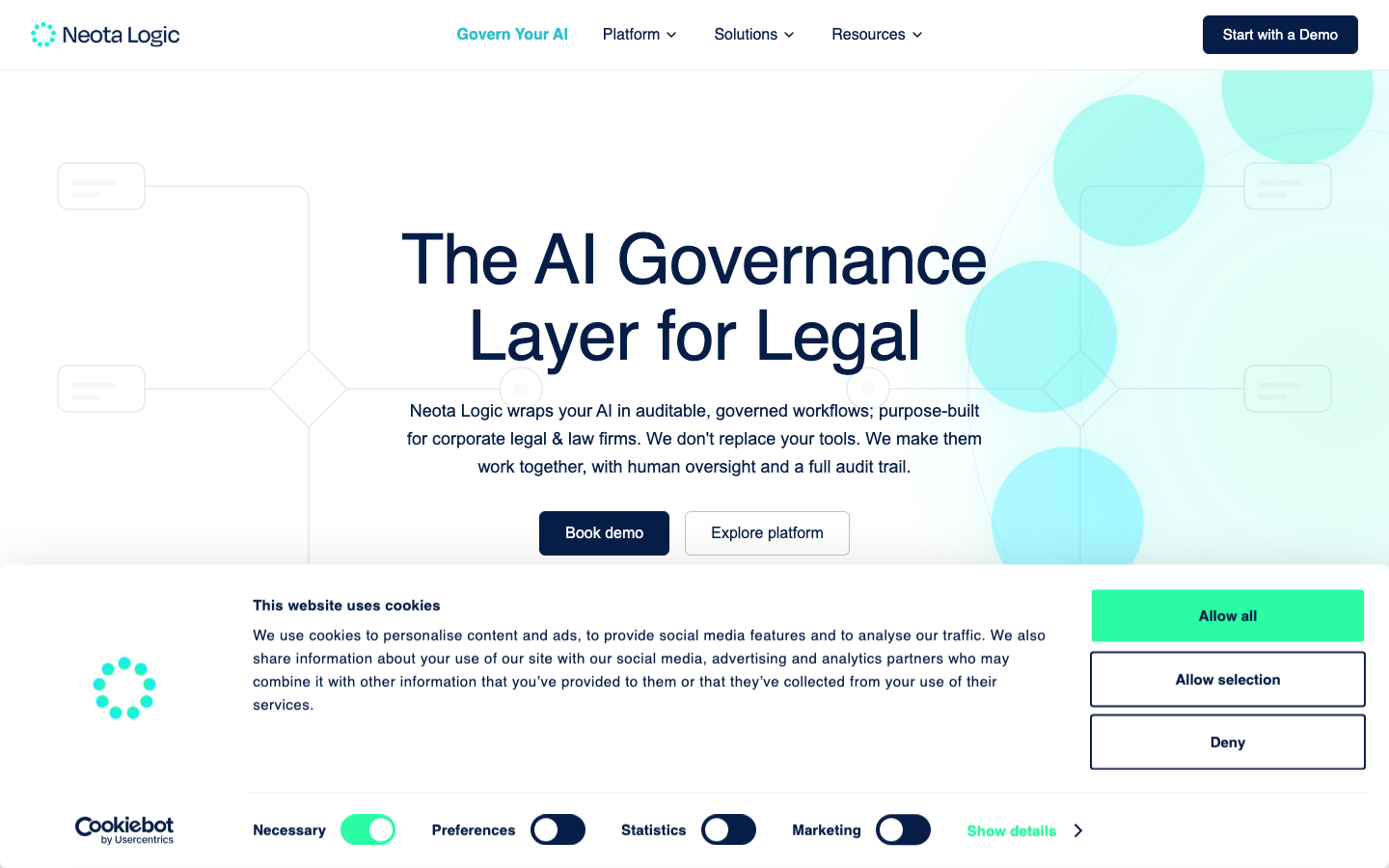
Neota Logic: Legal AI Governance Layer – Let AI operate within rules boundaries
Tool introduction
A brief comment: Neota Logic is not an independent AI chat tool, but a "governance layer" established between the legal team and generative AI - it uses a codeless logic engine to ensure that the output of AI is always subject to corporate rules, auditable, and traceable.
Publicity Verification: The official positioning is "The AI Governance Layer for Legal", which is not a false label. Unlike traditional legal automation tools (such as simple document merging, clause templates), the core difference of Neota Logic is that it organically combines a deterministic rules engine with generative AI. AI can be called in the workflow (such as contract review, summary extraction, clause drafting), but the output of each step is subject to preset rule verification, manual approval nodes and complete audit records. The client cases displayed on the official website (Fujitsu, Littler Mendelson, Harney's, Clifford Chance, etc.) are all authentic and verifiable from the world's top law firms and corporate legal departments, and their positioning is credible.
According to official website data, Neota Logic has cumulatively verified more than 100 million US dollars in value drivers, processed more than 8 million sessions per year, served 100+ law firms and legal teams, and covered 10,000+ global users (Source: neotalogic.com, accessed in July 2026).
Core functions
Neota Logic provides six core functional modules, covering the entire link from knowledge encoding to delivery management:
1. No-Code Builder
Drag and drop to build decision trees, rules engines, business processes and logical judgments. Legal staff can turn legal knowledge into actionable digital applications without relying on engineering teams. Supports advanced logic such as conditional branching, calculated fields, data search, external API calls, etc.
- Interactive Questionnaire: Construct guided interviews to automatically collect information required for business scenarios.
- Decision Logic Engine: Based on the "if-then" rule tree, automatically derive compliance conclusions, risk levels or action recommendations.
- Data verification and calculation: Built-in formula engine supports numerical calculation, date operation and cross-field consistency verification.
2. Document Automation
Embed logic-driven variable fields, conditional clauses, and AI drafting capabilities into Microsoft Word context with Neota's Word toolbar add-in. After users fill out the questionnaire or enter data, the system automatically generates formal documents such as contracts, legal opinions, and compliance reports.
- Smart Templates: Dynamically select terms, adjust wording, and insert definitions based on the rules engine.
- AI-assisted drafting: Within a deterministic template framework, the AI model is called to complete the filling and polishing of natural language paragraphs.
- Version Comparison: Automatically track document modification history and support red line comparison.
3. Workflow Orchestration
Integrate Neota applications, third-party tools and databases into end-to-end business processes. Supports manual approval, automatic routing and exception escalation across teams and systems.
- Visual process designer: Drag and drop to draw approval links, timeout upgrade logic and conditional branches.
- Manual Approval Node: Set up manual confirmation at key decision points, and AI output must be approved by experts before continuing.
- Scheduled triggering and event-driven: Automatically start workflow based on time schedule or external system events.
4. Governed AI - AI Task Node
This is Neota Logic’s most important capability upgrade for 2025-2026. Users can insert "AI Task Node" anywhere in the workflow and call external large models (GPT-4o, Claude, Gemini, etc.) to perform specific natural language tasks (such as clause extraction, risk classification, summary generation), but the output of AI is always constrained by the deterministic logic of the context.
- Model agnostic: Supports OpenAI GPT, Anthropic Claude, Google Gemini, Azure AI Foundry, Amazon Bedrock, and self-hosted private models. Switching models does not require rebuilding your workflow.
- Output Verification: The results returned by AI will be verified by preset rules (such as confidence threshold, field format, black and white list). If they fail, they will be automatically routed to manual processing.
- Cost Tracking: Token consumption, response time and model version of each AI call are recorded to facilitate cost accounting.
Expert View: The real value of AI Task Node does not lie in the "call model" itself, but in that it solves the biggest obstacle for enterprises to adopt generative AI - uncontrollability. The traditional approach is to independently generate content in AI tools and then manually copy it into the compliance process; Neota's approach is to embed AI into existing deterministic workflows. AI only functions within a preset "safe zone" and is automatically degraded to manual work beyond the boundary. This removes the burden on the legal team to conduct a full-text review of every AI output.
5. Data & Reporting
Track application usage, turnaround time, automation rates, and decision outcomes in real time. Supports exporting to visual panels and structured reports to provide operational transparency for management.
- Workbench Dashboard: Overview of key metrics for all running applications.
- Customized Report: Filter by time range, department, application type and other dimensions.
- Audit Log Export: Completely records every user operation, AI call and manual approval, and can be exported as an audit file that cannot be tampered with.
6. Governance Controls
- Role Permissions (RBAC): Fine-grained control over who can build, run, approve, and view applications.
- Single Sign-On (SSO): Supports SAML/OIDC integration and unifies enterprise identity authentication.
- Approval Gateway: AI recommendations must be confirmed by designated experts before they can be executed.
- Full Audit Trail: Every decision—whether made by AI or humans—is recorded in an immutable audit log.
Pricing strategy
Pricing model: Billed by solution/use case (not by number of users), the specific amount is not disclosed, you need to contact sales to get a quote (source: neotalogic.com/pricing).
| Dimensions | Details |
|---|---|
| Billing unit | By solution/use case (Per Solution), not by number of users |
| Pricing Structure | Decreasing tiered subscription fees + fixed fee professional services |
| Scale effect | The more solutions deployed, the lower the cost of a single solution, and the overall TCO decreases |
| Trial method | Discovery Sprint (fixed fee proof of concept to produce a working MVP) |
| Deployment options | Public cloud (AWS/Azure), private cloud, on-premises deployment |
| Professional Services | Implementation deployment, training, annual maintenance support (fixed fee structure) |
| Free trial | No public free version, need to experience through Discovery Sprint |
| C-side price | Not for individual users |
| API Pricing | API not sold separately, included with Enterprise Subscription |
Pricing Analysis: Billing by "plan" rather than "user" has significant cost advantages for large enterprise legal departments - a compliance audit application can be rolled out for use by the entire organization (thousands of employees) at no additional cost. However, the initial subscription threshold is high, making it difficult for small and medium-sized enterprises to afford it independently. The Discovery Sprint model (fixed-fee rapid prototyping) reduces first-time purchase risk and is suitable as a PoC entry point.
Advantages and Disadvantages Analysis
Advantages
- AI Governance Differentiation: At a time when "AI security compliance" has become an urgent need for enterprises, Neota is one of the few platforms that organically integrates deterministic rule engines and generative AI, rather than simply splicing them together. Its four-layer governance structure of "AI Task Node + Rule Verification + Manual Approval + Audit Tracking" is unique among similar products.
- True no-code: Legal/compliance experts can build applications independently after a short period of training without waiting for IT schedules. In the case shown on the official website, the Fujitsu team completed the first application prototype in two weeks.
- Model-agnostic architecture: Not locked into a single AI vendor. Enterprises can access OpenAI, Claude, Gemini and even self-hosted models at the same time, and hot switch between models to effectively avoid supplier risks.
- Enterprise-grade security endorsement: ISO 27001 certification, AES-256 encrypted SSO/RBAC, complete immutable audit logs - these are hard thresholds for law firms and financial institutions to make purchasing decisions.
- Rich out-of-the-box integration: Deeply integrated with mainstream enterprise tools such as Microsoft 365, Salesforce, DocuSign, iManage, NetDocuments, Slack, Teams, etc., reducing the mental cost of changing workflows.
Disadvantages
- Pricing is opaque and the threshold is high: There is no public price on the official website, so you need to contact sales. Combined with its customer base (top law firms, global legal counsel of Fortune 500 companies), the annual subscription fee may reach hundreds of thousands to millions of yuan, which is basically unaffordable for small and medium-sized enterprises.
- Natural language processing capabilities are not optimal: The core of Neota is governance and rules, not pure NLP. In the pure semantic analysis scenario of contract clauses, its depth is not as deep as that of dedicated tools such as Kira Systems and Luminance.
- The learning curve objectively exists: Although it is codeless, building complex rule logic (conditional combinations, nested decision trees, data linkage) still requires legal personnel to have certain logical thinking and structured expression capabilities, and it is not "drag-and-drop".
- Small community and ecosystem: Compared with the ISV ecosystem of mature platforms such as Salesforce, Neota's third-party template library and community contributions are less, and most applications need to be built from scratch.
- Language restrictions: Currently mainly for the English market, the interface and document automation templates have limited support for non-English languages such as Chinese, and international deployment requires additional evaluation.
Applicable scenarios
1. Corporate legal department - diversion and self-service of legal requests
Pain Point: Corporate legal teams receive a large number of repetitive inquiries (NDA reviews, data protection inquiries, contract template requests) every day, which takes up legal staff's time to deal with high-value matters.
Neota Plan: Build a "Legal Front Desk" application - guide the business department to input key parameters (trading counterparty, involved data type, amount range), and the system automatically determines whether formal legal intervention is required. About 60% of routine requests can be resolved automatically (such as generating standard NDAs, giving policy references), and only complex cases are escalated to manual processing.
Official data: Customer cases show that this scenario can reduce 60% of routine legal requests, increase turnover speed 3 times, and make all decisions 100% auditable (source: neotalogic.com/legal-teams).
2. Law Firm - Productization of Legal Services
Pain Point: Traditional law firms charge by the hour, making it difficult to transform standardized legal services (such as NDA reviews, GDPR compliance assessments, employment law consulting) into fixed-price products that can be scaled and have predictable revenue.
Neota Solution: Encoding law firm expertise into interactive client-facing applications. Customers can use it online 24/7, and the system automatically generates legal documents or risk assessment reports. Law firms gain new revenue streams through subscriptions or pay-per-view.
Official data: Harney's (funds and asset management law firm) used Neota to replace the past "fragmented email process" with a "guided digital experience" to achieve 5 times faster case delivery, and the first application went live in only 3 weeks (Source: neotalogic.com/law-firm-innovation).
3. Compliance and risk management - regulatory change tracking and policy compliance
Pain Point: Regulations such as GDPR, CCPA, and SOX are frequently updated. Enterprises need to continuously update compliance assessment standards. Manual maintenance costs are extremely high and easy to miss.
Neota Solution: Encode regulatory provisions into an executable rules engine. When regulations change, simply update the rule parameters in Neota and all running applications automatically adopt the new standard. The system can evaluate the compliance risks of business processes in batches and generate discrepancy reports.
Efficiency Improvement: According to industry analysis, traditional manual compliance review of the compliance status of a medium-sized enterprise (about 50 business processes) takes 4-6 weeks, which can be shortened to 2-3 days after using Neota, and the coverage and consistency are much higher than manual operations.
4. Insurance Industry – Automation of Underwriting Rules and Claims Review
Pain Point: Insurance underwriting and claims settlement involve a large number of conditional judgments (policy terms, exclusions, compensation limits), and manual processing is inefficient and prone to inconsistent judgments.
Neota Solution: Encode underwriting guidelines and claims rules into decision trees and rules engines. The front-end salesperson inputs case information, and the system outputs underwriting recommendations or claims settlement conclusions and basis in real time. High-risk or over-authority cases are automatically escalated to the underwriter/claims manager for approval.
5. Internal HR and Procurement - Policy Consulting and Supplier Management
Pain Points: Repeated inquiries from employees on HR policies (vacation, travel, reimbursement), as well as supplier admission review by the procurement department, occupy the energy of the legal and HR teams.
Neota Plan: Build self-service policy advisory tools and supplier due diligence workflows. Employees enter their own situation, and the system automatically gives policy references and operational suggestions. Background checks, qualification verification and compliance reviews are automatically triggered during the supplier review process.
Summary
Neota Logic's core competency is not "the smartest AI", but the "most credible AI workflow". It accurately addresses a market demand that is ignored by most AI tools - What corporate legal teams need is not more AI capabilities, but controllable governance of existing AI capabilities**. In 2026, when Shadow AI (the use of AI in shadow IT) has become the number one compliance risk for corporate legal teams, the "AI governance layer" positioning provided by Neota has a strong market timing fit.
Current Limitations:
- The initial investment cost is high, it is mainly aimed at medium and large enterprises and law firms, and the SMB market coverage is insufficient.
- Pure NLP capabilities (such as deep contract semantic understanding) are not as good as vertical tools such as Kira and Luminance, and need to be combined with AI Task Node to call external models to make up for it.
- Non-English market support is limited, and document automation templates in Chinese, Japanese and other languages require additional development.
- The community ecosystem and third-party template market are still in their early stages.
Follow-up observation points:
- The ecological expansion speed of MCP (Model Context Protocol) integration capabilities after its official release in 2026.
- Whether to launch a lightweight (SMB-friendly) version or a pay-as-you-go flexible plan.
- Localization progress in the Asia-Pacific region, especially the depth of support for Chinese/Japanese regulatory systems.
Procurement/Adoption Risk Assessment:
- It is recommended to first verify 1-2 high-frequency scenarios (such as automatic NDA generation, preliminary compliance assessment) through Discovery Sprint (fixed fee PoC), and evaluate the application construction efficiency and rule accuracy before expanding to the entire department.
- The contract needs to clarify the location of data residence (AWS/Azure region), rights to rule migration (to avoid lock-in), and data processing terms generated by AI model invocation (such as whether prompt words are used for model training).
- The legal team needs to be equipped with at least one "citizen developer" with logical thinking ability to be responsible for rule maintenance to avoid relying entirely on Neota's professional service team.
Efficiency improvement comparison
The following comparison is based on customer case data and industry analysis inferences from the official website. The content marked "according to industry analysis" has not been directly released by Neota officials.
| Business scenario | Traditional method | After using Neota | Improvement rate | Data source |
|---|---|---|---|---|
| Processing of routine legal requests | Manual processing one by one, an average of 2-3 days per case | Automated diversion, immediate resolution of routine requests | The number of requests is reduced by 60%, and the turnover speed is increased by 3 times | neotalogic.com/legal-teams |
| The law firm's first automated application is launched | The demand schedule is 3-6 months (waiting for IT development) | The legal team builds it by itself, 2-3 weeks MVP | The launch cycle is shortened from months to weeks | neotalogic.com/law-firm-innovation |
| Contract review (standard NDA) | Manual comparison of templates item by item, about 45-60 minutes/part | AI-assisted review + rule verification, 5-10 minutes/part | Efficiency improved 5-10 times | According to industry analysis |
| Regulatory compliance self-examination (50 processes) | Legal team manually evaluates one by one, 4-6 weeks | Rules engine batch evaluation, reports are issued in 2-3 days | Time shortened by 90% or more | According to industry analysis |
| Preliminary review of insurance claims | Case-by-case judgment by claims adjusters, 20-30 minutes/order | Automatic preliminary review + risk classification by rules engine, < 2 minutes/order | Efficiency improved 10-15 times | According to industry analysis |
| Supplier admission review | Cross-department email transfer, average 2-3 weeks | Online guided questionnaire + automatic verification, 3-5 days | Cycle shortened 60-70% | According to industry analysis |
Automation Boundary
Neota Logic's core design philosophy is "AI proposes, your people decide". This principle draws clear automation boundaries:
Can be 100% automated and organized
- Information collection and classification: Automatically collect structured data required for business scenarios through guided questionnaires, and automatically classify request types based on rules.
- Standardized document generation: Based on templates and rules engines, automatically generate the first draft of standardized contracts such as NDA and MSA, as well as compliance reports, policy reference letters, etc.
- Compliance judgment with clear rules: Scenarios with clear regulatory provisions and enumerable judgment conditions (such as "whether the counterparty is on the sanctions list", "whether the sales amount exceeds the approval threshold").
- Data Validation and Format Check: Automatically check input data for completeness, format compliance and cross-field consistency.
- Notifications and Routing: Automatically assign to-do tasks to designated approvers, or automatically escalate to superiors upon timeout.
There are knots that require manual intervention
- AI Output Confirmation: The term explanations, risk assessments or suggested conclusions generated by the AI Task Node must be manually approved when the confidence level is lower than the threshold or involves high-risk operations.
- Irreversible operations: For legally binding actions such as contract signing, final pricing determination, external regulatory declaration, etc., the system compulsorily sets a manual confirmation point.
- Rule Change Approval: When modifying the rule logic of a deployed application, it needs to be reviewed by experts with designated permissions before a new version can be released.
- Complex Discretionary Judgment: For matters involving business judgment, strategic trade-offs or legal gray areas (such as whether it constitutes a substantial breach of contract, suggestions for settlement amount ranges), Neota provides structured information assistance, but the final decision is made by humans.
- Exception Handling and Manual Digging: Exception requests that cannot be classified by the system, input whose data format cannot be parsed, and new scenarios not covered by the rule set are automatically routed to manual operators.
Recommended human-machine collaboration mode
[Request input] → [Rule engine automatic classification] →
  ├─ Standard request → [AI Task Node auxiliary processing] → [Automatic verification] → [Automatic completion]
  ├─ Medium risk request → [AI assistance + rule verification] → [Manual quick review] → [Complete]
  └─ High risk/abnormal → [Manual full process processing] → [Rule record] → [Complete]
Security and Compliance
Neota Logic makes security and compliance the cornerstone of the platform, not an add-on feature. The following information comes from the security page of the official website (neotalogic.com/security) and industry public information.
| Security dimensions | Measures |
|---|---|
| Certification Standards | ISO 27001 Certification (International Standard for Information Security Management Systems) |
| Data Protection Regulations | GDPR Compliant; data may reside in designated areas |
| Transport Encryption | TLS 1.3 (Encryption in Transit) |
| Storage Encryption | AES-256 (encryption at rest) |
| Identity Authentication | Single sign-on (SSO/SAML/OIDC), supports multi-factor authentication (MFA) |
| Permission Control | Role-based access control (RBAC), fine-grained to the application/function/data level |
| Infrastructure | Supports AWS or Microsoft Azure deployment, customer selectable region |
| Audit Log | Complete non-tamperable operation log, including user operation AI calls, rule changes, and approval records; supports export |
| Penetration Testing | Regular third-party penetration testing and ongoing security monitoring |
| Deployment Options | Public cloud, private cloud, on-premises |
| Data Isolation | Logical isolation in multi-tenant context; private cloud/local solution supports physical isolation |
| AI Data Governance | Each AI call record: model name, prompt word version token usage, confidence score, approver; enterprises can choose not to use data for model training |
Compliance Reminder: For highly regulated industries (e.g., financial services, healthcare, government contracts), it is recommended that:
- Choose private cloud or on-premises deployment options to ensure data sovereignty.
- Clearly stipulate in the contract the boundaries of Neota's data processing responsibilities towards AI model providers (especially when using third-party models such as OpenAI/Anthropic).
- Regularly review audit logs to ensure consistency with internal compliance policies.
Integrated Ecosystem
Neota Logic adopts an "open integration" strategy and provides both pre-built connectors and open APIs. The following integration capabilities are from the integrations page of the official website (neotalogic.com/integrations).
Pre-built integrations
| Categories | Tools/Platforms |
|---|---|
| Document Management (DMS) | iManage, NetDocuments, SharePoint, Box |
| Office Productivity | Microsoft 365 (Word toolbar plug-in), Outlook |
| Electronic Signature | DocuSign, Adobe Sign |
| CRM & Business Systems | Salesforce, Dynamics 365, HubSpot |
| Communication and collaboration | Slack, Microsoft Teams, Gmail |
| Database & Analytics | PostgreSQL, MS SQL, Power BI, Tableau |
| AI Models | OpenAI GPT Series Anthropic Claude, Google Gemini, Azure AI Foundry, Amazon Bedrock, self-hosted private models |
Open API and custom integration
- REST API (v2): Provides a complete inbound/outbound API that supports triggering Neota workflows, reading and writing data from external systems. Example:
  POST /api/v2/workflows/intake/run
  Authorization: Bearer <token>
  Content-Type: application/json
  {
    "matter": "NDA-2048",
    "counterparty": "Northwind",
    "priority": "high"
}- MCP (Model Context Protocol) - in preview: Neota exposes its own application as an MCP tool. AI assistants (such as Claude) can directly call Neota's logic engine through MCP to obtain governed, definite answers without the user leaving the AI chat interface. This is one of the most noteworthy features of 2026 and marks Neota's expansion from "AI within workflows" to "Workflows within AI."
- Custom Connector: Integrate with any system not in the pre-built list via REST API and Webhook mechanism.
Architecture link diagram
┌────────────────────────────────────────────────────┐
│ User interaction layer │
│ Web App │ Word Plug-in │ Teams / Slack │ AI Chat (MCP) │
└────────────────────────┬───────────────────────────────────────────────────────────────────────────
                          │
┌──────────────────────────▼─────────────────────────────┐
│ Neota Logic Platform │
│ ┌──────────┐ ┌──────────┐ ┌─────────────────┐ │
│ │Codeless Builder│ │Rule Inference Engine│ │AI Task Node │ │
│ │(Studio) │ │(Decision Tree) │ │ (GPT/Claude/Gemini)│ │
│ └──────────┘ └──────────┘ └──────────────────┘ │
│ ┌──────────┐ ┌──────────┐ ┌─────────────────┐ │
│ │Workflow orchestration │ │Document automation │ │ Governance layer (RBAC/Audit) │ │
│ └──────────┘ └──────────┘ └──────────────────┘ │
└────────────────────────┬──────────────

──────────────┘
                          │
┌──────────────────────────▼─────────────────────────────┐
│ Enterprise system integration layer │
│ Salesforce │ iManage │ SharePoint │ DocuSign │ ... │
│ OpenAI │ Azure │ AWS Bedrock │ Self-hosted LLM │
└──────────────────────────────────────────────────────┘
Implementation suggestions
Deployment path suggestions
- Discovery Sprint (Weeks 1-3): Choose a high-frequency, low-risk scenario (such as standard NDA generation, supplier compliance preliminary screening), and be guided by the Neota team to complete the construction and launch of the first MVP. Fixed fee, produces a working application.
- Internal promotion and expansion (weeks 4-8): After the first MVP is verified, promote it to the legal team, collect feedback and iterate. At the same time, start the second scenario (such as intelligent diversion of legal affairs requests). Cultivate internal "citizen developers".
- Scale deployment (weeks 9-24): Expand to scenarios such as compliance management, contract review, insurance claims, etc. Complete deep integration with core systems (CRM, DMS, ERP). Establish internal governance policies: who can build applications, who can approve rule changes, and AI model usage specifications.
- Continuous Optimization (After Month 6): Use the Data & Reporting module to analyze usage data and identify new automation opportunities. Evaluate the suitability of new features such as MCP integration.
Team training suggestions
| Role | Training focus | Training duration recommendations |
|---|---|---|
| Legal/Compliance Expert (Application Builder) | No-code builder operations, decision tree design, rule writing, document template production | 3-5 days |
| Approver/Senior Legal | Approval gateway operations, audit log interpretation, rule change review process | 1 day |
| IT Administrator | SSO configuration API integrated RBAC setup, deployment and maintenance | 3-5 days |
| End User (Business Department) | Front-end application usage (filling out questionnaires, submitting requests) | 2-4 hours |
Best Practices
- Start with Simple Scenarios: Don’t start by trying to automate complex litigation risk assessments or multi-jurisdictional compliance. First choose a scenario where "the input and output are enumerable and the rule logic is clear" (such as NDA clause compliance inspection) to build confidence.
- Normal maintenance of rules: Regulations and business policies will continue to change. It is recommended to designate a dedicated person to review and update the rule logic of deployed applications quarterly to ensure consistency with the latest policies.
- AI Task Node Use with caution: The introduction of AI increases uncertainty and cost. Only enable AI in scenarios where interaction with external models can significantly improve efficiency (e.g. free text extraction, preliminary classification), otherwise keep purely deterministic rule execution.
- Periodic review of audit logs: Don’t only review audit logs when a dispute arises. It is recommended to check the call records and manual approval decisions of AI Task Node every month to detect rule deviations or abnormal model behavior in a timely manner.
- Reduce Risk with Discovery Sprint: Instead of spending weeks negotiating a contract, jump right in with fixed-fee Discovery Sprint. This is the lowest-cost way to evaluate whether Neota is a good fit for your needs.
Neota Logic’s main functions
- Core Processing Capabilities: Provides core AI capabilities in the corresponding scenarios to support users to quickly complete tasks.
- Multi-modal interaction: supports text input and result output, and some scenes support image or file upload.
- Workflow Integration: Can be embedded into existing workflows or linked with other tools through APIs to reduce context switching.
Application scenarios of Neota Logic
- Personal Creation: Quickly generate or process content to improve daily work efficiency.
- Team Collaboration: Unify workflow and reduce repetitive manpower investment.
- Enterprise-grade deployment: Embed capabilities into on-premises systems via API or private deployment.
Neota Logic’s applicable groups
- Individual Users: Content creators and knowledge workers who need AI assistance to improve their daily work efficiency.
- Developers: Technical teams who need to integrate AI capabilities into their own products or services through APIs.
- Enterprise: Organizations seeking to deploy AI at scale in their field.
Neota Logic’s technical advantages
- Algorithm Optimization: Special optimization at the model or algorithm level has been carried out for the corresponding scenario to achieve a balance between response speed and result quality.
- Low-latency architecture: Adopts streaming or asynchronous processing architecture to reduce user waiting time and is suitable for high-frequency interaction scenarios.
Neota Logic’s core parameters and statistics
Specific technical parameters (such as model size, context length, supported file formats, input and output restrictions, etc.) are subject to the official product page. It is recommended that users verify the latest technical specifications and system requirements before choosing to ensure that they match their own usage scenarios.
Neota Logic’s user and market recognition
Gradually build user awareness in the field, and product capabilities are used by content creators and teams to improve work efficiency. Some industry users have incorporated it into their daily workflow. It is recommended to refer to the latest official disclosures for specific user scale and industry adoption rate data.
Neota Logic’s Cost Advantage
- C-side/Individual: Usually a free version is provided to experience the core functions, and high-frequency use requires a paid package subscription.
- API/Developer: Billed by call volume, suitable for development teams that can be flexibly integrated into their own systems.
- Enterprise/Privatization: Contact the business owner to obtain customized quotation and deployment plan. The specific price is subject to the official real-time pricing page.
Summary and Outlook of Neota Logic
It provides competitive solutions in its field, and its core value lies in lowering the threshold for AI use in this field. With technology iteration, products are expected to continue to improve in functional coverage and performance.
Current limitations: Some advanced functions require paid subscription, and the free version has function or usage limits; Specific technical details and performance benchmarks have not yet been fully disclosed, and it is recommended to fully verify them through trials before purchasing.
Neota Logic’s model and version evolution
Continuous iterative updates, the latest version introduces performance optimization and new features. Historical version information can be viewed on the official release page. There is no complete public version evolution timeline yet. It is recommended to pay attention to the official announcement to understand the rhythm of feature updates.
How to use Neota Logic
- Web client: You can use it by visiting the official website and registering an account. Most functions do not require installation.
- API Access: Provides RESTful API, developers can obtain the API Key and integrate it into their own applications.
Product Pricing for Neota Logic
The pricing model is subject to the official real-time page. Usually a freemium or subscription system is used, and basic functions can be used for free. Advanced functions or high-frequency use require paid subscriptions, and users are advised to evaluate the optimal solution based on actual usage.
Version Info
- Neota Logic Latest :There is no official precise date yet, but the AI inference engine and document automation capabilities will continue to be iterated.
- Neota Logic 2025 Update :There is no official precise date for the introduction of enhanced no-code builder and API integration.
User Reviews