 New Relic AI
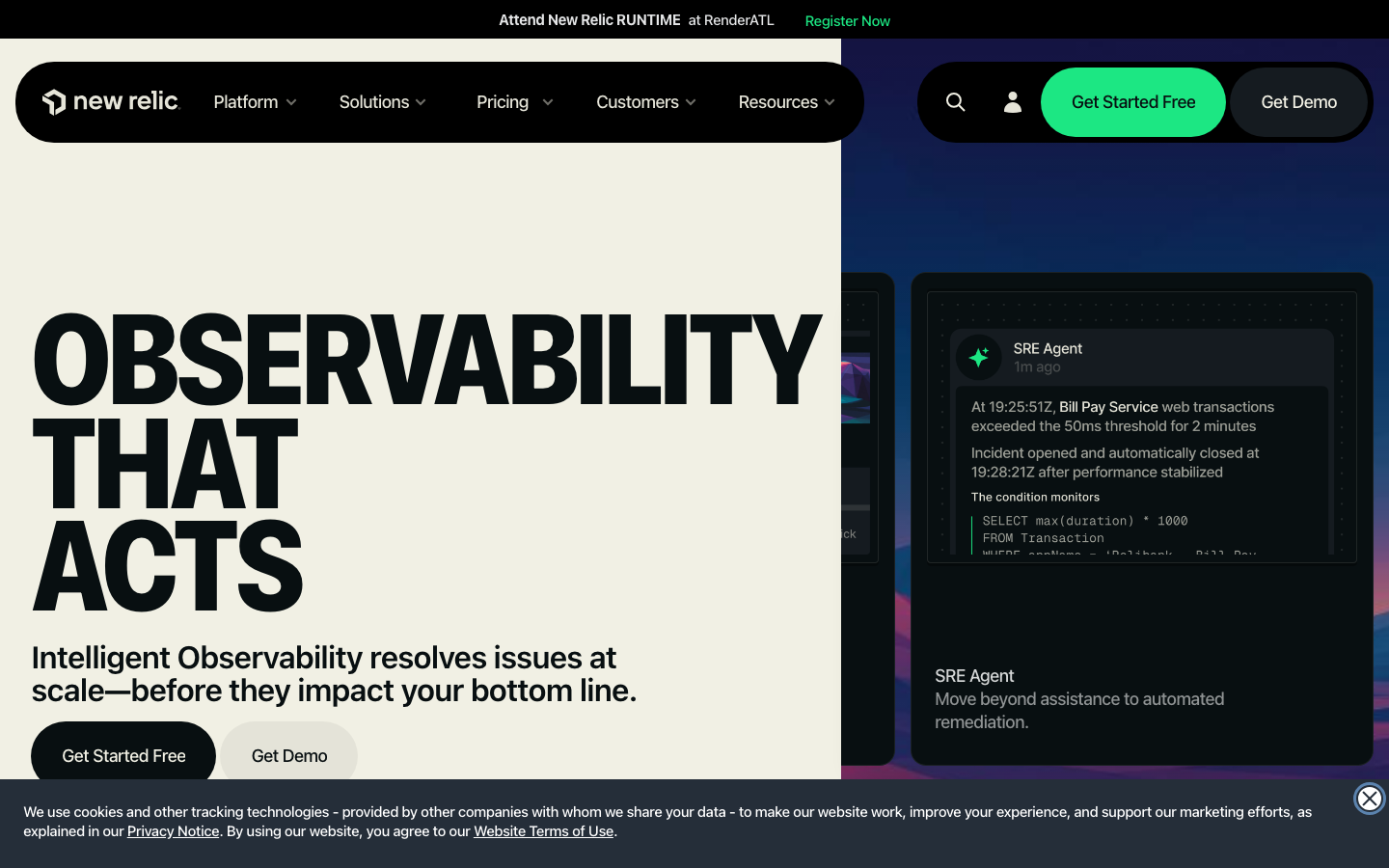
New Relic AI is an AI-enhanced observability solution launched by New Relic. It embeds AI operation and maintenance assistants, anomaly detection and intelligent alarms into modules such as APM, infrastructure monitoring and digital experience monitoring to help teams discover, troubleshoot and repair system problems faster.
NewRelicAI
Core parameters and statistics
New Relic AI is an AI-enhanced observability solution launched by New Relic since 2025. It embeds machine learning and generative AI capabilities into the original APM, infrastructure monitoring, log and digital experience monitoring (DEM) product lines, rather than operating as an independent product. The official positioning is "The AI-observability platform built for engineers".
| Projects | Public Information |
|---|---|
| Official positioning | The AI-observability platform built for engineers |
| Product Form | SaaS Cloud Platform + Agent Collection |
| AI product line | New Relic AI (unified portal), Grok AI (natural language query), anomaly detection, intelligent alarm |
| Core competency areas | APM, Infrastructure, Logs, Digital Experience, Browser, Mobile |
| Integration Ecosystem | 500+ Quickstarts, covering AWS, Azure, GCP, Kubernetes |
| Customer scale | 10,000+ paying customers worldwide (official disclosure) |
| Listing Information | NYSE: NEWR |
Product Positioning Difference: Unlike Datadog’s full-stack unified model, New Relic’s core advantage lies in the depth of the application layer where APM started. It has extensive experience in automatic tracking of Java, .NET, Node.js and other languages. If the team’s core requirement is application layer performance monitoring, New Relic’s traditional APM capabilities are still in the first echelon.
AI integration path: New Relic AI is not a new independent product module, but integrates Grok AI natural language query, ML-based anomaly detection, intelligent alarm grouping and other functions into one user interface. This means that the depth of use of AI capabilities depends on the breadth of existing data access. If only APM is connected but not Logs or Infrastructure, the range of answers that GroK AI can answer will also be limited.
User and market recognition
New Relic is a veteran manufacturer in the observability field, and its market recognition is based on twenty years of APM brand accumulation.
Customer base: Official disclosure of more than 10,000 paying customers worldwide, covering technology, finance, retail and media industries. New Relic's customer base is mainly medium-sized to large enterprises, and it maintains high recognition among traditional enterprise IT departments.
Market Competition Situation: New Relic forms a three-legged rivalry with Dynatrace and Datadog in the APM segmentation track. After the privatization and delisting in 2024 (a transaction in cooperation with New Relic management and private equity funds), New Relic will strategically focus more on product integration and AI capabilities, and will no longer be driven by the pressure of quarterly financial reports. This change gives it more room for maneuver in pricing flexibility than listed competitors.
Open Source and Community: New Relic has an active open source Agent ecosystem (open source agents for Ruby, Python, Java, Go and other languages), and is an early supporter of OpenTelemetry. However, this is mainly the perception of developers. APM depth and operation and maintenance reliability are the main considerations in enterprise purchasing decisions.
Cost advantage
New Relic is ramping up its free tier after 2025 in response to Datadog’s penetration into the small and medium-sized enterprise market.
C-side/Individual: New Relic provides a Free plan (100 GB/month data intake for free for 1 full-platform user, basic APM and infrastructure monitoring), which is suitable for individual developers to do small projects or personal experiments. Compared to Datadog’s only 14-day trial, New Relic’s permanent free quota is an obvious difference in customer acquisition.
API/Developer: Billed by usage (Data Ingest), and billed by GB after the Free quota is exceeded. APM is billed by Host, and Logs is billed by Ingest. For developers, the Free plan is usually sufficient if the usage of the test version is not large; however, the amount of data in the official version will quickly exceed the free quota.
Enterprise/Private: Pro and Enterprise plans are on an annual contract basis. After being privatized and delisted, New Relic is more flexible in contract negotiations than its listed peers, and corporate customers may be able to obtain more favorable multi-year contracts. Hidden costs: Data migration out of New Relic requires additional API calls or export toolchains, and it is recommended to plan the data migration window in advance before the contract expires.
Main functions
New Relic AI is not a single AI product, but a collection of AI capabilities embedded in the entire platform. The core modules include:
- Grok AI Natural Language Query: Users can use natural language to ask questions about system status, query performance indicators, and analyze error trends. For example "What were the 5 slowest API endpoints in the past 7 days?" No need to write NRQL. Grok AI automatically translates into query syntax and returns the results. The value lies in lowering the threshold for non-SRE roles (such as developers) to obtain monitoring data.
- AI Anomaly Detection and Alert: Automatically identify abnormal patterns based on historical baselines, eliminating the need to manually set alarm thresholds for each indicator. New Relic's anomaly detection engine supports multi-dimensional combined analysis (such as simultaneous detection by service + region + version), which is more accurate than a single indicator threshold.
- Intelligent Alarm Grouping: When multiple alarms are triggered at the same time, AI automatically groups and aggregates them by root cause to reduce alarm storms. In a large-scale microservice environment, a single deployment failure may trigger dozens of associated alarms, and intelligent grouping can reduce the number of events by 70-90% (based on industry deductions).
- AI-driven workflow automation: Automatic remediation actions suggested by AI, such as automatic rollback, restarting services, or calling webhooks. This is suitable for environments with a high degree of standardization, but it is recommended to start with read-only recommendation mode to ensure that the repair actions recommended by the AI are confirmed by humans before being executed.
Model and version evolution
Relevant information has not been made public, please refer to the official real-time page.
Technical advantages
The technical advantages of New Relic AI come from the architectural design of "APM depth + OpenTelemetry native support + AI embedded workflow":
APM automatic point burying accuracy: New Relic’s 20 years of accumulation in the APM field is reflected in the coverage and accuracy of automatic point burying. Supports Zero-config automatic instrumentation of mainstream languages such as Java, .NET, Node.js, Python, Go, Ruby, PHP, etc., and can be accessed without modifying the code. For teams that already have existing services, this significantly reduces access costs.
OpenTelemetry native compatibility: New Relic is one of the first major vendors to support OpenTelemetry. Users can use OTel SDK to collect data and send it natively to the New Relic platform without deploying a proprietary Agent. This can reduce the number of Agent types for teams that have adopted the OpenTelemetry standard.
Context fusion for AI reasoning: Grok AI's question and answer is not just a translation of text to NRQL, but the ability to build answer context across data types (metrics + traces + logs). For example, if you query "the reason for the slow response of the payment service", AI will simultaneously check APM data (which endpoint is slow), log data (whether there is an error stack) and infrastructure data (whether the CPU is overloaded), and then synthesize an answer.
How to use
New Relic provides a SaaS platform as the main entrance, supplemented by API and CLI tools:
| How to use | Suitable for people | Features | Cost |
|---|---|---|---|
| Web UI | SRE, DevOps, developers | Built-in Grok AI query portal, dashboard, alarm management | Billing by subscription plan |
| REST API | Automation platform CI/CD | Data writing, event query, metadata management | Billing based on API call volume |
| New Relic CLI | DevOps Engineer | Command line query and configuration management | Free |
| Terraform Provider | IaC Team | Infrastructure as Code Management New Relic Resources | No additional cost |
Typical usage process: Deploy New Relic Agent (or OTel Collector) → Select the product to be connected (at least one APM, Infrastructure, Logs) → Verify data arrival in the UI → Enable New Relic AI and Grok AI → Configure anomaly detection and intelligent alarms. It is recommended that before enabling AI alarms, you first manually verify 1-2 weeks of baseline data accumulation to ensure that the anomaly detection engine has sufficient historical data for learning.
Product Pricing
New Relic's pricing model undergoes significant changes after 2025, with a stronger free tier.
- C-side/Individual: Free plan provides 100 GB/month free data ingestion for 1 user, basic APM and Infrastructure monitoring. For individual projects or small team evaluations, this may be the lowest cost human solution. The free plan includes basic Grok AI capabilities, but advanced AI capabilities such as cross-data source root cause analysis may be limited.
- Developer/API: Charges will be based on usage after the free quota is exceeded. The Pro plan is billed based on data intake (GB/month) + number of hosts. The specific unit price is subject to the official pricing page. The development scope is usually controlled within the Free quota and can be covered.
- Enterprise: Enterprise plan includes advanced AI capabilities (combined anomaly detection, custom models), dedicated support, and SLA. Business confirmation is required for the annual contract price. It is recommended that enterprises run POC for 2-4 weeks before purchasing, use real business data volume to calculate costs, and then enter contract negotiations.
Application scenarios
The implementation scenarios of New Relic AI are concentrated in operation and maintenance situations that require in-depth application performance analysis:
- Application Performance Bottleneck Troubleshooting: GroK AI's natural language queries significantly reduce the need to write NRQL queries when troubleshooting APM issues. Deduction: The time it takes for an intermediate developer to locate a cross-service performance bottleneck can be shortened from 30 minutes to 5-8 minutes, provided that the APM buried point has completely covered the call chain.
- Alarm Storm Management: Intelligent alarm grouping can significantly reduce the processing pressure of the on-duty team in large-scale deployment (50+ microservices) scenarios. The number of alarms triggered by a single fault has been aggregated from dozens to 2-3 root cause alarms.
- Digital Experience Monitoring (DEM): New Relic's Browser and Mobile monitoring combined with AI analytics can identify whether front-end performance degradation is a client issue or a back-end API bottleneck. Suitable for product teams who are sensitive to user experience.
Applicable people
New Relic AI’s multi-level AI capabilities serve different roles:
- SRE and DevOps Engineers: Directly benefit from GroK AI’s natural language query and intelligent alarm grouping, reducing daily repetitive troubleshooting work. Suitable for teams that already have some experience using APM.
- Application Development Engineer: Use New Relic AI to quickly understand the production performance status of your own services during the development phase without switching context to operation and maintenance tools. The low threshold of the Free plan allows individual developers to access it.
- Head of Platform Engineering and Operations: Focus on the construction of a unified observability base. New Relic's native support for OpenTelemetry makes it easier to standardize across multi-language, multi-framework organizations.
Unsuitable Scenario: If the team is already a heavy user of Datadog or Grafana, the migration cost (including Agent replacement, dashboard reconstruction, and alarm rule reconfiguration) may be higher than the additional benefits brought by the AI function. In addition, New Relic's SaaS model cannot be deployed directly for pure intranet environments (completely offline).
Summary and Outlook
New Relic AI's core competitiveness lies in the technical depth of APM + the customer acquisition strategy of the free tier + the pricing flexibility after privatization and delisting. It's not the "most comprehensive" observability platform (the integration count is lower than Datadog), but for teams focused on application performance, the depth of APM and the natural language interactive experience of GroK AI have unique value.
Current limitations: The integrated ecosystem (500+ Quickstarts) is less than Datadog (700+); the quality of GroK AI’s question answers depends on data source coverage, and the initial experience may be unstable; the long-term product roadmap after privatization and delisting is less transparent than its listed peers.
Procurement/Adoption Risk Assessment: It is recommended to give priority to using the Free plan to conduct a 2-4 week POC to verify the answer accuracy and data access coverage of GroK AI on its own technology stack. Before signing an Enterprise contract, you need to confirm usage limits for advanced AI features, discount tiers for annual data volume estimates, and data export strategies and migration support during the contract period.
Version evolution of New Relic AI
As a SaaS platform, New Relic also adopts a continuous delivery model, and AI functions are iterated on a quarterly basis.
Grok AI ability line
- 2025-Q1: New Relic AI is released for the first time, integrating Grok AI natural language query, supporting basic NRQL translation and indicator query.
- 2025-Q3: Grok AI extends to log analysis, supporting natural language search of log content and pattern recognition.
- 2026-Q1: New Relic AI unified experience released, aggregating all AI capabilities into a single entry panel.
Anomaly detection capability line
- 2025-Q2: Introduce multi-dimensional anomaly detection and support combined analysis by services, regions, versions and other dimensions.
- 2025-Q4: Intelligent alarm grouping GA, automatically classify related events in alarm storm scenarios.
- 2026-Q2: Enhanced version of AI-driven root cause analysis, supporting joint anomaly positioning across APM and Logs data.
The latest capability changes are subject to the official Release Notes (docs.newrelic.com/docs/release-notes/). Since SaaS updates automatically, teams don't need to upgrade manually, but should verify compatibility of key dashboards and alerting rules in the Staging environment.
Version Info
- New Relic 2026-Q2 Release :Updated in the second quarter of 2026, the enhanced version of New Relic AI introduces the natural language query interface Grok AI to upgrade AI-driven alarm correlation analysis.
- New Relic 2026-Q1 Release :Updated in Q1 2026, launching New Relic AI unified experience that consolidates AI capabilities into a single portal.
- New Relic 2025-Q4 Release :Q4 2025 update introduces enhancements to AI anomaly detection and intelligent alert grouping.
User Reviews