 not if IC.love
Free
not if IC.love
Free
Notific.ai is an AI Agent platform, officially positioned as "AI that doesn't just chat—it completes tasks on your website". Unlike traditional chatbots, Notific.ai identifies website UI elements through data-ai-* HTML attributes, directly replaces users by clicking buttons, filling out forms, and navigating pages, completing tasks end-to-end. Currently in beta, free 30-day implementation is available.
Notific.ai
Core parameters and statistics
Notific.ai is an AI Agent platform for website owners, officially positioned as "AI that doesn't just chat—it completes tasks on your website." It does not belong to a traditional chatbot or customer service ticket system, but an AI execution layer that can directly operate the website UI - by identifying the data-ai-* attributes in HTML, AI can replace the user by clicking buttons, filling out forms, navigating pages, and completing tasks end-to-end.
| Projects | Public Information |
|---|---|
| Official positioning | AI that doesn't just chat—it completes tasks on your website |
| Product form | AI Agent (website UI interactive execution layer) |
| Deployment method | Cloud SaaS (embedded into target website through SDK) |
| Access method | npm install @notificai/sdk + HTML attribute tag |
| Front-end framework support | React, Vue, Angular, native HTML |
| Pricing Status | Free in Beta (free implementation for 30 days) |
| Key indicators (officially announced) | Conversion rate increased by +35%, support tickets reduced by -70%, user preference 91% |
| Compatible standards | MCP and emerging AI navigation standards |
| Privacy Policy | User interaction data is not used for model training |
| Current Stage | Public Beta (Free to Apply) |
Uniqueness of product form: Notific.ai is positioned between AI chatbots and RPA. Traditional chatbots can only "tell users what to do", while traditional RPA requires pre-recorded scripts. Notific.ai understands user intentions through semantics and then dynamically operates the UI - it is not simulating people, but executing it for people after understanding the interface structure.
Indicator Interpretation: The officially announced +35% conversion rate increase and -70% work order reduction come from self-test or early customer data (marked on the homepage as "One client saw a 28% increase in users completing onboarding in week 1") and have not yet been audited by a third party. These numbers are more suitable as "possibility references" than contractual commitments.
User and market recognition
Notific.ai is currently in the public beta stage. Market recognition mainly comes from the differentiated positioning of the product concept and early customer feedback, rather than large-scale public deployment or community data (the latter is not officially disclosed).
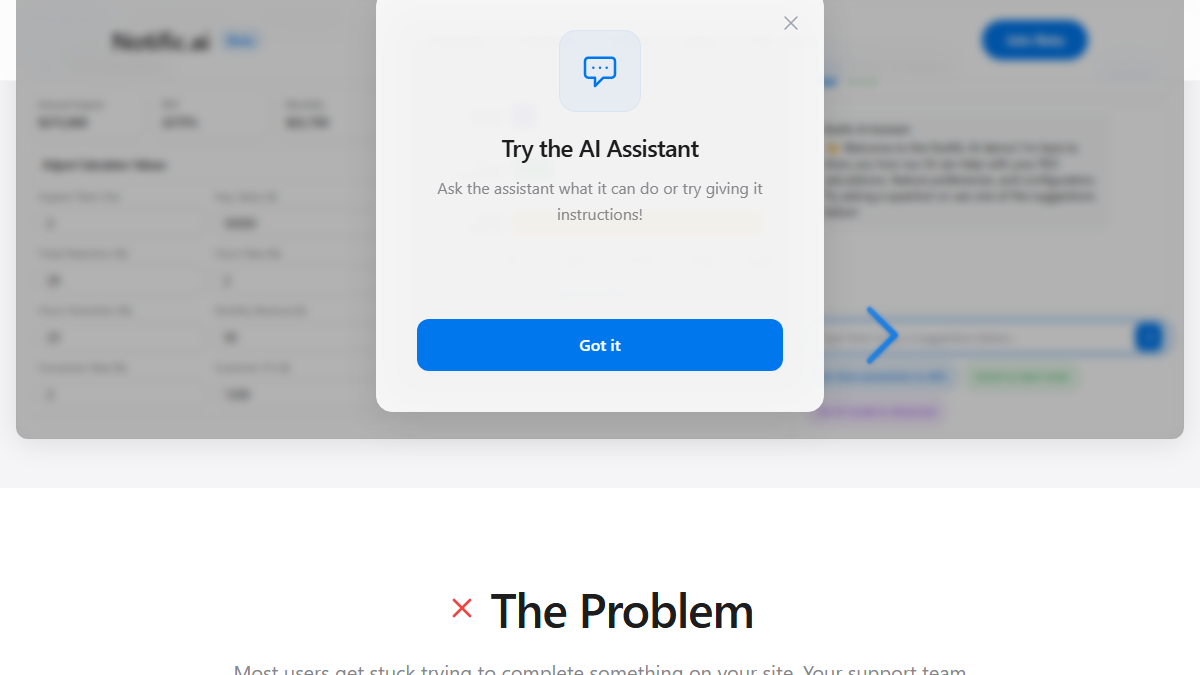
Product concept verification: The homepage provides a real-time interactive demo (ROI calculator + AI Assistant online demonstration), so visitors can directly experience the effect of AI operating UI. This "try before you buy" model lowers the understanding threshold for potential customers.
Early customer case: The official quoted the testimony of Jane Doe, CTO of a SaaS company - "One client saw a 28% increase in users completing onboarding in week 1". This points to early customers achieving significant results in user onboarding (Onboarding) scenarios, but the sample size and industry distribution are not disclosed.
Competitive positioning: Notific.ai challenges two traditional solutions at the same time - traditional chatbots and online help documentation. The core argument is that users often do not read help documents when they encounter problems, and chatbots can only explain the steps, and neither can truly "complete the operation for the user." This point of difference is particularly convincing in scenarios with high-frequency operations and multi-step processes.
Premise for implementation: The actual value of the product depends on the front-end transformation cost of the target website. Notific.ai requires websites to add data-ai-* attributes in HTML to mark interactive elements, which means that stock pages require a round of front-end markup investment. For SMBs without a front-end engineering team, the bar may be higher than expected.
Cost advantage
Notific.ai is currently in the Beta stage, and the cost structure has not yet been fully disclosed, but there is enough information to make a hierarchical assessment.
Free strategy in Beta stage: Officially provides free 30-day implementation, including team-assisted integration - customers only need to tell which processes they need AI to help complete (such as checkout, registration API key generation), and the Notific.ai team will be responsible for the technical configuration. This kind of "zero-commitment, verify first" pricing is more common in developer tool SaaS, which means that the beta period is a window period for low-risk trials.
Hierarchical expectations for the official version: From the "Pricing" entry in the official website navigation bar (although the specific price has not been disclosed) and the "Premium Plan" Demo screenshots, it is suggested that the product is likely to adopt a "free quota/standard version/enterprise version" hierarchical structure in the future. The specific billing dimension may be the number of monthly active users (MAU), the number of completed tasks, or the number of integrated website domain names - but these are all inferences and are subject to the official pricing page.
Hidden Cost 1: Front-end transformation cost. This is the core cost difference that differentiates Notific.ai from pure chatbot solutions. Pure chatbots only need to embed a piece of JS, while Notific.ai requires marking all UI elements that require AI operations (data-ai-field, data-ai-action) in the front-end code. For large websites or legacy projects, labeling effort and maintenance costs can significantly drive up the total cost of ownership.
Hidden cost two: AI execution error rate. When AI operates the UI, there may be accidental clicks, wrong fields filled in, or exceptions that cannot be handled (such as form validation failure pop-ups). If such errors require manual intervention to correct, the cost savings on work orders will be reduced. Data accumulation from the beta phase and early production releases is not yet sufficient to assess a baseline for such miss rates.
Hidden Cost Three: Impact of Website Upgrade. When the front-end is refactored or the UI framework is upgraded, the data-ai-* tags may need to be maintained simultaneously. This is equivalent to adding an "AI compatibility" maintenance debt to the front-end team.
Main functions
Notific.ai's capabilities are designed around "understanding user intent → find the target page → operate the UI → complete the task", and the public capabilities can be summarized into six categories:
- Semantic Intent Understanding: Users describe their needs in natural language ("I need to update my billing address"), and AI understands the specific operation goals instead of just returning preset answers.
- UI element identification and operation: Locate the target element through the
data-ai-field(fillable form field) anddata-ai-action(clickable action button) attributes, and perform actions such as clicking, filling in, and selecting. - Multi-step process navigation: Not limited to single-page operations - AI can navigate across pages ("Find the bill settings page → Locate the address form → Fill in the new address → Click Save") to complete the process completely.
- Action Mapping: Map the user's fuzzy needs to the website's preset atomic operations, such as "Complete purchase", "Schedule meeting", and "Generate API key".
- Real-time ROI calculation and demonstration: The homepage has a built-in interactive ROI calculator, which supports adjusting team size, salary, work order reduction rate, churn rate and other parameters, and dynamically displays annual impact and return on investment.
- MCP is compatible with future standards: The official clarification is that the product is compatible with MCP (Model Context Protocol) and other emerging AI navigation standards, preparing for subsequent AI Agent ecological interoperability.
Expert View: On the surface, Notific.ai's feature list is similar to the overlay of chatbot + RPA, but the truly valuable linkage lies in the end-to-end integration of "user intent → UI operation". In traditional solutions, users need to first understand the interface and then operate manually; Notific.ai hands over both "understanding" and "operation" to AI, which means that the user's role changes from "executor" to "commander". This change has obvious effects in high-frequency customer service scenarios (such as password resets and bill modifications), but in scenarios that require complex judgment or compliance confirmation, manual intervention is required.
Model and version evolution
Notific.ai is still in the public beta stage, and the official has not fully disclosed the version pedigree or underlying model details. The following information is based on the public content on the official website and reasonable product stage inferences.
Beta stage
- Beta Preview (~2026): The first public Beta version, core capabilities include
@notificai/sdkrelease,data-ai-*attribute system AI Agent execution engine, online demo and ROI calculator. Pricing is free for 30 days of implementation.
The current public version shows the early stage characteristics of "the function is ready to be experienced, the API and the documentation are still being improved". The official label "Documentation Coming Soon" shows that the developer documentation of the SDK is not yet complete. For teams looking to deeply evaluate API compatibility and customization capabilities during the beta phase, this means communicating directly with the Notific.ai team rather than self-service exploration.
Technical advantages
The core of Notific.ai's technology lies not in the capabilities of a single large model, but in the system engineering of "how AI can safely and accurately interact with the UI of unfamiliar websites."
HTML attribute tagging mechanism: By adding data-ai-field (mark fillable fields) and data-ai-action (mark executable actions) self-describing attributes on existing HTML elements, AI gains structured interface awareness. This is more reliable and safer than pure visual recognition (screenshot post-OCR parsing) or automatic DOM traversal - because it does not require guessing the function of interface elements, but understanding it through the semantics explicitly annotated by the developer.
Secure isolation execution context: Officially stated that AI runs in a secure isolation context and will not use user interaction data for model training. This design reduces data leakage and compliance risks for websites that handle sensitive information such as billing address API keys.
Action Mapping (Action Mapping) Mechanism: The website owner does not simply open all buttons to AI, but defines "what AI can do" through action mapping. For example, the checkout process is mapped to the Complete purchase action, and the AI can only perform actions within a preset range. This is equivalent to establishing a clear boundary control between AI freedom and website security.
Standard Compatibility Strategy: Officially clearly compatible with MCP and other AI navigation standards. This means that Notific.ai can not only be driven by its own AI, but may also be called by third-party AI Agents (such as general AI assistants) in the future - this is consistent with the "interoperability" trend of the current AI Agent ecosystem.
Comparison with traditional chatbots:
| Comparison Dimensions | Traditional AI Chatbot | Notific.ai |
|---|---|---|
| Interaction method | Conversational reply (tell the user what to do) | Directly operate the UI (complete it for the user) |
| How to complete the task | Users can operate by themselves after reading the instructions | AI navigation, click, fill in, submit |
| Requirements for the front end | Just embed a script | Data-ai-* attribute tags need to be added |
| Error disclosure | Only answers will be given, users can make their own judgment | Possible misoperation, manual/log rollback required |
| Suitable for scenarios | Questions and answers, FAQs | Multi-step operations, form filling, process navigation |
This comparison reveals a core trade-off: Notific.ai has a higher ceiling (can actually get the job done), but it also relies on more front-end markup work. It's not suitable for "zero-modification plug-and-play" scenarios.
How to use
The use of Notific.ai is divided into two levels: website owner integration and end-user use.
Site Owner Integration Path
The integration is divided into three steps, and officials claim that it can be completed within minutes:
- Install SDK: Execute
npm install @notificai/sdkin the project to embed the AI Agent runtime into the website. - Mark interactive elements: Add
data-ai-field(form field) anddata-ai-action(action button) attributes in HTML. For example:<input data-ai-field="email" />marks the email input box<button data-ai-action="submit-form">Sign In</button>marks the login button
- Configure action mapping: Map common user intentions (such as "update bill", "reset password") to preset operation links, and define the boundaries of behaviors that AI can perform.
Special support during beta period
Officials are offering a "team-assisted integration" service during the beta period - website owners only need to describe the process they want AI to help complete, and the Notific.ai team is responsible for the technical implementation. This is especially friendly to small and medium-sized enterprises that lack front-end resources, but means that the depth of integration in the beta phase is limited by the service capacity of the Notific.ai team.
End user usage
End users put forward requirements in natural language through the AI Assistant interface embedded in the website. After the AI understands the intent, it directly operates the website UI to complete the operation. During the entire process, users do not need to leave the current page, nor do they need to learn any operation paths.
Comparison with alternatives
| Dimensions | Notific.ai | Intercom AI / Zendesk AI | Traditional Help Documentation / Knowledge Base |
|---|---|---|---|
| What the user needs to do | Just state the requirement | Read the reply and then do it by yourself | Search and read the document by yourself |
| Task completion rate | AI end-to-end execution | Depends on the accuracy of user understanding | Extremely low (officially cited starting point) |
| Front-end modification cost | Requires data-ai-* tags | Only embed chat components | Document content needs to be maintained |
| Technical requirements for users | None | Need to be able to understand the guidelines | Need to be able to understand the documentation |
| Suitable for complex processes | Suitable for multi-step, cross-page | Only suitable for simple questions and answers | Not suitable for complex operations |
Product Pricing
Notific.ai's pricing has not yet formed a complete system in the public beta stage, and the information visible on the official website is limited. The following is a three-level analysis:
- C client/individual: Beta free trial (free implementation for 30 days), suitable for individual webmasters or small teams to verify product value for free. Whether the official version will launch a fixed low-price plan for small websites has not yet been disclosed.
- Developer/API layer:
@notificai/sdkis an npm public package and is currently free to use. However, the SDK itself needs to be connected to Notific.ai's cloud AI execution engine. After the official version, it may be billed based on the number of API calls or active users. The specific price is subject to official official release. - Enterprise/High Traffic Tier: Judging from the "Premium Plan" label in the demo screenshot and the "Enterprise" entry in the navigation bar, there is an enterprise plan for websites with high traffic, multi-process, and customized needs. You need to apply for Beta or contact sales for confirmation. Before purchasing, enterprises need to focus on confirming the data isolation level, execution of audit log SLA, and liability limits in the terms of service—especially the division of responsibilities for data loss caused by AI misoperation.
Real limitations of the free model: The free implementation offered during beta is facilitated by the Notific.ai team, which means the speed and depth of the integration are limited by the other party’s human bandwidth. In addition, the service agreement of the Beta version may limit the traffic limit and does not guarantee SLA. Please read the Beta terms carefully before using it.
Application scenarios
The value of Notific.ai is greatest in scenarios where "users need to complete operations but are prone to giving up". The following four types of scenarios are worthy of attention:
- E-commerce checkout and purchase process: When users hesitate or encounter errors on the checkout page, AI can assist in applying discount codes, switching payment methods, and completing orders. Official quoted data shows that the conversion rate increases by +35%, which is suitable for e-commerce websites with large traffic but high checkout churn rate.
- User Onboarding and Account Settings: The first configuration after new user registration (filling in information, connecting to third-party services, and setting preferences) is a typical high-risk area for abandonment. AI directly guides and completes the initial configuration on behalf of the user. Early cases show that the Onboarding completion rate increased by 28% in the first week.
- Developer Portal and API Management: Allows users to generate API keys, manage tokens, and update configurations through natural language operations - such operations are highly repetitive and have fixed steps, making it easy for the accuracy of AI operations to reach a high level.
- Reservation and Booking Platform: Simplify the complex reservation process (multi-step screening, calendar selection, information filling, payment confirmation), and reduce the proportion of users giving up midway due to too long processes.
Unsuitable Scenarios: Scenarios that require human professional judgment (legal contract review, medical diagnosis advice, high-value payment confirmation), scenarios that require creativity or subjective aesthetics (copywriting creation, design adjustment), and operations with extremely high compliance requirements (such as financial transactions, compliance report submission) - in these scenarios, the risk of misjudgment in AI operations exceeds the efficiency benefits, and manual confirmation should be set up.
Applicable people
The applicability of Notific.ai is closely related to the type of website and team capabilities. The following three types of roles are most likely to benefit:
- E-commerce and SaaS product/growth team: It is necessary to reduce user operation friction, improve conversion rate and retention, and have a clear KPI for "user completion rate". Notific.ai’s direct execution capabilities contribute more directly to metric improvements than chatbots.
- Customer Support and Operations Team: Handle a large number of repetitive tickets (password resets, bill inquiries, account settings changes), reduce front-line support burden through AI end-to-end execution, and allow the team to focus on high-value issues.
- Website front-end developer: Responsible for integrating and maintaining
data-ai-*attributes, need to understand AI operation boundaries and reserve compatibility in front-end architecture. There are certain requirements for the front-end team’s engineering capabilities and maintenance willingness.
Unsuitable situations: Individual webmasters who do not have a front-end development team and cannot undertake the work of HTML attribute tags; projects where the website UI is frequently revised and do not have a stable maintenance team; core processes in the financial and medical industries that require strong compliance audits; and plug-and-play scenarios that pursue "zero modification and play".
Prerequisite: Notific.ai’s value release relies on the markup quality and stability of the website’s front-end. If the website is in a rapid iteration period (UI revisions multiple times per week), the maintenance cost of data-ai-* attributes will become an ongoing burden. It is recommended to introduce this type of AI operation layer after the website UI is relatively stable.
Summary and Outlook
Notific.ai’s product concept—“Let AI directly operate the interface for users”—provides persuasive differentiation at a time when AI chatbots are rampant. What it aims at is not "better customer service", but the ultimate goal of "users don't need to find customer service at all". Its official data of +35% conversion rate improvement and -70% reduction in work orders are at least logically self-consistent: when AI can complete operations for users, operational friction and the need for help will naturally decrease.
However, the uncertainties at the current stage are equally obvious: the product is still in Beta, the official version pricing has not been disclosed, and the execution accuracy of the underlying model (especially the performance in boundary conditions, abnormal pages, and dynamic verification scenarios) lacks third-party evaluation. The SDK document is marked "Coming Soon", indicating that developers' self-service integration capabilities are not yet complete. The biggest risk point is the cost of front-end markup maintenance - for large websites or projects with frequent revisions, the data-ai-* attribute may become an ongoing front-end debt.
If you want to evaluate the implementation, it is recommended to apply for a free trial during the beta period, select 1-2 high-frequency, fixed-step, and risk-controllable processes (such as password reset, preference setting update) to conduct controlled experiments, count the AI execution success rate, manual regression rate, and user satisfaction changes, and then decide whether to extend it to sensitive processes such as payment and account management. Before an enterprise purchases, it is important to clearly specify in the contract the disclaimer of AI misoperation, data isolation commitment, and service availability guarantee, and ask for the ability to export execution audit logs—these may not be complete in the beta stage, but the official version must be a prerequisite for purchase.
Looking forward, Notific.ai’s compatibility strategy for open standards such as MCP deserves attention. If it can interoperate with the mainstream AI Agent ecosystem (such as general AI assistants, enterprise AI platforms), then its positioning will be upgraded from "an AI assistant for a website" to "the interface layer of a website for the AI Agent era." Whether this transformation can be realized depends on whether Notific.ai can maintain standards-compatible openness after the official version is launched, rather than moving towards a closed proprietary protocol.
Related tools:  CrewAI,
  LangChain
Version Info
- Notific.ai Beta :Open beta with free 30 days of implementation and team-assisted integration. There is no official precise date yet.
- Notific.ai Beta Preview :Early Beta preview version, core functions include SDK access to data-ai-* label mapping AI Agent execution engine. There is no official precise date yet.
User Reviews