 Nuclia (Progress Agentic RAG)
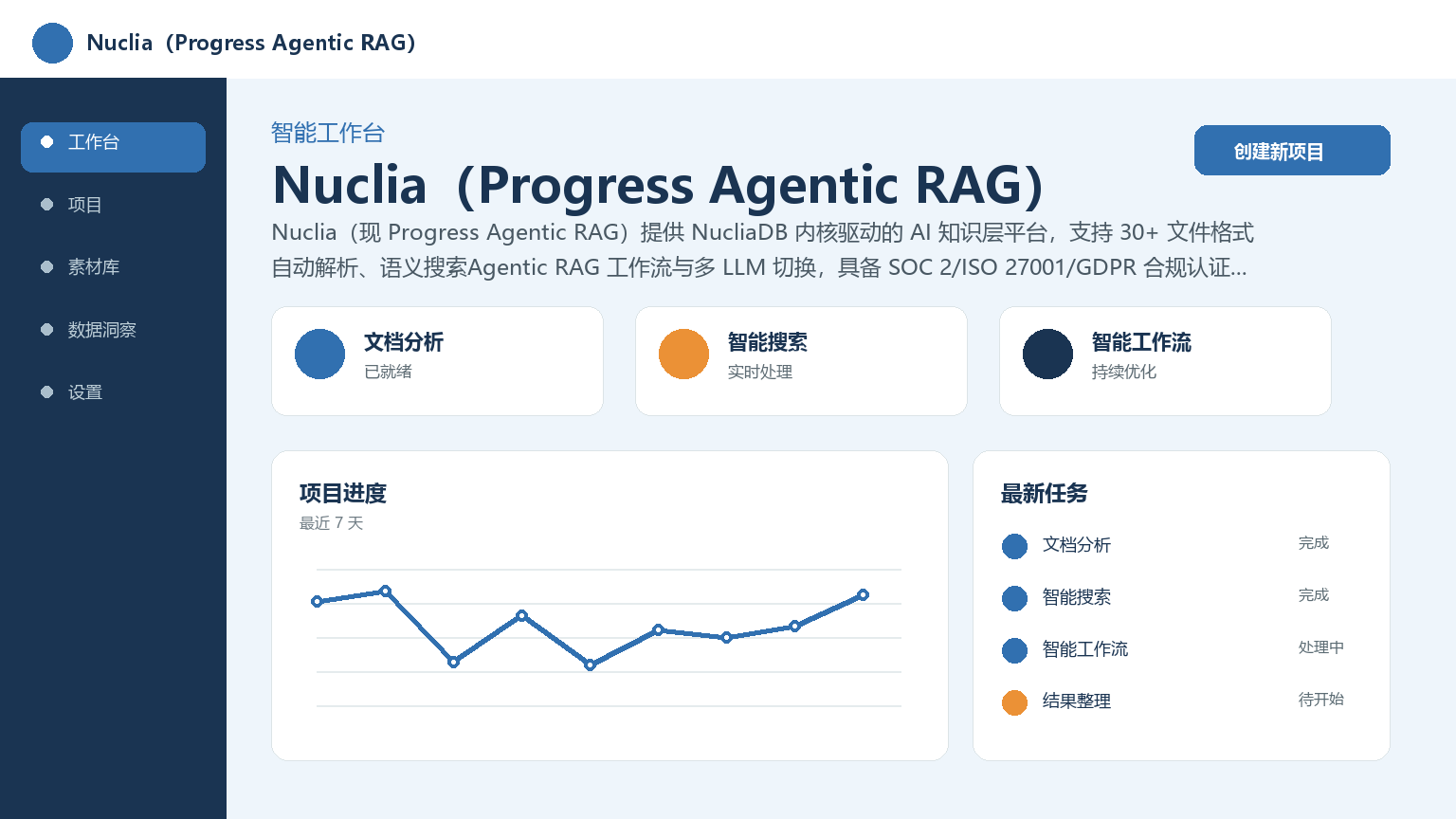
Nuclia (now Progress Agentic RAG) provides an AI knowledge layer platform driven by NucliaDB kernel, supports automatic parsing of 30+ file formats, semantic search Agentic RAG workflow and multi-LLM switching, and has SOC 2/ISO 27001/GDPR compliance certification. The core value is that once the knowledge layer is built, it can support all AI scenarios such as enterprise search AI assistant, customer service self-service, and engineering documents.
Nuclia (Progress Agentic RAG)
Nuclia’s core parameters and statistics
Nuclia initially entered the market with NucliaDB as its core product - one of the world's first AI search databases designed specifically for RAG (Retrieval Augmented Generation). After being acquired by Progress Software in 2024, its core capabilities were integrated into the Progress Agentic RAG product line, officially positioned as "Build an Agentic Knowledge Layer Once to Power Every AI Use Case". The current product form is mainly SaaS cloud services, while retaining the open source NucliaDB engine for developers to self-host.
| Projects | Public Information |
|---|---|
| Product Positioning | Agentic Knowledge Layer - Build a knowledge layer at once to support all AI scenarios |
| Core Engine | NucliaDB (AI Search database for RAG) |
| File format support | 30+ types: text documents PDF, Word, HTML, Markdown, JSON, images, videos, audio |
| Number of LLMs supported | 40+ models (OpenAI, Azure OpenAI, Anthropic Claude, Google Gemini, etc.) |
| Search form | Semantic search Hybrid Search, Agentic RAG, multi-source routing search |
| Deployment method | SaaS cloud service, open source NucliaDB self-hosted |
| Compliance Certification | SOC 2 Type II, ISO 27001, GDPR |
| Security capabilities | AES-256 encryption at rest TLS transport encryption RBAC, PII anonymization |
| Open source warehouse | nucliadb (718 stars, 58 forks), frontend (56 stars) |
| Awards | 2026 AI Excellence Award in RAG, 2025 Global Tech Awards |
Knowledge Layer Architecture: The key difference between Nuclia and general vector databases is that it does more than just vector storage and retrieval. It provides a complete pipeline from file ingestion to QA generation: automatically parsing content in 30+ formats, performing OCR and speech-to-text, generating vector + text dual representation, and enabling cross-source reasoning through retrieval agents. This means that the team does not need to build four independent systems for parsing, chunking, embedding and quality monitoring outside of OpenAI/Claude.
Product evolution after acquisition: After being acquired by Progress, Nuclia's capabilities were embedded into Progress's larger digital experience platform (Sitefinity CMS) system, while retaining the independent Agentic RAG product line. For existing users, this means more stable enterprise-level support and compliance endorsement, but it also means that the product roadmap is no longer entirely decided independently by the original Nuclia team.
Nuclia’s users and market recognition
The market recognition of Nuclia (now Progress Agentic RAG) is mainly reflected in three aspects: open source community foundation, industry award endorsement, and enterprise-level channels gained after being acquired by Progress.
Open source community foundation: The core engine NucliaDB has about 718 stars and 58 forks on GitHub. Although it is smaller than competing products such as Pinecone and Weaviate, it is precisely positioned for specific scenarios (RAG-first database). Community discussions and issue feedback focus on document parsing accuracy, multi-modal retrieval and Agent workflow integration. The supporting frontend project (56 stars) and Python SDK nuclia.py (7 stars) indicate that its technology stack is mainly Python/TypeScript and is suitable for AI application developers to start with.
Industry Awards & Recognition: The product received the AI Excellence Award in RAG at the Globee Awards in 2026, the Global Tech Awards in 2025, and was mentioned in the Forrester Wave in the Digital Experience Platform category in January 2026. These third-party recognitions verify the maturity of its RAG technology route to a certain extent.
Enterprise Ecosystem Integration: After being acquired by Progress Software (a publicly traded enterprise software company with over 40 years of history), Nu-clia's products have direct access to Progress' existing customer base for Sitefinity CMS, Corticon BRM, DataDirect and other products. This channel synergy is of practical help to its enterprise-level promotion, but it also means that the independent innovation rhythm of the product may be affected by the parent company's product matrix strategy.
Prerequisites for implementation: Nuclia's typical customers already have a certain scale of digital content assets (document library, knowledge base, media files) and a clear "use AI to answer internal questions" scenario, rather than building a knowledge base from scratch. If the team does not already have a systematic collection of enterprise content assets, the value of Nuclia will be greatly reduced.
Nuclia’s Cost Advantage
Nuclia's cost advantage is not reflected in "the cheapest", but in that it compresses a RAG pipeline that usually requires a combination of 3-5 suppliers (file parsing + vector database + Embedding model + LLM + quality monitoring) into one platform, thereby reducing integration costs and trial and error cycles.
C-side/individual
The official website provides a 14-day free trial, which is suitable for individual developers and small projects to verify core capabilities. The quota limit (document volume, number of API calls, storage space) during the free trial period is subject to the official registration page. For personal study and small-scale proof-of-concepts, the bar is low.
Developer/API
Nuclia provides REST API and Python SDK (nuclia.py), and developers can directly call its document parsing, indexing and retrieval capabilities through API Key. API pricing is based on document processing volume and retrieval times, but the official does not display a specific standard price list on the public page. You need to register or contact sales to obtain it. The open source NucliaDB provides a self-hosted path - zero subscription fee but you need to bear the infrastructure and maintenance costs yourself, which is suitable for teams with existing operation and maintenance capabilities.
Enterprise
The enterprise version of Nuclia (Progress Agentic RAG) is delivered through Progress’ sales channels and supports enterprise-level features such as SSO, RBAC, audit logs, private deployment, etc. Pricing is subject to business communication, and there is no published price. The actual cost of corporate procurement should include:
- Explicit cost: Platform subscription fee (billed based on document processing volume/retrieval volume/number of users, subject to the business contract)
- Hidden Cost: Cleaning and formatting effort of migrating existing content to Nuclia indexes
- LLM calling fee: Nuclia supports 40+ LLM, but the model inference cost is borne directly by the user or paid through the platform. This part will become a major cost item when used on a large scale.
Comparative Analysis: Compared with the three-piece combination solution of Pinecone + LangChain + OpenAI, Nuclia's "one-stop" model eliminates the cost of pipeline construction and version compatibility maintenance; however, compared with pure vector databases, its flexibility in retrieval customization may be limited by the abstraction layer of the platform. What needs to be weighed when choosing is "time-saving integration" vs "freedom of customization".
Nuclia’s main features
The capabilities of Nuclia (Progress Agentic RAG) cover the complete link from data ingestion to AI answer generation. The core can be summarized into five functional groups:
-
Multi-format automatic parsing and indexing: Supports 30+ file formats, including PDF, Word, HTML, JSON, pictures (JPEG/PNG/TIFF), videos (MP4/AVI/MPEG), audio (MP3/WAV), etc. OCR (character recognition in images), ASR (speech to text), semantic chunking and vectorization are automatically performed after uploading without manual preprocessing. This is especially important for enterprise content libraries that include scanned documents, meeting recordings, and training videos—traditional solutions require a two-step process, but here you can do it all in one go.
-
Semantic Search and Hybrid Search: In addition to semantic search based on vector similarity, it also supports Hybrid Search strategy combined with keyword matching. Users can optimize the recall effect for specific business scenarios (such as legal contract retrieval vs technical document retrieval) through Metadata filtering and segmentation strategy adjustment.
-
Agentic RAG Workflow: This is Nuclia’s core differentiating capability from earlier RAG solutions. Retrieval Agents can automatically decompose a question into sub-questions, query multiple Knowledge Boxes, SQL databases, Internet search engines and MCP servers at the same time, and then merge the multi-source results into a comprehensive answer. The entire process does not require users to manually specify each route. The agent automatically determines the query target and sequence based on the content of the question.
-
REMi Quality Evaluation System: The built-in RAG Evaluation Model (RAG Evaluation Metrics Intelligence) continuously monitors three core indicators: answer relevance (whether the user question is answered), context relevance (whether the retrieved content matches), and Groundness (whether the answer is based on the retrieved content rather than model illusion). The evaluation results are displayed as a trend over time in the dashboard, making it easy to make adjustments before quality deteriorates.
-
Multiple LLM switching and governance: Supports 40+ large language models, including OpenAI GPT-4o, Anthropic Claude, Google Gemini, etc. Switching models does not require re-indexing the knowledge base or adjusting the retrieval pipeline - just a configuration change in the console. This provides flexibility when enterprises need to compare the output quality of multiple models, or respond to service outages of a single model.
Expert View: Nuclia's functional design hides a synergy - putting "document parsing" and "retrieval quality monitoring" on the same platform, which allows the team to see "which documents were not indexed correctly due to formatting issues" and "which questions' answers were of low quality due to insufficient context" in the same dashboard at the same time, thus forming close improvements. In traditional multi-tool combination solutions, these two fault domains often belong to different tools and responsible persons, resulting in a long troubleshooting chain and slow response.
Nuclia’s model and version evolution
Nuclia's product evolution has gone through three stages: "independent business → acquisition and integration → brand upgrade". The following is a summary of its version history by milestone nodes.
Independent stage: NucliaDB open source release
Nuclia first entered the market as the NucliaDB open source project, positioned as "AI Search database for RAG". The core goal of this stage is to verify the technical route of "redesigning enterprise search in an AI-native way". The open source warehouse has attracted about 718 stars on GitHub, and its main user groups are AI application developers and RAG researchers. There is no standardized enterprise pricing at this stage, and functional iterations mainly focus on document parsing accuracy, retrieval latency, and performance optimization.
Acquisition integration: Progress Software
In 2024, Progress Software acquired Nuclia and integrated its technology into Progress's digital experience platform system. After the acquisition, Nuclia's product form evolved from an independent open source database to Progress's SaaS product line. The main changes in this stage include:
- Rebranded to Progress Agentic RAG
- Supplementary enterprise-level compliance capabilities (SOC 2 Type II, ISO 27001 certification) -Introduced Agentic RAG workflow and REMi evaluation system into the product
- Build integrations with products like Progress Sitefinity CMS
Current version: Progress Agentic RAG (~2026-Q2)
The current product is delivered as SaaS, and once you sign up you can create a Knowledge Box at rag.progress.cloud and get started. The specific version number is not marked on the public page in the traditional way, and feature updates are notified through the official Progress release channel. Core competencies include:
- Agentic RAG workflow (multi-source retrieval agent)
- REMi Quality Assessment and Dashboard
- 40+ LLM switching support
- RBAC and audit logs
- 14-day free trial
Version evolution features: Nuclia is not released by semantic version numbers (such as v2.3.0) like traditional software, but evolves as a continuously updated SaaS service. For enterprise evaluation, the focus should not be "which version is more stable", but "whether the current product's functional maturity and SLA commitments meet production needs."
Nuclia’s technical advantages
Nuclia's technical advantage does not come from the breakthrough of a single model or algorithm, but from its architectural choice of "vertical integration around the full RAG link".
Full pipeline integrated architecture
The core design concept of Nuclia is to use one pipeline to cover the entire process from original files to AI answers, rather than letting users splice together multiple independent services. Its technology stack includes:
-
File parsing layer: Built-in OCR (image text extraction) and ASR (speech to text) capabilities, supporting automatic parsing of 30+ formats. This means that spoken content in videos and tabular text in scanned PDFs can all be indexed and retrieved without the need for additional pre-processing pipelines.
-
Dual representation index: Generate vector representation (for semantic similarity retrieval) and text representation (for keyword matching and Hybrid Search) at the same time for each document. This design is superior to the "vector-only" solution in terms of retrieval recall rate, especially in scenarios with dense professional terms or a mixture of multiple languages.
-
Retrieval Agents: This is Nuclia’s core technical differentiation. Traditional RAG is a straight-line pipeline of "once retrieval, once generation". The retrieval agent transforms this process into: analyzing the problem → breaking down sub-questions → dynamically selecting data sources → parallel retrieval → synthesizing answers. This design significantly improves the quality of answers to complex questions that require cross-document reasoning (such as "Comparing revenue in last year's Q3 and this year's Q3, which business lines do the differences mainly come from?").
Built-in quality monitoring (REMi)
Most RAG solutions lack continuous retrieval quality monitoring after going online, resulting in pipeline degradation (data updates, distribution drift) not being detected in time. Nuclia's built-in REMi evaluation model continuously calculates three indicators: answer relevance and contextual relevance Groundedness. These metrics are trended over time and visualized in dashboards, which can catch quality degradation before users notice it. This is a key evolution from "monitoring infrastructure health" to "monitoring retrieval quality".
Model-independent search layer
There is a loose coupling relationship between Nuclia's knowledge layer and LLM. All indexing, chunking, and retrieval strategies are independent of the specific generative model. Switching LLM does not require reprocessing any documents or adjusting any search parameters. This means enterprises can switch answer models from GPT-4 to Claude or a self-hosted open source model at any time without disrupting knowledge layer services. This design has actual cost value in the current rapid iteration of large language models - when the new model is more cost-effective, you only need to update the configuration to enjoy the benefits.
Engineering Pitfall Guide
Based on Nuclia’s Agentic RAG architecture features, special attention needs to be paid to the following issues in actual implementation:
-
The Token cost of multi-source retrieval has skyrocketed: When the retrieval agent queries multiple Knowledge Boxes and external data sources at the same time, the total number of retrieval results may far exceed the single-source RAG solution. If there is no upper limit on the context token budget of each round, the cost of LLM calls will increase linearly. It is recommended to clarify the upper limit of search results for each source when configuring the search agent (for example, Top-K=5 for each source), and set soft and hard limits on the total context tokens.
-
Difference in parsing quality of multi-modal content: Nuclia supports 30+ formats, but the parsing accuracy of different formats varies significantly. PDF OCR accuracy for clear print is very high, but parsing results for handwritten annotations, low-resolution scans, and documents with complex tables may be incomplete. It is recommended to conduct a sampling quality audit of the target document library before the official launch, and perform format standardization preprocessing in advance for document categories with a high parsing failure rate.
-
Agent loop and delay control: The retrieval agent may perform multiple rounds of query and result fusion when facing complex problems, causing the end-to-end delay to increase from 2-3 seconds for a single round of RAG to more than 8-15 seconds. For real-time dialogue scenarios (such as customer service online assistants), you need to set the maximum number of steps (max_steps) and timeout threshold for the retrieval agent, or enable a fast channel for simple questions (skip multi-source routing directly and use single-source RAG acceleration).
How to use Nuclia
Nuclia (Progress Agentic RAG) provides two main usage paths: SaaS cloud service and open source self-hosting, covering different needs from rapid verification to enterprise-level deployment.
| How to use | Applicable scenarios | Entrance/method | Start-up cost |
|---|---|---|---|
| SaaS cloud service (14-day free trial) | Quick evaluation and proof of concept | rag.progress.cloud registration | Free trial, then pay per volume/subscription |
| API / SDK integration | Developers can embed their own applications | REST API + Python SDK (nuclia.py) | Billing based on API calls |
| Open source NucliaDB self-hosting | Enterprises with high data sovereignty requirements | GitHub warehouse deployment | Infrastructure + operation and maintenance costs |
| Progress Enterprise Edition | Large-scale deployment and compliance requirements | Obtained through Progress sales team | Business confirmation required |
Quick Start Guide:
- Visit rag.progress.cloud and use your business email to register a 14-day free trial account
- Create a Knowledge Box - this is the basic unit for storing and indexing content in Nuclia
- Upload documents or connect to external data sources - supports uploading files directly, configuring connectors, or pushing data through APIs
- The system automatically completes parsing, chunking, indexing and vectorization without manual pipeline configuration.
- Test the retrieval effect in the search interface or API, and adjust the Hybrid Search weight and Metadata filtering conditions
- Connect the search API to the front-end application or embed the AI assistant Widget
For the development team, you can also install nuclia.py SDK through pip and call the API directly:
# Basic usage of Nuclia Python SDK (subject to official documentation)
from nuclia import nuclia

#Initialize client
client = Nuclia(api_key="<YOUR_API_KEY>")

# Upload documents for indexing
client.upload(file_path="annual-report-2025.pdf")

# Perform semantic search
results = client.search(query="2025 revenue growth rate", top_k=10)
Product Pricing for Nuclia
The pricing model is subject to the official real-time page. Usually a freemium or subscription system is adopted, basic functions can be used for free, and advanced functions or high-frequency use require payment.
Nuclia application scenarios
The core value of Nuclia (Progress Agentic RAG) is to transform the enterprise's scattered unstructured content into an AI-usable knowledge layer. Its typical application scenarios cover five categories:
-
Enterprise Knowledge Management: Unify the indexing of PDF, Word, PPT and other content scattered in the internal document library Wiki, SharePoint and local file servers. Employees can directly obtain answers based on internal knowledge through natural language questions, instead of just searching for file names or keywords. Key points for implementation verification: whether cross-file reasoning is required, the update frequency of the knowledge base, and the accuracy of permission isolation.
-
AI-Powered Enterprise Search: Deploy AI search in a portal, intranet, or customer self-service portal to replace the traditional keyword search experience. Nuclia's semantic search capabilities allow visitors to find content using natural language queries such as "Look for materials on compliance training from last year" rather than precise keywords. The focus of the implementation verification: whether the click-through rate of search results and user satisfaction are significantly improved.
-
Customer service self-service and AI assistant: Build an AI customer service assistant based on the product document FAQ and knowledge base indexed by Nuclia. After users ask questions, they will directly give answers with source citations (Source Citation) instead of simple fragment matching. Key points of implementation verification: Groundedness score of answers, customer problem resolution rate, and transfer rate requiring manual intervention.
-
Engineering and technical document retrieval: Developers can use Nuclia to index SDK document API specifications, design documents, and operation and maintenance manuals to quickly find the required technical information through a unified search portal. Especially in large engineering teams with microservice architecture and multi-repository management, the cost of repeatedly switching between multiple wikis and documentation sites is eliminated.
-
Compliance and audit query: After indexing compliance documents, audit reports, and regulatory documents into the Nuclia platform, auditors and compliance officers can use natural language to query historical compliance status, compare audit findings in different periods, and trace the source of specific clauses. Source citation and audit log functionality play a key role here.
Applicable groups of Nuclia
The product positioning of Nuclia (Progress Agentic RAG) determines that it mainly serves the following five types of roles:
-
AI application developers: Developers who need to embed enterprise knowledge retrieval into existing applications (CRM, work order systems, internal tools) through APIs. The REST API and Python SDK provided by Nuclia enable it to be used as a "retrieval capability as a service", eliminating the cost of building a RAG pipeline by yourself. It is suitable for teams that already have experience in API integration but do not want to invest in repetitive work for document parsing and indexing.
-
Enterprise Knowledge Manager: Operation and maintenance personnel responsible for the company's internal knowledge base, document management and information architecture. Nuclia's fully automated pipeline (upload as index) significantly reduces the labor cost of manually maintaining a knowledge base. But what they need to pay attention to is whether the block granularity of automatic parsing is reasonable and whether metadata rules need to be customized for specific document types.
-
Product and Technology Leader: Technical manager who plans and evaluates the "AI + Knowledge Base" product route. Nuclia's "build once, reuse in multiple scenarios" architecture gives it a clear cost-effective advantage under diversified AI needs (not only internal search, customer assistant, and document analysis). However, it needs to be verified in the POC stage whether the parsing coverage and retrieval accuracy of long-tail document types meet business requirements.
-
Compliance and Information Security Team: Corporate compliance personnel who have strict requirements for data sovereignty, compliance certification, and audit traceability. Nuclia's SOC 2 Type II, ISO 27001, GDPR compliance certification RBAC and audit logs are themselves a requirement in purchasing decisions. But they need to additionally confirm where the data is stored and whether Progress's Data Processing Agreement (DPA) covers the specific regulatory requirements of their industry.
-
**Not suitable for people: It is not recommended to choose Nuclia in the following situations:
- Only a simple keyword search is required, no AI Q&A capabilities are required - traditional search engines are cheaper
- There are no digital document assets at all, and a knowledge base needs to be created from scratch - Nuclia is good at indexing existing content, but does not provide document creation and knowledge base building capabilities
- Requires highly customized vector retrieval logic and extremely low latency (<100ms) - a dedicated vector database is better in customization and performance
- The team does not have basic API integration or SaaS configuration capabilities - fully automated deployment still requires a certain amount of platform configuration effort
Summary and Outlook of Nuclia
The core competitiveness of Nuclia (Progress Agentic RAG) is that it provides an end-to-end knowledge layer solution from "file ingestion" to "AI answer generation", integrating document parsing, vector index Agentic retrieval and quality monitoring into one platform. For companies that already have a large number of digital content assets and want to reuse the same AI retrieval infrastructure in multiple business scenarios, this "one-stop" architecture can indeed reduce the hidden costs caused by integration fragmentation. Compliance certifications and enterprise-level channel support gained from its acquisition by Progress Software further lower its barriers to entry in regulated industries.
Current Limitations and Uncertainties:
- Insufficient pricing transparency: As of now, the public page does not display standard package prices and billing details. Enterprises need to communicate with sales during the purchasing decision-making stage, which increases the cost of horizontally comparing competing products (such as Pinecone, Weaviate, and Azure AI Search).
- Differential positioning of the open source version and the SaaS version: The comparison boundary between the feature set of the NucliaDB open source version and the SaaS commercial version is unclear. It is difficult for self-hosted users to predict which advanced functions (such as Agentic RAG workflow REMi evaluation) need to be used under commercial authorization.
- Market perception during the brand transition period: The brand change from Nuclia to Progress Agentic RAG is still in the transition period. nuclia.com has been redirected to progress.com/agentic-rag, but "Nuclia" is still the mainstream search term in community discussions and technology blogs. This brand dual-track status may increase buyers' information collection costs in the short term.
- Large-scale actual performance of multi-modal retrieval: Although the product claims to support semantic retrieval of 30+ file formats and video/audio content, the retrieval latency and accuracy data on enterprise-level large-scale document libraries (more than one million documents) have not been publicly disclosed. It is recommended to use the target size data volume for stress testing during the PoC stage.
Purchasing and Adoption Recommendations:
It is recommended to adopt the path of "verify first, then expand". The first stage (2-4 weeks): Take advantage of the 14-day free trial, select a business scenario (such as customer service knowledge base or IT document retrieval), upload 500-1000 representative documents, and manually test the answer quality of semantic search and Agentic RAG, focusing on file format dead ends, the accuracy of multi-document reasoning, and the referability of REMi scores. The second stage (target scenario expansion): After passing the verification, expand to 2-3 business departments, access Production-level document volume, and examine the retrieval delay and system stability. The third stage (commercial procurement): After determining the ROI indicators, confirm with the Progress sales team the enterprise contract terms that include SSO, audit SLA and data localization, paying special attention to the excess unit price and data migration costs after exceeding the package quota.
How to use Nuclia (Progress Agentic RAG)
- Web client: You can use it by visiting the official website and registering an account. Most functions do not require installation.
- API Access: Provides RESTful API, developers can obtain the API Key and integrate it into their own applications.
Version Info
- Progress Agentic RAG (NucliaDB driver) :The product has been integrated into the Progress platform system and continues to iterate the Agentic RAG workflow REMi evaluation indicators and multi-source retrieval capabilities; the specific version number is subject to the official real-time page.
- Nuclia standalone version (NucliaDB) :An independent release version of Nuclia before it was acquired by Progress, providing NucliaDB open source engine and SaaS services. There is no official precise date yet.
- NucliaDB early release :NucliaDB is publicly released as an AI search database designed specifically for RAG, supporting multi-modal data indexing and semantic retrieval. There is no official precise date yet.
User Reviews