 OneTrust AI
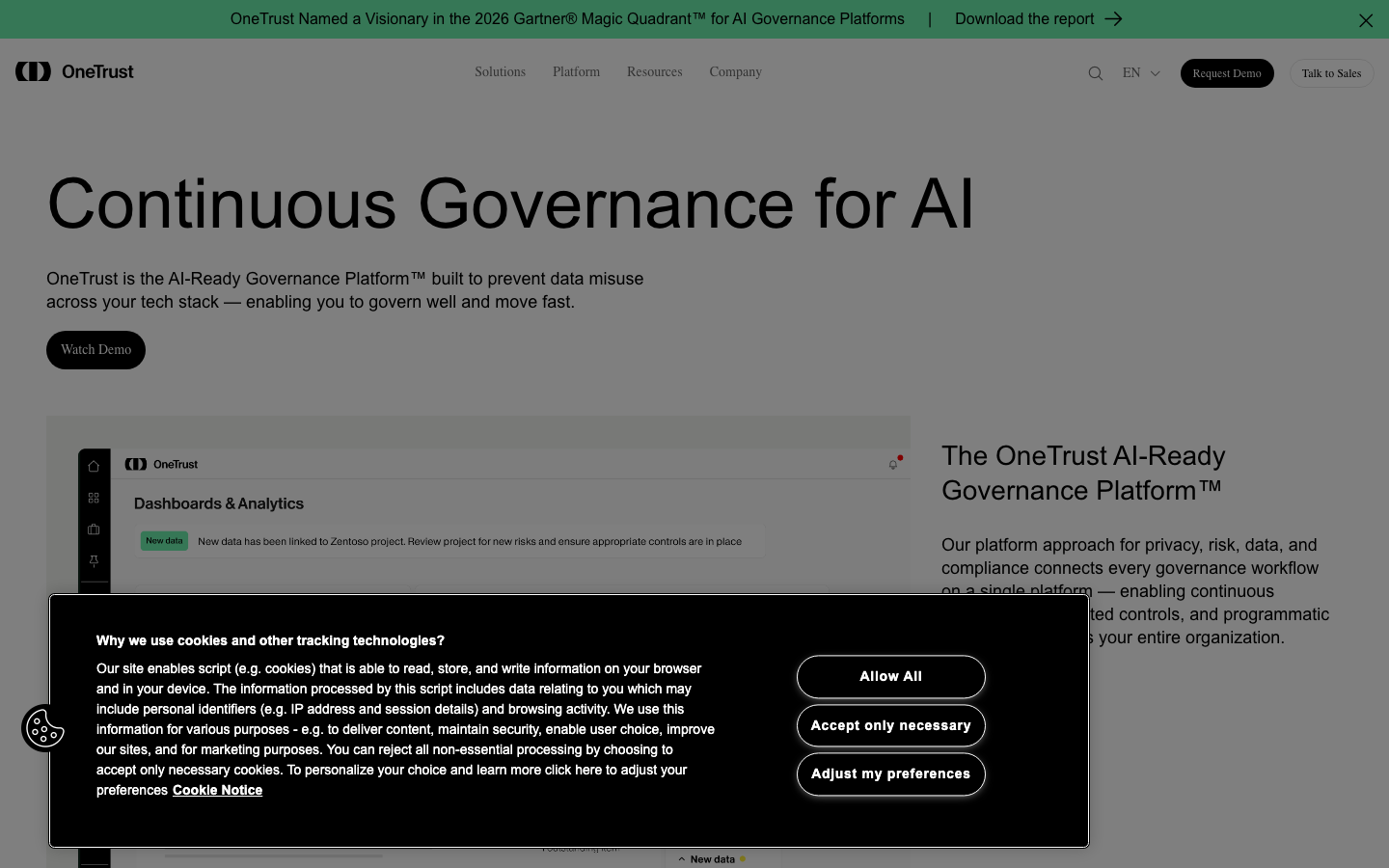
OneTrust is the world's leading AI governance, privacy, risk and compliance platform, covering AI governance, privacy automation, data use governance, technology risk and compliance, third-party management and consent preference management with the AI-Ready Governance Platform. 2026 Gartner Magic Quadrant for AI Governance Platforms Visionary and Forrester Wave Leader for Privacy Management Software. Clients include Adobe, Aetna, Samsung, Chewy, Iberia Airlines and more.
OneTrustAI
OneTrust AI’s core parameters and statistics
OneTrust is positioned as an "AI-ready governance platform". Unlike pure security tools, its core is governance, compliance and risk management, rather than network security detection and response. Its customers are privacy, compliance, legal and risk management teams, not security operations teams.
| Dimensions | Public information |
|---|---|
| Product Positioning | AI-Ready Governance Platform |
| Six major solutions | AI Governance, privacy automation, data use governance, technology risk and compliance, third-party management, consent and preference management |
| Analyst recognition | Gartner AI Governance Platform Visionary (2026, inaugural), Forrester Wave Privacy Management Software Leader (Q4 2025) |
| Customer coverage | Cross-industry global enterprises (Adobe, Aetna, Samsung, Iberia, Chewy, etc.) |
| Latest financing | Undisclosed (raised US$210 million in financing in 2020, valued at US$5.1 billion) |
| CEO | John Heyman (appointed 2026) |
| Headquarters | Atlanta, Georgia, USA |
| Deployment method | Mainly SaaS cloud delivery, supporting private deployment (OneTrust Gov) |
| Compliance Certification | SOC 2 Type II, ISO 27001, GDPR, CCPA, HIPAA, etc. |
Boundary distinction from competing products: OneTrust does not directly compete with network security vendors (CrowdStrike, Palo Alto) - its benchmark targets are BigID, Securiti.ai, TrustArc and the governance modules of traditional GRC vendors (ServiceNow, SAP). OneTrust's core differentiator is the integration of six governance capabilities into a single platform, rather than providing point solutions.
User and market recognition of OneTrust AI
Enterprise customer structure: Global enterprise customers cover leading companies in multiple industries - Adobe (technology), Aetna/CVS Health (medical health), Samsung (consumer electronics), Chewy (e-commerce), Iberia Airlines (aviation). The commonality among customers is that they need to deal with complex privacy regulations (GDPR, CCPA, LGPD, PIPL, etc.) in more than two regions and have a dedicated internal compliance or privacy team. OneTrust does not disclose the specific number of customers and annual revenue. Third parties estimate that its annual revenue is in the range of $300-500 million and it has about 2,000 employees.
Industry analysis recognition:
- Gartner Magic Quadrant for AI Governance Platforms Visionary (2026): The first Magic Quadrant for AI Governance Platforms was released, and OneTrust was positioned as a Visionary for its unified governance platform strategy, recognizing its ability to integrate AI governance and privacy compliance.
- Forrester Wave Privacy Management Software Leaders (Q4 2025): Forrester ranks OneTrust as a leader in privacy management software, with high scores across the dimensions of existing products, strategy, and market share.
- Gartner AI Governance Platform Market Report (2025): Recognizes OneTrust for complete coverage of AI governance, privacy automation, and data governance.
Market Shift Signal: New CEO John Heyman takes over in 2026, previously serving as President and Chief Product Officer of OneTrust. This is the first CEO replacement after founder Kabir Barday handed over the reins. It marks the company's shift from founder-driven to professional manager governance, and also hints at its strategic intention to accelerate commercialization in the AI governance track.
Cost Advantages of OneTrust AI
OneTrust's pricing strategy is a typical enterprise-level SaaS model. Unlike personal-oriented AI tools (such as ChatGPT Plus, Midjourney) or pay-as-you-go API services, its cost structure needs to be evaluated from three levels:
C client/individual users: There is no personal version product. The minimum configuration of OneTrust also requires enterprise-level purchasing, and there is no direct purchasing path for individuals. For individual privacy consultants or freelance compliance experts, OneTrust does not offer independent subscription plans and recommends using free alternatives (such as Cookiebot Basic Termly).
Developer/API Tier: No separate API developer pricing is available. OneTrust's API capabilities (such as connecting to Cookie Consent, DSAR workflow, and privacy notification push) are provided as part of the enterprise subscription and cannot be purchased separately. This means that small development teams cannot trial its API capabilities at low cost - they must first enter an enterprise subscription contract.
Enterprise/Private Deployment: Adopt SaaS annual subscription system, comprehensive pricing according to the following dimensions, subject to official sales quotation:
| Pricing dimensions | Typical billing basis | Description |
|---|---|---|
| Module combination | AI Governance, privacy automation, data governance, etc. independent or bundled | Obtain discounts for bundled purchases, and the minimum payment threshold for a single module is higher |
| Data scale | Number of privacy requests (DSAR), number of data processing activities (ROPA), number of suppliers | Volume-based tiered pricing, exceeding the upper limit triggers contract upgrade |
| User seats | Number of platform analyst/administrator accounts | Read-only or restricted accounts are usually not or under-counted |
| Geographic coverage | Number of countries/regions requiring compliance (GDPR, CCPA, LGPD, PIPL, etc.) | Multi-regional coverage directly drives up annual costs |
| Privatization Plus | OneTrust Gov Privatization Deployment Premium + Infrastructure Cost | Applicable to government, financial and other regulated industries |
Hidden costs (must be included in the budget when purchasing):
- Migration Cost: Migrating existing privacy processes into OneTrust requires redesigning the DSAR workflow, organizing records of data processing activities (ROPA), and mapping data flows. First migrations for mid-sized businesses typically take 3-6 months and require a dedicated project team.
- Integration Cost: API integration development and testing with existing GRC tools SIEM, HR system, and customer service work order system. OneTrust offers pre-built integrations, but custom integrations still require internal or partner resources.
- Training and Change Management: The compliance team's learning curve and process changes - switching from manual/semi-automatic processes to platform-based operations, the initial work efficiency may not increase but decrease.
- Annual Renewal Increase: Enterprise-level SaaS contracts typically include annual price increase provisions of 5-10%, and the upper limit needs to be clearly defined in procurement negotiations.
Price comparison with major competing products (The following is an unofficial quote based on the deduction from the public pricing page):
| Tools | Getting Started | Typical Annual Costs (1,000 employee business) | Core Coverage |
|---|---|---|---|
| OneTrust | Annual Enterprise Subscription | Undisclosed (estimated from $50,000-$150,000) | Privacy + AI Governance + Risk + Third Parties |
| BigID | Annual Enterprise Subscription | Undisclosed (estimated from $40,000-$120,000) | Data Discovery + Privacy + AI Governance |
| Securiti.ai | Annual Enterprise Subscription | Undisclosed (estimated from $30k-100k) | Data Security + Privacy + AI Governance |
| TrustArc | SaaS Subscription | Undisclosed (Estimated starting at $20-80K) | Privacy Compliance + Assessment Management |
| Cookiebot | Free/subscription by domain | Free to hundreds of dollars/year | Cookie Consent only |
Human-Machine Collaboration Boundary (Rule D Mandatory Content): Sections that OneTrust can 100% automate include – Cookie Consent Banner Delivery DSAR Authentication and Data Retrieval, Privacy Notice Distribution, Compliance Framework Mapping and Report Generation. Manual confirmation points are required for the following steps: the final approval and signature of the AI impact assessment, the authorization and release of high-risk data processing activities, the approval of contract terms from third-party suppliers, and the reporting of key disclosure events communicated with regulatory agencies. When enterprises deploy, they should configure approval nodes through OneTrust's workflow engine to establish compliance red lines between automated processes and manual control.
Key Features of OneTrust AI
OneTrust's six major solutions cover the entire link from compliance assessment before AI models go online to daily privacy request processing, and data sharing between modules creates synergy rather than a platter of independent functions.
-
AI Governance: Manage the full life cycle of AI applications - AI model registration, AI impact assessment (DPIA, Data Protection Impact Assessment), AI risk scores, compliance audit trails and EU AI Act regulatory mapping. Synergy: AI Governance can directly reuse the data processing records (ROPA) and user consent data in the privacy automation module without re-entering it, reducing the initial preparation time for AI compliance assessment by more than 60%.
-
Privacy Automation: DSAR full process automation (identity verification → data retrieval → review → reply), Cookie Consent banner management, privacy notice version management and preference center. Synergy: The user preferences collected by Cookie Consent automatically flow into the data usage management module and are used as the basis for policy execution in data sharing and AI training scenarios, forming a chain of "consent collection → policy mapping → compliance execution".
-
Data Use Governance: A real-time policy engine that automatically executes compliance policies when data usage is regulated (AI training data calls, data sharing, analysis queries), and intercepts unauthorized data usage. Scenario value: A scenario where customer data is used to train a large model - before the model goes online, the policy engine automatically verifies whether the training data covers the user's "data is not used for AI training" preference setting. If it does not meet the requirements, the model will be blocked from going online and trigger a compliance review.
-
Tech Risk & Compliance: IT risk control assessment framework, compliance mapping (SOC 2, ISO 27001, PCI-DSS, HIPAA, etc.), control test automation and risk registry management. Synergy: The conclusions of the compliance mapping module automatically flow into the model risk assessment in the AI Governance module, avoiding repeated filling in of control evidence across modules.
-
Third-Party Management: Supplier risk assessment questionnaire automation, third-party due diligence process, supplier life cycle management and contract risk monitoring. Implicit linkage: When a supplier assessment finds compliance risks in its AI services, the assessment results automatically notify the AI Governance module, triggering a risk reassessment of the corresponding AI model.
-
Consent & Preferences: Unified management of user preferences across channels (web, mobile, email, offline), supporting real-time preference synchronization and preference change audit logs. Engineering Pitfall Tip: In a global deployment scenario, the consent collection standards of different regions (mixed mode of GDPR's opt-in and CCPA's opt-out) require multiple sets of rules to be configured in the preference center. OneTrust supports the distribution of different versions of consent templates by geographical region.
Functional integration acceptance focus: In the actual PoV, verify whether the automatic flow of data across modules meets the company's own compliance process (for example, whether the AI impact assessment has a complete approval signature chain instead of just generating a PDF draft), and whether the real-time interception delay of the policy engine in the data usage scenario is within an acceptable range.
OneTrust AI model and version evolution
Continuous iterative updates, the latest version introduces performance optimization and new features. Historical version information can be viewed through the official release page. There is currently no complete public version evolution timeline.
OneTrust AI’s technical advantages
OneTrust's technical advantage lies not in pure engineering performance (such as lower latency or higher throughput), but in converting complex governance logic into executable automated policies - which is fundamentally different from pure data classification or risk assessment tools.
Unified governance data model vs. fragmented data silos: OneTrust's core technology asset is its "governance data model" - it predefines entity relationships in the privacy AI, risk, third party and data governance areas into a standardized data model (such as "data processing activities" associated with "AI models" which are associated with "user consent records"). The governance data model ensures that data references across modules require no additional ETL and mapping work. Compared with scenarios where multiple independent tools are used (private data is stored in BigID, AI models are stored in Excel, and third-party risks are stored in SharePoint), enterprises need to spend 30-50% of their time on cross-system data reconciliation. OneTrust’s unified model zeroes in on this reconciliation effort, with governance costs primarily reflected in the initial data import phase rather than the ongoing operations phase.
Semantic understanding of regulatory engines: OneTrust’s regulatory engine parses legal texts (such as EU AI Act risk classification provisions, compliance obligations of China’s Generative AI Management Measures) into executable assessment templates and policy rules. Its core mechanism is to map obligatory expressions such as "should/must/must not" of regulations to the platform's policy template library, and then achieve continuous compliance through the pipeline of "regulation changes → template updates → policy push". Engineering meaning of the mechanism: When the phased effective date of a compliance requirement of the EU AI Act is updated, the OneTrust background updates the "applicable time window" field of the corresponding assessment template, and the created assessment report automatically updates the deadline, eliminating the need for the compliance team to manually check the affected assessment items.
Architectural Differences in Continuous Monitoring vs Periodic Auditing: Traditional GRC workflows rely on periodic (quarterly/annual) control testing and manual evidence review. OneTrust's continuous monitoring engine regularly pulls data usage logs, access control changes, and third-party vendor status through APIs for real-time comparison with preset compliance policies. When a deviation is detected (for example, the training data of an AI model suddenly has a new data source that is not authorized for use), a non-compliance event is automatically created and the relevant responsible person is notified. Architecture premise: Enterprises need to complete API access to data sources and AI systems first - for old systems without standardized log output, the coverage of continuous monitoring will be limited.
The synergistic advantages of AI governance and privacy compliance: OneTrust's most unique competitive position is "privacy data accumulation feeds back AI governance". Enterprises have managed user consent and data processing records for many years through OneTrust. When the AI Governance module comes online, these historical data can be directly used as input for AI impact assessments (such as "existing data usage records show that the training data for this model belongs to a highly sensitive category") without the need to collect it from scratch. This kind of "capitalization of existing data" effect is difficult to replicate in the short term on competing platforms.
How to use OneTrust AI
OneTrust's implementation path is usually divided into three stages, with clear acceptance criteria set at each stage:
| Phases | Main actions | Typical duration | Acceptance criteria |
|---|---|---|---|
| Phase 1: Discovery and Assessment | Import enterprise AI application inventory and data processing activities (ROPA) → complete the first batch of AI impact assessments → establish an AI model registry | 4-8 weeks | AI model registry covers ≥90% of identified AI applications; first batch of DPIA completed and signed |
| Phase 2: Policy configuration and integration | Configure data usage policy → Set up compliance framework mapping (EU AI Act, GDPR, etc.) → Connect with the enterprise’s existing systems (HRIS, SIEM, work order system) | 4-12 weeks | The policy engine successfully intercepts the use of illegal data in the sandbox environment; the compliance reporting automation rate reaches 80% |
| Phase 3: Continuous Operations | Enable continuous monitoring → Configure periodic compliance reports and dashboards → Establish incident response and audit workflows | Continuous | Continuous monitoring dashboards cover all key risk indicators; shorten the first compliance audit cycle by ≥50% |
Deployment method and entrance:
- SaaS Cloud Delivery (default): Log in through the OneTrust official website, suitable for most enterprises, and data is stored in OneTrust's AWS infrastructure.
- OneTrust Gov (Private): For government, defense and highly regulated financial institutions, supports deployment on customer-owned infrastructure or dedicated cloud, with additional audit logs and data residency controls.
- API integration: OneTrust provides REST API to support integration with third-party platforms such as ServiceNow, Salesforce, Jira, and Slack. The DSAR process can be triggered through the API, and the Cookie Consent can query the user preference status through the API.
Implementation Tip: It is not recommended to sign a large multi-year contract before Phase 1. First, a 6-8-week PoV is conducted to verify the match between the governance data model and the enterprise's existing processes, and then it is expanded into modules. The PoV stage focuses on: whether the AI impact assessment template covers the specific regulations applicable to the enterprise, and the completeness of the data fields after ROPA is imported.
Product Pricing for OneTrust AI
OneTrust does not disclose a standardized price list to the public, and pricing is entirely based on customized quotations based on enterprise needs. The following structure is based on common industry practices and public information, and the official sales quotation shall prevail.
Module composition and procurement method:
- AI Governance: The latest flagship module, billed by the number of AI models managed and the number of DPIA evaluations.
- Privacy Automation: Basic Cookie Consent and DSAR modules, billed by monthly active users (MAU) or number of DSAR requests.
- Data Usage Governance: Billed based on the number of policy rules and the number of controlled data sources.
- Technical Risk & Compliance: Billed based on the number of control tests and compliance frameworks.
- Third Party Management: Billed based on the number of suppliers evaluated and frequency of questionnaires.
- Consent and Preference Management: Billed based on the number of user preference profiles and channels.
Typical procurement scenario deduction:
- Scenario A (SMB, Cookie Compliance Only): No need to purchase OneTrust, use Cookiebot Free or Termly ($99-$199/year) to meet basic GDPR cookie compliance requirements. OneTrust is over-purchased in this scenario.
- Scenario B (medium-sized enterprise, GDPR + CCPA + AI governance): It is recommended to start with the privacy automation + AI Governance dual module, with an estimated annual budget of US$50,000-80,000. PoV verification extends to data usage governance.
- Scenario C (large multinational enterprise, multi-region + multi-module): All modules are bundled and signed, with an annual budget starting from US$150,000 to US$300,000, depending on the number of users and data scale. Contracts that include the OneTrust Gov privatization option may be negotiated.
Trials and PoVs: OneTrust offers standard product demonstrations and proof-of-concept (PoV) scenarios, lasting 4-8 weeks. During the PoV period, enterprises should focus on testing: the regulatory coverage of the AI impact assessment template, the accuracy of the DSAR automated process (especially the accuracy of data retrieval under complex search conditions), and the loading performance impact of the Cookie Consent banner on the main site.
OneTrust AI application scenarios
-
AI regulatory compliance (emerging regulations such as the EU AI Act): The OneTrust AI Governance module covers everything from model registration to DPIA to compliance reporting - after the enterprise enters the AI application list at one time, the system automatically matches applicable regulatory provisions and generates assessment tasks. Quantitative deduction: For a medium-sized enterprise planning to deploy 20+ AI applications, it would take 3-6 months to manually complete the compliance assessment (each application assessment takes 1-2 weeks, involving legal, privacy, technology, and business parties). Using OneTrust can compress the parallel assessment process to 4-8 weeks. The core time savings comes from template automation (saving about 40% of document drafting time) and regulatory mapping (saving about 30% of legal interpretation time). Implementation Tip: The final signature of the assessment conclusion still requires manual confirmation by the person in charge of compliance - automated templates reduce draft preparation time rather than shifting decision-making responsibilities.
-
Privacy request automation (DSAR batch processing): OneTrust uniformly receives DSAR requests from multiple channels (web forms, email API), automatically completes identity verification, cross-system data retrieval (supports 200+ pre-built connectors), privacy auditing and data package delivery. Cost Reduction and Efficiency Increase Deduction: For a large B2C enterprise that processes 10,000+ DSARs annually, it takes about 2-4 hours to manually process each DSAR (identity verification 0.5h + data retrieval 1-2h + review 0.5h + reply 0.5h). After using OneTrust automation, the processing time of regular DSAR can be reduced from 2-4 hours to 30-60 hours. minutes (main savings in data retrieval and response), annual labor cost savings are estimated at 6-12 full-time FTEs. Border Statement: Extremely complex DSARs (involving cross-border transfer of overseas data, special sensitive data, or legal disputes) still need to be handled by legal teams on a case-by-case basis and cannot be fully automated.
-
AI training data governance and compliance control: When an enterprise uses customer data to train large models, the OneTrust data usage governance module verifies in real time whether the training data is within the user's consent range - automatically compares the "agreement tag" of the data source (such as the "not used for AI training" preference setting) before starting the training task. If it matches, it will be released, if it does not match, it will be blocked and alerted. Project pitfall tip: The real-time performance of the policy engine depends on the response speed of the data source API. For batch offline training tasks, it is recommended to change to the "pre-training batch review" mode to avoid the policy engine becoming a bottleneck of the training pipeline.
-
Third Party AI Vendor Risk Management: Conduct security and compliance assessments of vendors using external AI services (API calls to SaaS AI tools). The OneTrust third-party management module automatically sends assessment questionnaires, analyzes responses, calculates risk scores, and generates supplier risk reports. Synergy: When a third-party supplier's AI services are found to have compliance risks, the assessment results automatically flow into the AI Governance module, marking all AI applications using the supplier as "pending re-evaluation", triggering a secondary DPIA. Adaptation Boundary: This scenario is of greatest value in highly regulated industries such as finance, medical, and government affairs; for enterprises that only use general SaaS (such as Slack, Zoom), OneTrust's third-party management capabilities are over-configured.
Who is suitable for OneTrust AI?
-
Data Protection Officer (DPO) and Privacy Team: the core user groups. OneTrust’s privacy automation and AI governance modules directly support the DPO’s day-to-day compliance efforts – DSAR processing DPIA management ROPA maintenance and cross-border data transfer assessments. Not Fitting the Boundary: Not recommended for small businesses without a dedicated privacy person – a team without a DPO cannot effectively operate OneTrust’s governance processes. For such enterprises, basic privacy policy requirements and cookie compliance can be prioritized without investing in an enterprise-level governance platform.
-
Chief Compliance Officer (CCO) and Legal Team: Compliance leaders who need to deal with multi-regional AI regulations (EU AI Act, China Generative AI Management Measures, Brazil LGPD, etc.). OneTrust's automated regulatory mapping and continuous compliance monitoring take compliance status from an "annual audit snapshot" to a "real-time dashboard." Prerequisite: Enterprises need to have at least 1-2 compliance operations personnel responsible for the daily configuration and monitoring of the platform - OneTrust reduces the complexity of compliance management rather than the need for compliance professionals.
-
Risk Management and GRC Team: OneTrust Technology Risk & Compliance, Third-Party Management modules are suitable for unified management of the enterprise's IT risk framework. Applicable prerequisite: The enterprise already has basic GRC operating processes - risk assessment framework, control testing cycle and risk registration system. For companies whose GRC processes are still in the early stages of construction, it is recommended to establish a basic risk management framework first and then introduce OneTrust to achieve digitalization.
-
AI Product Manager and Model Owner: Direct users of the AI Governance module - need to complete model registration, impact assessment and risk self-assessment for each AI application. OneTrust’s templated DPIA lowers the compliance threshold for model owners, but still requires business leaders to understand what data sources their AI applications use and what automated decisions are made. Misfit Boundary: If the enterprise does not yet have a systematic inventory of AI applications, or the number of AI applications is very small (less than 3), it is more cost-effective to manually manage AI compliance than to introduce OneTrust.
Clearly not suitable for people:
- Localized enterprises that do not need to deal with multi-regional privacy/AI regulations (small and medium-sized enterprises that only operate within China and do not involve cross-border data transfer);
- Micro businesses without dedicated compliance or privacy staff (recommend using free/low-cost point tools such as Cookiebot, Termly);
- Security operations teams whose primary needs are network security (vulnerability management, threat detection SOC operations) rather than governance compliance - these needs should turn to security platforms such as CrowdStrike, SentinelOne or Palo Alto.
Summary and Outlook
OneTrust’s core competency is embedding AI governance into an enterprise’s existing privacy and compliance infrastructure, rather than selling it as a standalone AI security tool. For multinational enterprises that must simultaneously deal with multiple compliance pressures such as the EU AI Act, China's generative AI regulations GDPR, and CCPA, OneTrust has not yet encountered a substitute of the same size in the dimensions of cross-module data collaboration (especially private data feeding back AI governance) and regulatory automation mapping.
Current Core Advantages:
- Unified data model across six major governance modules, eliminating cross-system data reconciliation costs.
- Collaboration of AI governance and privacy compliance - existing privacy data can be directly reused for AI impact assessment.
- Double recognized by Gartner and Forrester, reducing enterprise selection risks.
- Continuous monitoring engine evolves compliance status from annual snapshots to real-time dashboards.
Major current limitations and uncertainties:
- AI security technology depth is limited: The AI Governance module (launched in 2025-2026) is not as good as specialized AI security vendors (such as Protect AI, Snyk AI, HiddenLayer) in AI adversarial attack detection, model bias analysis, and AI supply chain security capabilities. Enterprises need to purchase additional complementary products if they need in-depth detection of AI security technology.
- Intensified market competition: Traditional GRC majors (ServiceNow, SAP) are extending their compliance workflows to AI governance scenarios; data intelligence platform vendors (BigID, Securiti.ai) are also superimposing AI governance on the basis of privacy - the three enter the same track from different starting points, and the competitive landscape has not yet been finalized.
- Uncertainty in the rhythm of regulatory enforcement: The EU AI Act will take effect in stages until 2028, and China’s generative AI management measures will continue to be updated - OneTrust’s regulatory engine relies on continuous regulatory tracking and template updates, and companies need to pay attention to its update frequency and response timeliness.
- Small and Medium Enterprise Coverage Blind Spot: The price and complexity of OneTrust prevent it from reaching the small and medium-sized enterprise market that only requires basic cookie compliance. It also means that it lacks usage habit cultivation and ecological penetration among small and medium-sized enterprises.
Procurement and Adoption Risk Assessment: OneTrust is best suited for global enterprises that have established mature privacy compliance systems and now need to expand their AI governance capabilities. The recommended procurement path - starting from the 6-8 week PoV of the AI Governance single module, the core verification is three elements: whether the AI impact assessment template covers the specific regulations applicable to the enterprise (such as whether the EU AI Act high-risk classification is accurately triggered), the data docking method with the enterprise's existing manual AI asset list (API import vs. CSV batch upload vs. manual entry), and whether the automatic data flow between modules meets the integrity requirements of the compliance audit chain. For businesses that only need a Cookie Consent banner and a basic privacy notice, lightweight tools like Cookiebot or Termly will suffice without purchasing OneTrust. For companies that are not under urgent pressure to comply with AI regulations (for example, AI applications are mainly for internal decision-making and do not involve sensitive customer data), it is recommended to observe the first round of enforcement cases of the EU AI Act in 2027 before deciding whether to initiate the procurement process.
How to use OneTrust AI
- Web client: You can use it by visiting the official website and registering an account. Most functions do not require installation.
- API Access: Provides RESTful API, developers can obtain the API Key and integrate it into their own applications.
Version Info
- OneTrust AI-Ready Governance Platform (2026 H1) :The AI Governance module has been significantly upgraded, adding AI impact assessment and AI model registration capabilities; synchronized with Gartner AI Governance Magic Quadrant recognition. There is no official precise date yet.
- OneTrust Platform (2025 Release) :The AI Governance module is initially launched; data usage governance is enhanced. There is no official precise date yet.
- OneTrust Platform (2024 Release) :The privacy automation platform continues to iterate; third-party management and technical risk management capabilities are enhanced. There is no official precise date yet.
User Reviews