 OpenArt
Free
OpenArt
Free
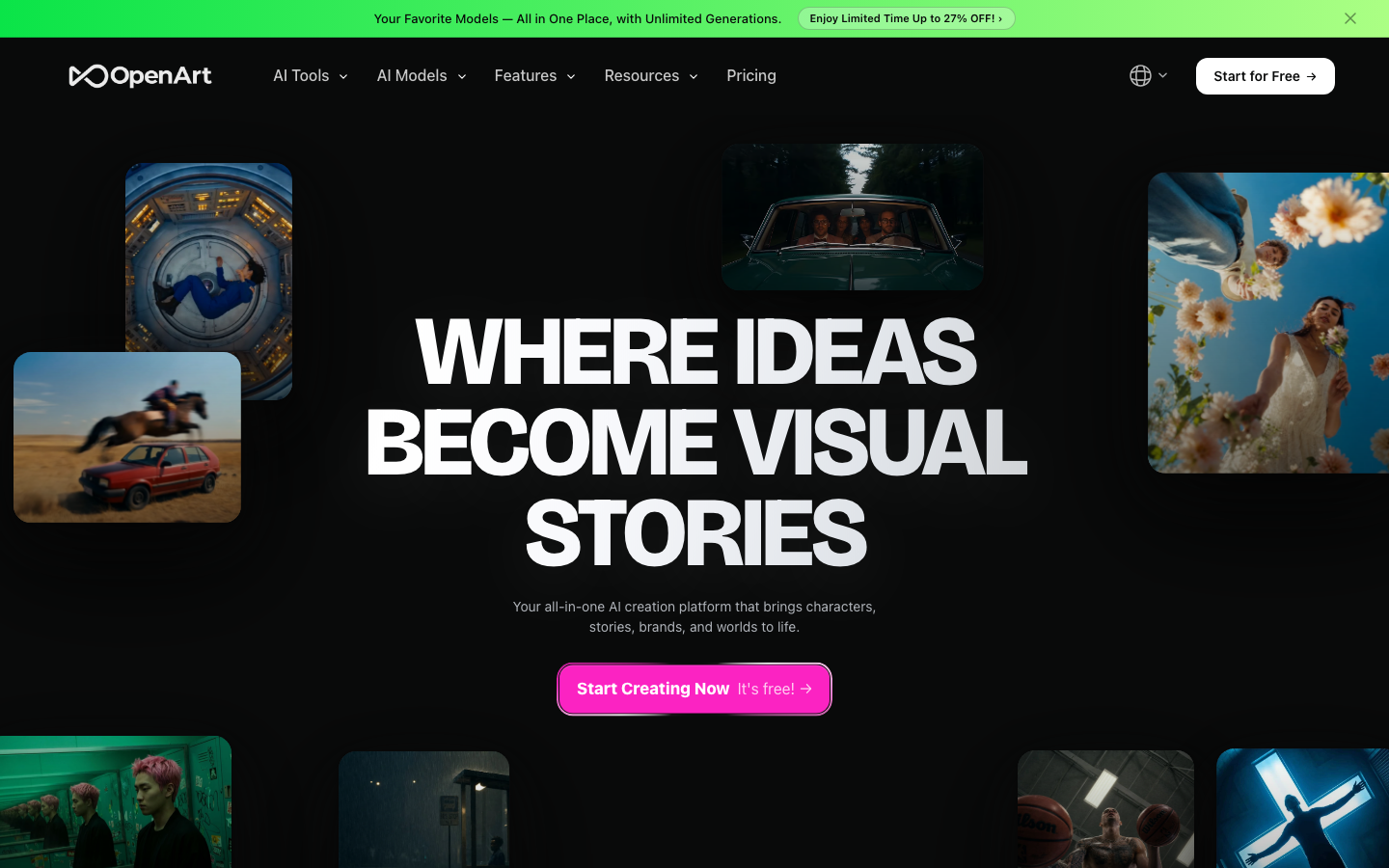
OpenArt is a one-stop AI visual creation platform that aggregates 100+ top-level image/video/audio models and provides full-link creation capabilities such as AI image generation and editing, AI video director (Director), AI character creation, 3D world generation, and voice soundtrack. Founded by former Google engineers and used by 10M+ creators and brands such as Google/Netflix/Disney/Adobe.
OpenArt
Core parameters and statistics of OpenArt
OpenArt has experienced a transition from "AI image generation and prompt word search platform" to "full category AI visual creation suite" in the past year. As of July 2026, it has aggregated 100+ top-level AI models, covering full-link capabilities such as image generation and editing, video directing and editing, character creation, 3D world building, and voice scoring. It is positioned as a "creative studio in the AI era" - allowing creators to complete the entire process from inspiration to finished product in one interface, without having to switch between multiple professional tools such as Midjourney, Runway, Suno, Blender, etc.
| Projects | Public Information |
|---|---|
| Product positioning | One-stop AI visual creation platform |
| Core Competencies | AI image/video/audio generation, character creation, 3D world AI director |
| Number of aggregated models | 100+ (Seedream 5.0, Seedance 2.0/2.5, Veo 3, GPT Image 2, Nano Banana Pro, Sora 2, Kling 3.0, Grok Imagine, MiniMax Hailuo, HappyHorse, etc.) |
| Video generation limit | Maximum 5 minutes, up to 4K resolution |
| Character Consistency | Supports keeping character faces and appearances consistent across images/video scenes |
| Language Support | 30+ Language Speech Synthesis |
| Platform | Web |
| Home | US (San Francisco) |
| User scale | 10 million+ creators (subject to official website disclosure) |
| Enterprise customers | Google, Netflix, Canva, Disney, Adobe, Microsoft, Samsung, Amazon, etc. |
Brief review in one sentence: OpenArt is not another AI image generator, but a "unified operating system for AI visual creation" - it stuffs the five creative dimensions of images, videos, character 3D, and audio into a browser window, allowing you to use dialogue to complete things that used to take a team a week to complete.
OpenArt’s users and market recognition
OpenArt's market influence presents a two-wheel pattern of "word-of-mouth driven by individual creators + brand corporate endorsement".
C-side Creator Market: According to official website data, OpenArt has been used by 10 million+ creators. On third-party evaluation platforms such as Trustpilot, user feedback focuses on the two core values of "one-stop convenience" and "freedom of multiple model selections" - "no need to buy 5 subscriptions for different AI tools" is a frequently mentioned purchase motivation. Early users interacted directly with the founding team in the Discord community, forming an active feedback relationship. Users gradually shift from the initial understanding of "prompt word search tool" to the mental migration of "full-process creation platform".
B-side brand market: The cooperative brands disclosed on the OpenArt official website include Google, Netflix, Canva, Disney, Ogilvy, L'Oréal, Dentsu, P&G, Samsung, Roblox, Adidas, Adobe, EA, Paramount, Amazon, Microsoft, Puma and other leading companies across the technology, advertising, consumer goods, and entertainment industries. This indicates that the quality of its output has reached usable standards for commercial-grade advertising and branded content. The value for corporate customers is that internal creative teams can use OpenArt to quickly produce concept plans and material prototypes, reducing dependence on external production teams and communication costs.
Media Exposure: OpenArt has received coverage from mainstream media such as ABC News, Fox, Bloomberg, TIME, The Wall Street Journal, TechCrunch, etc. This is relatively high-level media coverage among AI visual tools.
Third-party evaluation signal: User reviews on Trustpilot generally recognize its performance in "role consistency" and "model category coverage". Many users mentioned that "I have tried many AI platforms before, but OpenArt is still the best in terms of character creation and image quality." But please note: The evaluation sample size and score distribution are based on the Trustpilot real-time page. This article does not make up specific score numbers.
Cost Advantages of OpenArt
Cost Advantage: Replace five tool subscriptions with one subscription
OpenArt's core cost value proposition is "aggregation instead of decentralization" - combining subscription fees for multiple professional AI tools into one. However, the payment tier design makes the actual costs of users with different usage differ greatly, which requires careful dismantling.
C-side/personal creator
Free Trial: Provides daily free quota, no need to bind a credit card to start the experience. The free credit can be used for basic image generation and prompt word search, but the output resolution and model selection are limited, and the generation is watermarked. Suitable for first-time experience and low-frequency creation.
Paid Subscription (Monthly/Annual Fee):
| Package | Monthly fee (monthly payment) | Monthly fee (annual payment after discount) | Monthly quota | Approximate number of pictures | Approximate number of videos | Parallel generation | Number of characters | Commercial authorization |
|---|---|---|---|---|---|---|---|---|
| Essential | $14 | $12.6 (10% off) | 4,000 credits | ~4,000 sheets | ~50 pcs | 8-way | ~13 pcs | No watermark |
| Advanced | $29 | $23.2 (20% off) | 12,000 credits | ~12,000 cards | ~150 pieces | 16 lanes | ~40 pieces | ✓ |
| Infinite | $56 | $43.7 (22% off) | 24,000 credits | ~24,000 cards | ~300 pcs | 32 lanes | ~80 pcs | ✓ + Priority Support |
| Wonder | $240 | $175.2 (27% off) | 106,000 credits | ~106,000 pieces | ~1,300 pieces | 32 ways | ~353 pieces | ✓ + unlimited creations |
Hidden Cost: The consumption ratio of Credits between images and videos is different (video consumption is much higher than that of images). In actual use, if videos are the main focus, the quota consumption rate will be significantly faster than that of pure image scenarios. Credits are reset monthly and are not accumulated, and the unused quota at the end of the month cannot be rolled over to the next month.
Developer/API access
OpenArt is aimed at end creators rather than the developer market, and does not expose independent APIs. However, the platform provides OpenArt MCP (Model Context Protocol), which allows developers to connect OpenArt's creative capabilities to AI programming tools such as Claude Desktop through the MCP protocol. For detailed usage of MCP, please refer to official documents.
Enterprise/Team
OpenArt offers Team and Enterprise plans (undisclosed pricing). The core differences include a shared Credits pool, collaborative workspace, unified account management, priority technical support, etc. Enterprise pricing needs to be confirmed by contacting the business, and there is no public price list.
Hidden benefits/costs: For creators who previously subscribed to Midjourney ($10-30/month) + Runway ($15-95/month) + ElevenLabs ($5-22/month) + ChatGPT Plus ($20/month) + Gallery license ($29+/month), OpenArt’s Infinite package ($56/month) can cover the core capabilities of the above-mentioned tools at one time, and the monthly expenditure starts from $80-200 down to $44-56. But for users who only use a single function (such as only image generation), OpenArt's price/performance ratio is weaker than Midjourney's dedicated subscription.
Main functions of OpenArt
OpenArt's functional system has been upgraded from the original "multi-model image generation + prompt word search" to a complete suite covering five creative dimensions. The following is expanded by capability domain:
Image generation and editing
- Multi-model image generation: Use Seedream 5.0, GPT Image 2, Nano Banana Pro and other models to generate images in a unified interface. It supports cross-model side-by-side comparison of the same prompt words to quickly find the output that best suits the style.
- AI Canvas Editor: Combine, edit and iterate multiple AI generated results in the canvas, supporting post-operations such as local erasure (Inpaint), image expansion (Outpaint), background replacement, style transfer, 4K super-resolution amplification and other post-processing operations.
- Reference Image Consistency: After dragging in the reference image, AI maintains the visual consistency of the subject during the entire editing process - changing the background, changing the style, adjusting the light and shadow, and the identity of the subject remains unchanged.
Video generation and director (Director)
- Vibe Directing: This is OpenArt's most differentiating capability. Users do not generate videos by writing prompts, but "direct" the entire video using natural language like a movie director - describing scenes, characters, emotions, and rhythm, and AI converts them into coherent film- and television-level clips. Supports long video output up to 5 minutes (most AI video tools have an upper limit of 10-30 seconds).
- Smart Shot: One prompt automatically generates 3-5 movie-quality clips from different camera positions, including multi-angle switching, professional camera movement and visual consistency.
- Motion Sync Video: Upload a 3-30 second reference action video to transfer dance, exercise, walking and other actions to the target character.
- Camera Angle Control: Adjust the angle of view of the image by rotating the slider and selecting the focal length - from wide angle to close-up, from overhead to overhead.
- In addition, it supports video background replacement, video relighting (Relight), video repair (Inpaint) and other refined editing capabilities.
Character Creation (AI Character)
- Users can create consistent AI characters by referring to images or text descriptions. After saving to the character library, they can simply mark the character in any image and video generation to maintain the exact same face, body shape, and appearance. "Cross-scene character consistency" has been a long-standing technical pain point in AI visual creation, and it is also the most frequently recognized feature in OpenArt user feedback.
3D world generation (Worlds)
- OpenArt Worlds: Enter a sentence or a reference image, and AI generates a navigable, persistent 3D spatial context. Users can place characters, add objects and props, take still photos, or export the scene to professional 3D tools (such as Blender, Unreal Engine) for further processing. This capability extends OpenArt's usage scenarios from "flat content production" to "immersive space design."
Audio generation
- Speech Synthesis: 30+ languages, AI voiceover with lip sync, clone sounds from reference samples, or use presets.
- Music Generation: Generate original compositions of any style based on scene descriptions, which can be directly used as video soundtracks.
- Sound Effect Generation: Add layered sound effects such as footsteps, rain sounds, ambient sounds, etc. Each audio track can be exported to WAV/MP3 format and aligned with the video timeline.
[Expert View·Hidden Linkage]: OpenArt's five-dimensional capabilities (image → video → character → 3D → audio) constitute a complete "visual narrative workflow": the creator first defines the protagonist with the character function → uses image generation or canvas editor to design scenes and key frames → uses Director to direct the script into a coherent video → uses Worlds to build scenes that require 3D immersion → finally uses the audio module to score and dub. These five sections are combined in one interface. The traditional workflow requires at least 4-5 professional software (Photoshop + Premiere + Character Creator + Blender + Audition) + a lot of manual stitching. The stickiness of OpenArt lies not in the extreme power of a single function, but in the coherent experience of "the creative process does not leave the current window".
OpenArt model and version evolution
OpenArt's product evolution has experienced rapid iteration from "single-point image tools" to "full-category creation suites" and can be divided into four stages according to capability expansion:
Phase 1: Multi-model image generation platform (2025-09 to 2026-Q1)
OpenArt was launched with the initial positioning of "integrated context for AI image generation". The core value is the aggregation of the generation capabilities of multiple mainstream models such as SD 1.5, SDXL, DALL-E 3, Midjourney, etc., coupled with a tens of millions of prompt word search engines, which solves the pain point of creators switching back and forth between multiple image tools. The product form at this stage is in direct competition with tools such as midjourney and leonardo.ai, but differentiation is reflected in the combined experience of "prompt word search + multi-model comparison".
Phase 2: Character and video capability expansion (2026-Q1 to 2026-Q2)
Launched AI Character character creation system and AI video generation function. The character consistency capability solves the long-standing problem of "the same character looks inconsistent in different pictures" in AI visual creation. The video function introduces video models such as Seedance and Kling, and begins to extend from static images to dynamic videos. At this stage, OpenArt's positioning has been upgraded from "image tool" to a trinity platform of "image + video + character".
The third phase: full category creation suite (2026-Q2 to 2026-06)
Launched OpenArt Worlds (3D world generation) and Audio (voice/music/sound effects generation), and also launched OpenArt MCP integration capabilities. The product positioning has been officially upgraded to a "all-round AI creation suite", covering the five major creation dimensions of images, videos, character 3D, and audio. The competitive benchmark at this stage is no longer individual image tools, but broader platforms such as Runway Gen-3 (video + image) and Pika Labs.
The fourth phase: Director era (2026-06 to present)
OpenArt Director officially released on June 23, 2026, is OpenArt’s most groundbreaking capability. It proposes the concept of "Vibe Directing" - users use natural language to "direct" videos (rather than "generate" videos), and AI understands narrative intentions, character relationships, and emotional rhythms and then autonomously completes the entire process from script to finished film. Supports video output of up to 5 minutes, multi-role management, and brand materials (Logo/font/color) are automatically consistent. Director marks the evolution of OpenArt from "tool" to "creative partner" - the role of the creator changes from operator to director.
Recent key model updates
OpenArt continues to integrate the latest models. Important models recently launched include Seedance 2.5 (video), Seedance 2.0 (video), Nano Banana 2 (image), Kling 3.0 (video), SwitchX (editing), Wan 2.7 (video), etc. The platform model library operates in a "model as a service" manner, and users do not need to subscribe to an independent platform for each model separately.
Technical advantages of OpenArt
The technical barrier of OpenArt is not in the self-developed basic model (it aggregates third-party models rather than self-developed), but in the "unified creative abstraction layer" - allowing 100+ AI models with different parameter systems, output styles, and resolutions to be called and arranged like one model.
Unified model abstraction layer: Each connected AI model has independent API specifications, parameter formats and output restrictions. OpenArt has built a standardized adaptation layer on the back end, encapsulating the differences of each model in adapters and exposing a unified creation interface upwards. Users do not need to relearn operating logic when switching models in the interface - changing models is just a matter of selecting an option in the menu, rather than switching to a completely different tool. The engineering complexity of this abstraction layer increases linearly with the number of models rather than being constant—each new model needs to be adapted, tested, and tuned.
Cross-scene character consistency engine: The same character maintains consistent appearance in different images or video frames, which is a long-term technical difficulty in AI visual creation. OpenArt's solution is a "character token" mechanism - after the user creates a character, the system extracts a latent space representation of its facial features, body shape, and style, and injects this representation into the model as a condition for each generation. This approach is more reliable than hand-picked solutions after redrawing, but also relies on the quality of the underlying model's response to conditional controls - different models vary in their ability to retain characters.
Vibe Directing's orchestration architecture: The core of Director is not to generate a single video, but to understand the narrative structure, decompose scenes, and maintain cross-scene consistency. Its technical architecture can be understood as a combination of "LLM screenwriter + multi-model rendering engine": the LLM layer understands the user's natural language description and decomposes it into structured instructions such as scene description, character scheduling, camera setting, and emotional rhythm; the rendering layer calls the corresponding image/video model to generate material according to these instructions; and then outputs the final film through post-production pipelines such as splicing, transition, and soundtrack. This arrangement allows Director to generate "videos" rather than "clips" - the output of most AI video tools is isolated 10-second clips, while the output of Director is a coherent video with a complete narrative structure.
Applicable scene boundaries: The advantages of OpenArt's abstraction layer are most prominent in scenarios that require "multi-model comparison and selection" and "cross-category creation". However, when you need to use the exclusive new features of a certain model (such as the specific motion brushes of Midjourney's latest character reference mode Runway), there may be a time lag in OpenArt's adaptation. In addition, because the underlying model is not under the control of OpenArt, interruption or major changes to a certain model will affect the platform's ability to respond.
How to use OpenArt
The portal of OpenArt is centered on the Web side and cooperates with MCP integration to cover different usage levels from manual creation to automated workflow:
| How to use | Access path | Suitable scenarios | Payment model |
|---|---|---|---|
| Direct creation on the Web | openart.ai registration | Daily image/video/character/3D/audio creation | Free quota + paid subscription |
| Director Vibe Directing | openart.ai/suite/director | Long video narrative creation | Same as above |
| AI model direct selection | openart.ai/ai-model | Select specific model generation on demand | Same as above |
| OpenArt MCP | Integrated into Claude Desktop and more | Developers control creation programmatically | Subscription + MCP configuration required |
Typical usage steps (image generation):
- Visit openart.ai, register or log in
- Enter the Create Image interface and select a model (such as Seedream 5.0, GPT Image 2, etc.)
- Enter a text description or drag in a reference image
- Adjust generation parameters (resolution, style reference, character markers, etc.)
- After generation, enter the canvas editor for post-adjustment (erase/expand/background replacement)
- Export the final work (supports multiple formats and resolutions)
Typical usage steps (Director video director):
- Enter the Director interface (openart.ai/suite/director)
- Use natural language to describe the video idea ("A cyberpunk-style product ad featuring a woman in a silver coat showing off a smartphone on a neon street")
- AI automatically breaks down the scene and generates a preliminary storyboard
- The user adjusts the scene, characters, and rhythm through dialogue ("Change the second scene to a rainy day")
- Director renders the final video and exports it after previewing
OpenArt Product Pricing
OpenArt's charging model is a "Credits prepaid subscription system". Credits are consumed in different proportions between different types of generation - the credit consumption of video generation is much higher than that of image generation.
| Fee level | Package selection | Average monthly cost (annual payment) | Core restrictions | Suitable for the crowd |
|---|---|---|---|---|
| Free | Credit card-free trial | $0 | Limited, watermarked, low resolution | First time experience, very low-frequency users |
| Getting Started | Essential | $12.6/month | 4,000 credits/month, ~50 videos or 4,000 images | Individual hobbyists and light creators |
| Advanced | $23.2/month | 12,000 credits/month, including commercial license | Freelance creators, small teams | |
| Advanced | Infinite | $43.7/month | 24,000 credits/month, priority support | High-frequency creators, medium and large projects |
| Flagship | Wonder | $175.2/month | 106,000 credits/month, unlimited creation, unlimited use of Seedream 5.0 Pro | Professional studio, brand team |
| Team/Enterprise | Team/Enterprise | Business Pricing | Shared Credit Pool, Collaboration Space, Unified Management | Agencies, Corporate Creative Departments |
Price competitiveness analysis: Among aggregation platforms, OpenArt’s pricing is in the upper-middle range. Taking the Advanced profile ($23.2/month) as an example, it provides 16 channels of parallel generation of 40 characters, commercial licensing and other capabilities. Compared with Midjourney Standard Plan ($30/month, image generation only) or Runway Pro ($15-95/month, video + image), OpenArt has a clear advantage in "category coverage", but it is not as good as native tools in "single model feature depth". Enterprises need to evaluate when selecting: whether the types of models used by the team are within the coverage of OpenArt, whether there is a strong need for role consistency, and whether they accept workflow adjustments brought about by platform changes.
Cost Trap: The credit consumption of video generation is significantly higher than that of images, and the actual cost for heavy video users may be higher than the estimate for pure image scenarios. Credits are reset monthly. It is recommended to choose a package based on actual usage rather than simply upgrading based on "maximum possible usage".
OpenArt application scenarios
OpenArt's capabilities span five creative dimensions, and its application scenarios cover personal content creation, commercial advertising production, e-commerce marketing, game development, brand building and other fields:
-
AI video advertising and brand content production: The brand team uses Director to quickly produce product advertising videos, brand videos, and UGC-style content. The traditional process requires script planning → casting → shooting → post-editing → soundtrack → review. The production cycle of a 30-second advertisement is usually 1-2 weeks. After using OpenArt Director, the process from concept to first draft can be compressed into a few hours, and multiple versions can be quickly modified - changing characters, scenes, and soundtracks only requires dialogue adjustments. Key points of verification: The ability to maintain the consistency of brand materials (logo, fonts, color matching) - whether the brand guide can be automatically applied after uploading.
-
Social media content mass production: Individual creators or MCN institutions frequently produce short videos such as TikTok/Reels/Shorts. OpenArt supports pre-made multiple short video templates and aspect ratios (vertical 9:16, horizontal 16:9, square 1:1), which can be generated once and published directly. The character creation function allows creators to create "AI virtual human" IP and maintain a consistent image in different videos. Key points to check: The consistency of the character in different scenes and lighting conditions - whether it is "the same person in different places" rather than "different people who look like".
-
E-commerce and product visual design: The e-commerce team generates product display pictures, scene pictures, and model pictures. The traditional process requires product photography studio + model + retoucher, and the cost of visual materials for a single SKU is hundreds to thousands of yuan. Using OpenArt's image editing suite, product photos can be inserted into different scenes, models can be changed, and styles can be adjusted. A designer can complete the output of visual solutions for dozens of SKUs in one day. Key points of verification: Whether the product details (trademark, packaging text, product shape) remain accurate and not distorted after style migration.
-
Preliminary concept design of games and virtual worlds: The game team uses 3D Worlds to quickly build concept prototypes of game scenes for project establishment communication and early gameplay verification. Character creation functionality is available for NPC character design exploration. Traditional concept design requires several days of hand-drawing or 3D modeling by concept artists. OpenArt compresses the "from text to 3D scene" cycle to minutes. Key points to check: Whether the navigability and export format of the 3D context are compatible with the professional engine used by the team (such as Unity/Unreal).
-
Education and training content production: Educational institutions produce visual materials and animation demonstration clips in course videos. OpenArt's audio capabilities support dubbing and lip syncing in 30+ languages, making it suitable for the production of multilingual course content. Key points to check: The voice naturalness and lip synchronization accuracy of the dubbing - whether it remains natural during longer monologue passages.
Who is OpenArt suitable for?
OpenArt adapts to a wide range of user groups from individual creators to brand teams through multi-category coverage and tiered pricing:
-
Individual AI Creators and Enthusiasts: Get access to most core features with a free trial or Essential plan. Suitable for daily social content creation, personal project exploration and AI art experimentation. Unfit Boundary: For advanced users who require extreme parameter control of a single model (such as precise control of underlying parameters such as SD's CFG Scale, noise scheduling, etc.), OpenArt's abstraction layer may limit these fine-grained adjustments.
-
Short video creators and social media operations: Use Director, role creation and video templates to produce platform-adapted content at high frequency. AI virtual human capabilities allow individual creators to create "starring character" IP at a very low cost. Prerequisites: Clear content positioning and release rhythm are required - the value of the tool depends on the frequency of use, and low-frequency users may not feel the value of subscription.
-
Brand Marketing and Advertising Team: Use Director to quickly produce advertising creative prototypes and A/B testing materials. In the traditional advertising production process, the creative team needs to first make the concept into a "reference image" (Lookbook, Animatic) so that stakeholders can understand the direction. This process usually takes days to weeks. OpenArt can compress creative direction verification cycles into hours. Not suitable for the boundary: TV commercials or cinema commercials that have extremely high quality requirements for post-production - although the output quality of OpenArt is improving rapidly, it cannot completely replace the professional VFX pipeline.
-
E-commerce operation and product designer: Batch production of product visual materials (scene pictures, model pictures, advertising pictures). The team can create a "brand character library" (including models, sets, props) that can be quickly reused and adjusted with each update, rather than reshooting each time. Prerequisite: A certain amount of prompt engineering experience is required to stably produce a visual style that conforms to the brand's tone.
-
Independent Game Developers and Concept Designers: Use 3D Worlds and characters to create rapid production of game concept drawings and scene prototypes for project persuasion, crowdfunding pages, and early gameplay testing. Not suitable for boundaries: It cannot replace the final pipeline of game asset production - the output of 3D Worlds is concept level rather than production level, and it still needs to import professional tools for refinement.
Summary of unsuitable groups: ① Users who only need a single AI function (such as image generation only) and are cost-sensitive - the same price package of dedicated tools (such as Midjourney) may provide deeper single-point capabilities; ② Enterprises that need to self-deploy or run models locally - OpenArt only provides SaaS services and cannot be deployed privately; ③ High-end visual artists who have extremely original requirements for output styles - the depth of style personalization of the aggregated model is not as deep as that accumulated by the single model community LoRA/fine-tuning ecology.
Summary and Outlook
OpenArt started as a "multi-model image generator" in September 2025 and evolved into a one-stop AI visual creation platform in less than a year. Its product iteration speed ranks first among similar tools. The core competitive barrier is not the breakthrough innovation of a single technology, but the product effect of "breadth of category coverage × smoothness of cross-category workflow connection".
Current core advantages: 100+ aggregation models covering the breadth of capabilities in all categories of image/video/character/3D/audio; Director’s Vibe Directing concept has formed a differentiated perception in the field of AI video - not another tool for "writing prompts to generate a few seconds of video", but an experience reshaping of "directing a complete video with dialogue"; the character consistency engine solves one of the most stubborn pain points in AI creation; the public endorsement of brand companies has verified its commercial-grade usability.
Current main limitations: The inherent contradictions of the aggregation model - the depth of control over the functions of a single model is not as good as that of native tools, and there is a time lag in the access of new models; the monthly credit clearing mechanism is not friendly enough to non-high-frequency users; the credit consumption of video generation is high - the actual cost growth curve for heavy video users may be steeper than expected; the privatization deployment plan has not yet been announced, and government and enterprise customers who are sensitive to data sovereignty do not have the selection conditions.
Follow-up observation points: Can Director's Vibe Directing really change the user mentality of "AI video = input prompt → output clip"; whether 3D Worlds will evolve from a "conceptual design tool" to a "production-level 3D asset generation pipeline"; whether OpenArt MCP can form a developer ecosystem and expand enterprise-level automation scenarios; whether the platform will introduce a more flexible credit point structure (such as monthly accumulation, pay-as-you-go options) to lower the entry barrier for medium and low-frequency users.
Procurement and Adoption Risk Assessment: For individual creators, there are no substantial risks in the free trial and Essential packages - it is recommended to use the free quota to experience the core process first, and confirm that the consistency of commonly used models and roles meets expectations before upgrading. For teams or enterprises, it is recommended to first verify the workflow matching in 1-2 specific projects in the Advanced file. The core evaluation dimensions are: ① Whether all the AI models used daily by the team are in OpenArt’s aggregate library ② The stability of role consistency in the team’s typical creative scenarios ③ Whether the output quality of Director can meet brand standards. Before purchasing, enterprises need to confirm: the commercial licensing terms define the ownership of the generated content, the SLA guarantee of API/MCP integration, and the potential impact of the platform model update strategy on existing workflows. For industries with strict data compliance requirements, OpenArt currently only offers SaaS form, and the lack of private deployment options may constitute a key rejection.
Related tools:  Midjourney, stable-diffusion
Version Info
- Director Release :Released OpenArt Director (Vibe Directing), which supports directing up to 5 minutes of coherent AI videos through natural language dialogue and integrates the latest models such as Seedance 2.0 and GPT Image 2.
- Suite Expansion :Launched OpenArt Worlds (3D world generation), Audio (voice soundtrack), and MCP Server integration, and the platform was upgraded from an image tool to a full-category creation suite. There is no official precise date yet.
- Character & Video :Launched AI Character creation system and AI video generation function, supporting video models such as Seedance and Kling. There is no official precise date yet.
- Multi-Model Launch :The product is officially launched, integrating multi-model image generation and prompt word search, supporting models such as SD 1.5/SDXL/DALL-E 3/Midjourney. There is no official precise date yet.
User Reviews