 OpenLIT
Free
OpenLIT
Free
OpenLIT is an AI development tool and observability platform for AI application production. It adopts the OpenTelemetry-native architecture and covers LLM/Agent tracing, metrics, errors, evaluations, Prompt Hub, Vault, GPU monitoring and OTLP export. It is suitable for engineering teams that need to incorporate GenAI applications into formal monitoring and evaluation.
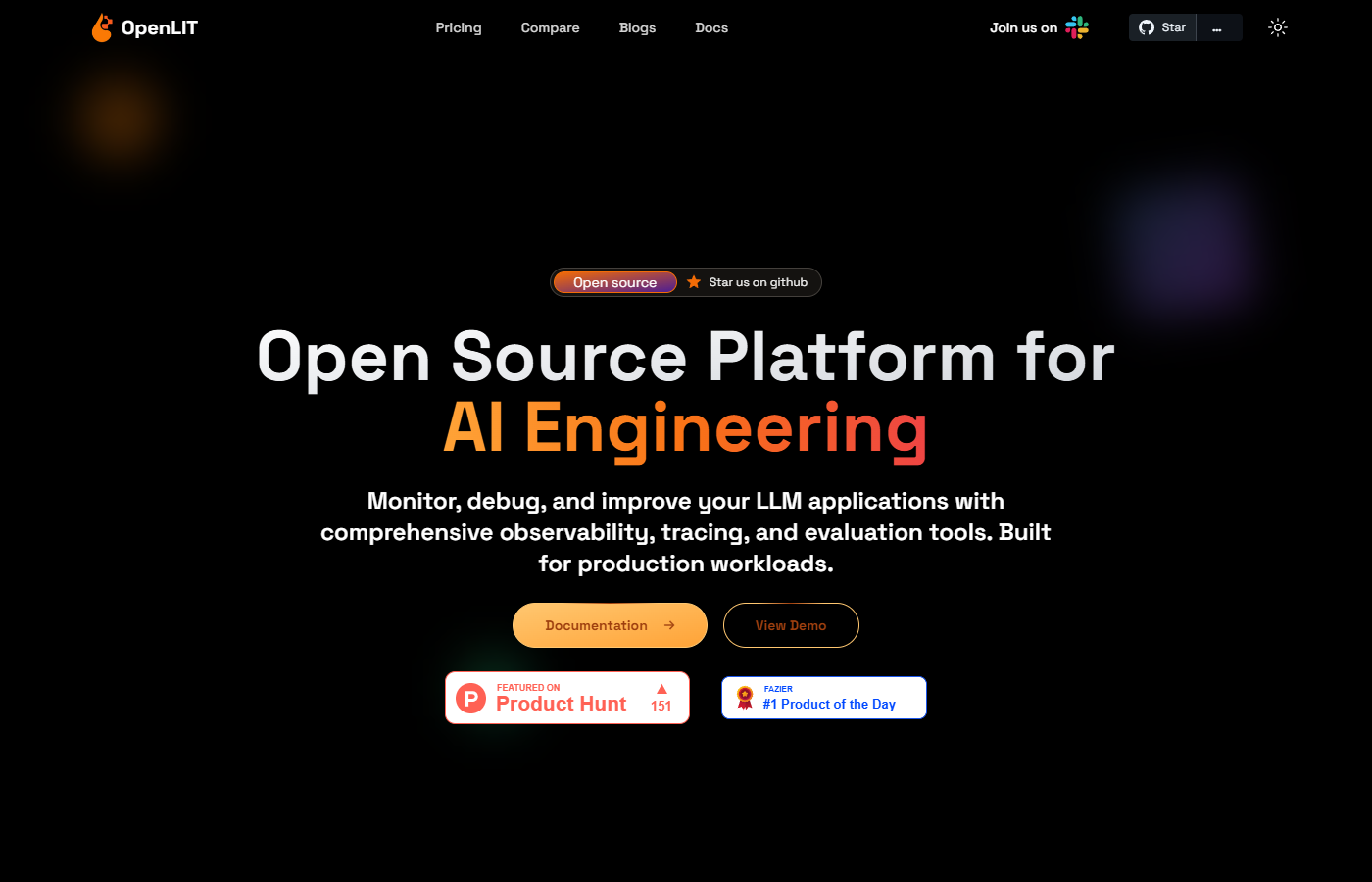
OpenLIT
Core parameters and statistics
OpenLIT is officially positioned as an open-source AI engineering platform. The goal is not to simply record LLM request logs, but to put the links from development, debugging, evaluation, and production monitoring of AI applications into the same OpenTelemetry-native system. Its core objects include LLM calling Agent execution, vector database MCP, GPU and custom business services.
| Projects | Public Information |
|---|---|
| Official entrance | https://openlit.io/ |
| Product form | Open source platform + SDK + Controller + Web UI |
| Technology Base | OpenTelemetry Semantic Conventions / OTLP |
| Core modules | Tracing, Metrics, Errors, Evaluations, Dashboards, Prompt Hub, OpenGround, Vault, Fleet Hub |
| Open Source License | Apache-2.0 |
| GitHub repository | openlit/openlit |
| Community size | About 2,534 stars, 304 forks |
| Latest GitHub Release | controller-0.9.0, 2026-06-10 |
| Python SDK | PyPI openlit 1.42.0 |
| Deployment methods | Self-hosted, Docker/Docker Compose, Kubernetes, Linux, OpenLIT Cloud waitlist |
| External backends | Grafana, Datadog and any OTLP-compatible backend |
Positioning boundaries: OpenLIT is more like an AI observation and evaluation control surface than a model vendor, training platform or general business BI. It can help the team see clearly the AI call link, cost, quality and errors, but it cannot replace the business team's definition of "good answer" standards, nor can it automatically fix quality problems.
User and market recognition
Open Source Adoption Signals: The openlit/openlit repository has formed a visible developer community, the GitHub API currently shows approximately 2,534 stars and 304 forks, and the project is still being submitted and released in June 2026. For AI observability tools, this kind of data shows that it has passed the pure concept stage and has the basis for external reproduction, deployment and issue feedback.
Ecological position: OpenLIT places itself within the OpenTelemetry ecosystem, rather than just making a private format LLM log panel. This choice reduces the resistance for teams to access existing observation infrastructure such as Grafana, Datadog, ClickHouse, and OTLP Collector, and also makes it easier to enter organizations that already have SRE/platform engineering systems.
Market Boundary: The number of paying customers, revenue, retention rate or industry distribution is not officially disclosed; the pricing page marks Cloud as coming soon, indicating that the main value at this stage is still focused on open source self-hosting and developer adoption, rather than the mature SaaS contract system.
Cost advantage
C-side/Individual: Individual developers and small teams can run the full stack with zero license fees using the self-hosted path. The pricing page clearly states that Self-Hosted is $0 for Apache-2.0, no license key, and no usage limits; the real cost mainly comes from local or cloud server resources, storage retention period, and a small amount of operation and maintenance time.
API/Developer: Developer costs focus on accessing the SDK, defining trace/span semantics, cleaning sensitive fields, maintaining evaluation samples, and accessing the OTLP backend. The advantage of OpenLIT is the reuse of OpenTelemetry: teams that already have APM, logs and indicator systems do not need to build a completely isolated monitoring pipeline for AI applications.
Enterprise/Private: Enterprises using self-hosting can keep log prompts, call parameters, error stacks and evaluation data within their own infrastructure, reducing the risk of data outsourcing and vendor lock-in. The price is upgrades, backups, access control, data retention, alerting policies, and high-availability deployment. The Cloud plan is not yet open, and terms such as SSO/SAML, audit logs, SLA, and dedicated support need to be confirmed after official Cloud or business information is clear.
Main functions
- LLM and Agent Tracing: Record the steps of LLM calling Agent, tool calling MCP, vector database and GPU related links to help the engineering team split a failed answer into a replayable execution path.
- Metrics and cost tracking: Summarize token usage, cost, latency, error rate and other indicators to bring model quality, call cost and system stability into the same view.
- Errors and exception monitoring: Track application errors and stack traces, suitable for locating problems such as "the model is correct but the system link fails", such as retrieval failure, tool timeout, missing parameters or backend exceptions.
- Evaluations: Supports online LLM-as-a-judge and programmed evaluation, converts real samples in traces into quality monitoring input, and reduces the blind spots of relying solely on manual spot checks.
- Prompt Hub and OpenGround: Manage prompt versions, experiments, and context rules, suitable for comparing the impact of different prompts, models, or context combinations on output quality.
- Vault and model price management: Centrally manage secrets, model prices and cost calibers to avoid separate maintenance of credentials and price lists for evaluation, observation and production calls.
- Fleet Hub and remote collectors: Collect and manage AI application observation data for multiple deployment environments, suitable for multi-service systems in Kubernetes, Docker and Linux environments.
Model and version evolution
Mainline release
controller-0.9.0 (2026-06-10): GitHub Releases currently verifies the latest version, indicating that OpenLIT is strengthening the Controller route. Controller is oriented to Kubernetes, Docker and Linux scenarios, and reduces the access threshold for zero-code observation through eBPF and automatic SDK injection.
Python SDK 1.42.0 (2026-06): The current public version of PyPI, the package description highlights OpenTelemetry-native auto instrumentation for monitoring LLM Applications and GPUs. SDK is the key entrance for OpenLIT to enter the observation system from developer applications.
Product Milestones
Open source AI engineering platform mainline (2026-06): The documentation page lists OpenLIT, OpenLIT SDKs, and OpenLIT Controller as three types of OSS tools. The platform capabilities have been extended from LLM tracing to prompt management, evaluations, dashboards, logs, remote collectors, and GPU Collector.
Cloud waitlist phase: The pricing page marks Cloud as coming soon, promising managed infrastructure, automatic upgrades, dedicated support, SLA guarantees, SSO/SAML, and audit logs. This status shows that the commercial cloud solution is still in the pre-opening stage, and the production team should evaluate it based on self-hosting capabilities at this stage.
Technical advantages
OpenTelemetry-native mechanism: OpenLIT follows the OpenTelemetry semantic convention and connects to external backends through OTLP. The effect is that traces, metrics and errors of AI applications can enter the existing observable system, which is suitable for platform teams that have already built Grafana, Datadog or unified Collector.
Automatic instrumentation: OpenLIT SDKs provide automatic instrumentation for LLMs, agents, frameworks, vector databases, MCP and GPUs. The effect is to reduce handwritten logs and manual span maintenance, and is suitable for AI application teams that need to quickly cover multiple models, multiple frameworks, and multiple services.
Controller and eBPF route: OpenLIT Controller targets Kubernetes, Docker and Linux, emphasizing zero-code LLM and Agent observability. The effect is to lower the access threshold from "changing code for each application" to infrastructure-side injection, which is suitable for scenarios where the platform team manages multiple applications in a unified manner.
Evaluation and observation coupling: OpenLIT not only stores trace, but also puts online LLM-as-a-judge, programmatic evaluations, Prompt Hub and OpenGround into the same platform. The effect is that online abnormal samples can be reflowed for evaluation and prompt experiments, which is suitable for products that require continuous optimization of answer quality.
How to use
The usage entrance of OpenLIT is divided into three layers: self-hosted platform SDK access and Controller access. The lightest path is to first use Docker Compose to run the complete stack, then connect a low-risk AI service to the SDK, and observe whether traces, metrics, errors, and cost calibers are in line with the team's existing monitoring habits.
- Get self-hosting instructions in the OpenLIT repository or documentation page, and use Docker/Docker Compose to start the UI, ClickHouse storage, and OpenTelemetry Collector.
- Install the OpenLIT SDK in Python or the target application, and configure the OTLP endpoint, application name, context, and necessary model price information.
- Select an LLM/Agent link to access the automatic buried point, and check whether the trace contains model call, tool call, retrieval step token, latency, cost and error information.
- Configure evaluations for online or test set samples and associate quality results with traces.
- When unified access to multiple services is required, then evaluate Controller, remote collectors, Grafana/Datadog export and Vault key management.
Key points for acceptance: At least four things should be confirmed during the pilot phase: whether the trace structure can locate the failed node, whether the cost statistics are consistent with the model billing caliber, whether sensitive fields have been desensitized or not collected, and whether the evaluation results can reflect the real business quality.
Product Pricing
The current structure given by the OpenLIT pricing page is clear: Self-Hosted is available and permanently free, Cloud is not yet open, and the sponsorship program supports project maintenance through OpenCollective.
| Plan | Public Price | Status | Main Content |
|---|---|---|---|
| Self-Hosted | $0 / forever | Available Now | Apache-2.0, no license key, no usage limits, full LLM observability, 60+ integrations, GPU monitoring, Prompt Hub, Vault, Fleet Hub, Evaluations, OTLP export |
| Cloud | Unpublished | Coming Soon | Hosted infrastructure, automatic upgrades dedicated support, SLA, SSO/SAML, audit logs, priority feature requests |
| Token Supporter | $10 / month | Sponsor | Community supporter badge priority GitHub issue triage, Discord sponsor channel |
| Context Window Hero | $50 / month | Sponsor | Contains Token Supporter rights README sponsor logo, roadmap input, monthly call |
Price Boundary: Just because the open source software itself is free does not mean that the total cost is zero. Production deployment will still incur costs for server ClickHouse storage, log retention, backup, monitoring, upgrades, and security governance; Cloud's enterprise price SLA and data terms are currently undisclosed, and are subject to the official real-time page.
Application scenarios
- Production LLM Application Observable: Suitable for teams that have already launched chat RAG, AI search, customer service or content generation services. The focus of verification is whether the trace can cover model calling, retrieval, tools and back-end exceptions.
- Agent debugging and playback: Suitable for multi-step Agent, tool calling Agent, MCP connection and workflow orchestration scenarios. The focus of verification is whether the input and output of each step, tool parameters, errors and time consumption can be located.
- LLM quality evaluation and regression monitoring: suitable for products with frequent changes in prompts, models, and retrieval strategies. The focus of verification is whether the evaluation standards are stable, whether online samples can be converted into test sets, and whether bad examples can be reproduced.
- GPU and model cost monitoring: Suitable for self-hosted model GPU inference or hybrid model supplier scenarios. The focus of verification is whether the GPU indicator token cost, delay and error rate can be uniformly attributed.
- Enterprise Observation Stack Integration: Suitable for organizations with existing Grafana, Datadog or OTLP backends. The focus of verification is whether OpenLIT data can enter existing alarm, reporting and auditing processes.
Applicable people
- AI Application Engineer: Need to locate prompt, retrieval, tool calling and model output problems in the LLM/Agent link. It is suitable to upgrade debugging from console log to structured trace.
- Platform Engineering and SRE Team: GenAI services need to be integrated into the existing observability, alarm and cost management systems, and it is suitable to use OpenTelemetry and OTLP to reduce duplication of construction.
- LLMOps / Evaluation Manager: It is necessary to string together real traces, evaluation set prompt versions and quality indicators, which is suitable for establishing continuous regression monitoring.
- Data Compliance and Security Team: Focus on prompts, user input, keys and log retention boundaries, suitable for reducing outbound risks through self-hosted Vault, desensitization policies and access control.
Not suitable for the boundary: One-time demos, personal scripts without online traffic, projects that only call a single model and have enough supplier logs may not be able to use the complete platform in the short term. If the team has not defined trace naming, sensitive field processing, evaluation standards, and data retention policies, direct large-scale access will generate noisy data and governance burdens.
Summary and Outlook
The core value of OpenLIT is to put AI observability, OpenTelemetry, evaluation prompt management and self-hosted deployment into the same engineering path. It's suitable for teams that have pushed LLM/Agent applications into production and need to account for quality fluctuations, cost anomalies, tool call failures, and GPU resource consumption.
The current limitations are also clear: Cloud is still in the waitlist stage, and enterprise-level SLA, SSO/SAML, audit logs, commercial support and hosting prices have not yet been fully disclosed; the community size is lower than that of more mature general-purpose APM or some LLMOps platforms; the quality of OpenTelemetry access still relies on the team's own span design, desensitization strategy and evaluation standards. It is recommended to start with a core AI link, use one to two weeks to compare the manual troubleshooting time, trace completion rate, cost caliber consistency and evaluation hit rate, and then decide whether to expand to multiple services and enterprise-level self-hosting.
Related tools:  GitHub Copilot,
  Cursor
Version Info
- OpenLIT Controller 0.9.0 :GitHub Releases can currently verify the latest version, focusing on OpenLIT Controller; the current PyPI version of Python SDK is 1.42.0, which is used for automatic tracking of OpenTelemetry-native.
- OpenLIT Python SDK 1.42.0 :The current public version of PyPI, the package description is OpenTelemetry-native automatic tracking library for LLM Applications and GPUs.
- Open-source AI engineering platform :The main product line disclosed on the documentation page covers tracing, prompt management, evaluations, dashboards, logs, remote collectors, OpenLIT SDKs and OpenLIT Controller.
User Reviews