 OpenPipe
OpenPipe is an AI training model platform for developers and AI application teams. Its public documents cover data sets, fine-tuning DPO, evaluation criteria, Chat Completions, Caching, deployment and external model access; its ART project extends Agent reinforcement learning training to multi-step real tasks.
OpenPipe
Core parameters and statistics
OpenPipe's public product form can be divided into two main lines: one is a managed LLM fine-tuning and evaluation platform, which works around data sets, training tasks, evaluation tables, and inference deployment; the other is ART, or Agent Reinforcement Trainer, which extends reinforcement learning training to a multi-step Agent workflow. According to the official page and document positioning, it is more suitable to be classified into the model training category rather than a pan-data processing tool.
| Project | Current Public Information |
|---|---|
| Official entrance | https://openpipe.ai/ |
| Document entrance | https://docs.openpipe.ai/ |
| Classification | ai-model-training |
| Main capabilities | Fine Tuning, DPO, Evaluations, Criteria, Chat Completions, Caching, Deployments, External Models |
| Agent training capabilities | ART uses GRPO to train multi-step Agents, supporting model routes such as Qwen, GPT-OSS, and Llama |
| Platform form | Web console API, official open source training project |
| Public contact email | hello@openpipe.ai |
| ART public repository statistics | About 10,150 stars, 906 forks, Apache-2.0 license |
Positioning Boundary: The value of OpenPipe does not lie in replacing general model services, but in turning existing business logs, labeled samples, preference data and evaluation standards into trainable, comparable and online model assets. For teams that only need to call large models once, its training and evaluation system will appear to be too heavy.
User and market recognition
OpenPipe's recognition mainly comes from the developer scene and public code ecosystem. The public description of the ART warehouse is "Agent Reinforcement Trainer", and it clearly places keywords such as GRPO, multi-step Agent, Qwen, GPT-OSS, Llama, etc. in the project positioning; this shows that it does not serve ordinary chat front-ends, but hopes to continue to train failed samples of Agents in real tasks into engineering teams with improved capabilities.
Developer signal: ART public repository shows about 10,150 stars, 906 forks, the default language is Python, the license is Apache-2.0, and the theme covers agent, agentic-ai, grpo, llms, lora, qwen, reinforcement-learning, rl. This scale shows that OpenPipe has attracted strong developer attention in the direction of Agent reinforcement learning training, but the number of enterprise customers, revenue and payment scale have not been disclosed.
Product Signal: The left navigation of the official document covers Fine Tuning, DPO, Evaluations, Criteria, Chat Completions, Caching, Deployments and External Models, which shows that OpenPipe is not a single-point training script, but strings data, training, evaluation, inference and external model access into one package.
Cost advantage
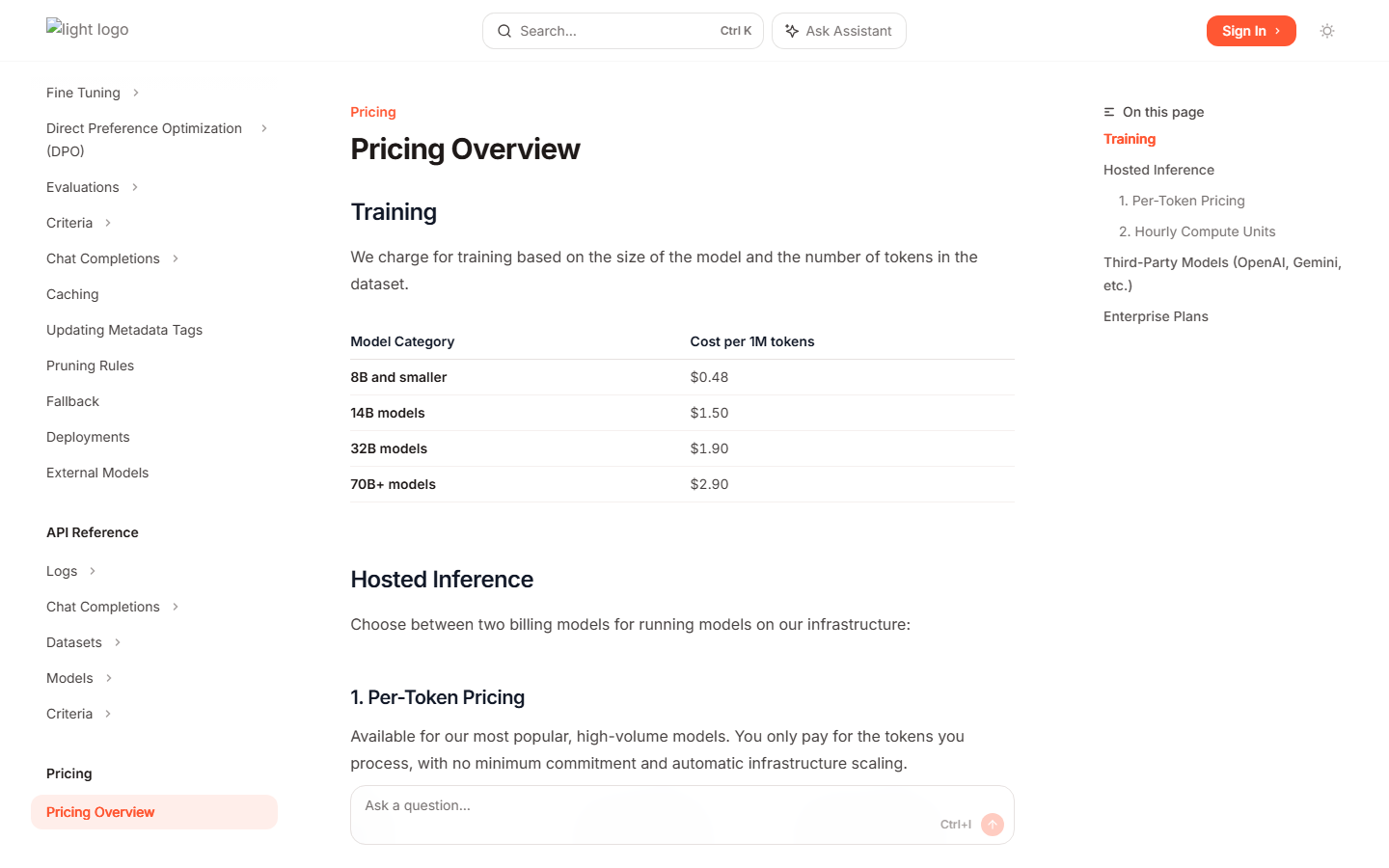
OpenPipe's cost advantage comes from its billing method that is "split by training scale, inference token, or computing unit." Instead of jumping directly into a custom enterprise contract during the pilot phase, teams can first estimate training costs by model category and then choose per-token or compute unit mode based on inference volume.
C-side/Personal: OpenPipe is not a free application for ordinary personal chat. The public pricing page is mainly for developers and organizations to train and deploy models. Individual developers can experiment via the web and API, but the cost depends on the amount of training data, model type, and inference usage.
Developer/API: Training is billed by model size and data set token number; managed inference can be billed by token or CU hours. When a third-party model is fine-tuned by OpenPipe, official instructions do not add additional markup, and the call and costs are borne by the corresponding model supplier's standard rates.
Enterprise/Private: Enterprise plans cover volume discounts, on-premises deployment options, dedicated support, custom SLAs, advanced security features, and increased data storage. Specific contract SLA and deployment boundaries require business confirmation.
| Billing objects | Official public billing method | Public price/boundary |
|---|---|---|
| Training 8B and smaller | Press 1M tokens | $0.48 |
| Training 14B models | Press 1M tokens | $1.50 |
| Training 32B models | Press 1M tokens | $1.90 |
| Training 70B+ models | Press 1M tokens | $2.90 |
| Hosted Inference Llama 3.1 8B Instruct | Input/Output 1M tokens | $0.30 / $0.45 |
| Hosted Inference Llama 3.1 70B Instruct | Input/Output 1M tokens | $1.80 / $2.00 |
| Compute Unit | By CU hour | 8B/12B is $1.50, 32B/14B is $6.00, 72B/70B is $12.00 |
Main functions
- Dataset and Training Entry: The Fine-Tuning quick start page requires you to create a dataset first and import at least 10 pieces of training data; by default, 10% of the data will be retained as a test set during training to evaluate the new model output.
- Fine-tuning task management: The official process includes selecting training data, naming the model, adjusting hyperparameters, starting training and viewing the trained model. It is suitable for converting production samples into reusable model versions.
- DPO and Preference Optimization: The official navigation provides Direct Preference Optimization separately, which is suitable for scenarios where you already have preference samples and want to make the model closer to human judgment or business standards.
- Evaluation system: Evaluations supports code evaluations, criterion evaluations, and head-to-head evaluations, which respectively correspond to deterministic tasks, free text tasks, and multi-model quick comparisons.
- Inference and Caching: Chat Completions, Caching, Deployments and External Models allow the trained model to enter the inference link and form a unified calling interface with external model suppliers.
- Agent Reinforcement Learning: ART uses GRPO to train multi-step Agents, which is suitable for learning from real task execution trajectories, rather than just fine-tuning a single round of prompt output.
The key to combining these functions is to collect data and logs first, then train the model, then use the evaluation table to judge the output quality, and finally deploy it to the inference link. Even if a team that lacks evaluation criteria completes training, it will be difficult to judge whether the model is really better than the base model.
Model and version evolution
OpenPipe does not uniformly display semantic version numbers on the official website like traditional software, so it is more suitable to use public product milestones to describe evolution. The current title of the official website shows "RL For Agents", indicating that the product narrative has been further expanded from the early fine-tuning platform to Agent reinforcement learning training; the official document still retains Fine Tuning, DPO, Evaluations and inference hosting capabilities.
| Phase | Version/Milestone | Date | Public Meaning |
|---|---|---|---|
| Fine-Tuning Platform | OpenPipe Fine-Tuning Platform | ~2024-09 | A managed training platform with data sets, training tasks, model deployment and evaluation as the core, no official precise release date yet |
| ART public project | OpenPipe ART | 2025-03-10 | Official public warehouse created, positioned as Agent Reinforcement Trainer |
| Current official website positioning | OpenPipe RL for Agents | ~2026-06 | The official website title shows RL For Agents, the product narrative focuses on Agent reinforcement learning training, there is no official precise release date yet |
Version Judgment: For production environments, the "version" of OpenPipe should be accepted based on capabilities and deployment dependencies, rather than just looking at the version number. Fine-tuning, evaluation, inference hosting, and ART training links involve different operational contexts, and pilots require fixed data sets, base models, evaluation standards, and inference cost calibers.
Technical advantages
No training mechanism: OpenPipe puts dataset, fine-tuning, evaluations, and deployments in the same set of documents and product paths. Mechanically, the training data first enters the data set, then forms a training task, and then uses the test set and evaluation rules to compare the output; in effect, the team can more clearly see whether the model has really improved; applicable scenarios are tasks such as classification, extraction, customer service, summarization, and code generation that have stable samples and evaluation criteria.
Multiple evaluation modes: code evaluations are suitable for deterministic output, criterion evaluations are suitable for free text, and head-to-head evaluations are suitable for quick comparisons between multiple models. Mechanically, it splits the subjective judgment of "looking good" into different evaluation methods; in effect, it reduces the blind area before the model goes online; the applicable scenario is a development team that needs to continuously compare the base model, fine-tuning model and external model.
Agent reinforcement learning route: ART is oriented to multi-step agents and provides on-the-job training through GRPO. Mechanically, it focuses on task execution trajectories and reward signals; in effect, the training target is closer to the actual work completion; applicable scenarios are tool calls, long-link tasks, code agents, and automated systems that require continuous improvement strategies.
How to use
The path to using OpenPipe usually starts with the data set rather than the model parameters. The development team first organizes logs or labeled samples into training entries, enters the Web console or API to create a dataset; then selects the base model, names the model, sets hyperparameters, and starts training. After training is completed, use the default test set or custom evaluation task to check the output differences, and finally connect the qualified model to Chat Completions or deployment link.
Web console path: Suitable for quick verification by small teams, focusing on whether the training data format, default test set, hyperparameter selection and evaluation table can cover business tasks.
API path: Suitable for linking production logs, annotation platforms and CI evaluation processes. The premise of the API path is that the team has a stable data flow and clear evaluation criteria, otherwise automated training will only amplify data noise.
ART path: Suitable for Agent teams, combining the real task execution process, reward signals and model strategy iteration. It is closer to an engineering training framework and generally requires developers to understand reinforcement learning, model running contexts, and evaluation metrics.
Product Pricing
OpenPipe's public pricing page breaks down costs into Training, Hosted Inference, Third-Party Models, and Enterprise Plans. The training fee is calculated based on the model category and the number of data set tokens; inference hosting provides two methods: per-token pricing and hourly compute units; there is no additional price increase when third-party models are fine-tuned through OpenPipe, and the corresponding supplier will settle the bill at standard rates.
Training fee: $0.48/1M tokens for 8B and below models, $1.50/1M tokens for 14B models, $1.90/1M tokens for 32B models, $2.90/1M tokens for 70B+ models. The larger the training data and the larger the model, the higher the total training cost.
Inference fee: High-volume models are suitable for per-token pricing; experimental or low-volume models are suitable for CU hour. A Compute Unit officially states that it can handle up to 24 simultaneous requests per second and remain available for 60 seconds after traffic spikes.
Enterprise Fee: Enterprise plans require contacting hello@openpipe.ai to confirm on-premises deployment, discounted SLA, support, security features, and data storage terms.
Application scenarios
- Customer service and operation text model: Organize historical work orders, manual responses and quality inspection standards into training sets, and reduce formatting errors and tone deviations through fine-tuning; the focus of acceptance is the error rate, manual rework rate and assessment task pass rate.
- Information extraction and classification: code evaluations are suitable for deterministic tasks such as structured extraction, label classification, and field normalization; the focus of acceptance is accuracy, recall, and boundary sample performance.
- Multi-model evaluation and routing: head-to-head evaluations can be used to compare base models, fine-tuned models, and external models to help decide which tasks are worth taking on with smaller models and which tasks are reserved for stronger models.
- Agent Reinforcement Learning: ART is suitable for training multi-step Agents, such as tool invocation, code tasks, post-retrieval execution and workflow automation; the acceptance focus is task completion rate, failure recovery capability and unit task cost.
OpenPipe is more suitable for teams that "already have data and evaluation criteria." If the business tasks have not been stably defined, it is more important to do data governance and evaluation standards first than to directly train the model.
Applicable people
- AI application development team: Need to convert production logs into fine-tuning data, and determine whether the model is worth launching through the evaluation process.
- Platform and MLOps team: Need to uniformly manage training, inference hosting, external models and evaluation standards, focusing on cost, quality and traceability.
- Agent Engineering Team: It is necessary to use reinforcement learning methods such as GRPO to train multi-step Agents, focusing on real task completion rather than single-round text scores.
- Data annotation and evaluation leader: Artificial standards need to be turned into reusable criteria, codes or head-to-head evaluations.
Scenarios that are not suitable include: there is no training data, no evaluation standards, only a common chat entrance is needed, or the team cannot afford the cost of model training, deployment and maintenance. At this point it's often lighter to use the generic model API directly.
Summary and Outlook
OpenPipe's core competency is to put LLM fine-tuning, evaluation, inference hosting and Agent reinforcement learning training into the same engineering path. It is not a chat product for the public, but a platform for developers who want to use data to continuously improve model performance; when the team has accumulated production logs, labeled samples and clear evaluation criteria, OpenPipe can turn "whether the model is getting better" from a sensory judgment into an evaluable process.
The current limitations are also very clear: the public information does not disclose the complete number of customers, revenue, corporate contract details, and all historical version dates; although ART has active attention, the reinforcement learning training itself has high requirements for data, reward design, and engineering context. When companies implement it, it is recommended to first select a high-frequency, clear-bounded, and quantifiable task pilot, and then expand to more business lines after confirming the training costs, assessment benefits, inference delays, and data security terms.
Related tools:  Hugging Face, replicate
Version Info
- OpenPipeART :The official ART repository was created on 2025-03-10 and is described as Agent Reinforcement Trainer, which uses GRPO training for multi-step Agent tasks.
- OpenPipe RL for Agents :The title of the official website publicly shows that OpenPipe is currently positioned as RL For Agents, and the official document also retains the capabilities of fine-tuning DPO, evaluation, inference hosting, and external model access; there is no official precise release date yet.
- OpenPipe Fine-Tuning Platform :The official document discloses the form of the model fine-tuning platform, covering data set import, training, hyperparameter adjustment, model deployment and evaluation after training is completed; there is no official official release date.
User Reviews