 Opik
Free
Opik
Free
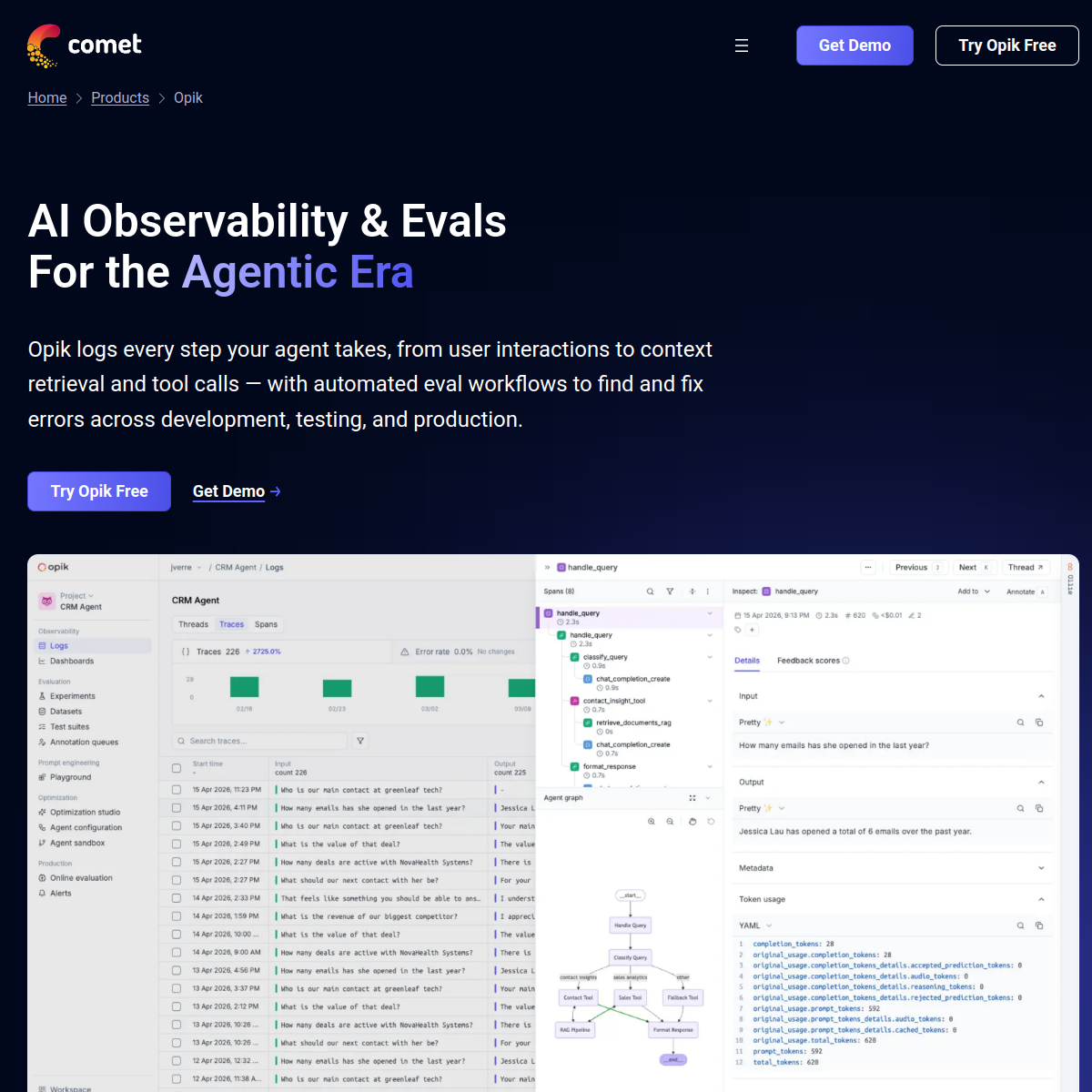
Opik is an open source AI Observability and Evals platform launched by Comet, covering Trace, Test Suites, Prompt optimization and production alerts, and supports cloud and self-hosted deployment.
Opik
Core parameters and statistics
| Projects | Public Information |
|---|---|
| Product Positioning | Open-source AI Observability, Evaluation, and Optimization |
| Key Capabilities | Tracing, LLM-as-a-Judge, Test Suites, Prompt/Tool Optimization |
| Deployment Path | Open Source Self-Hosted + Free/Pro/Enterprise Cloud |
| Integration scale | Pricing page public 40+ integration ecosystem |
| Production scale signal | README announces design target 40M+ traces/day |
| Community size | GitHub 19.4k+ stars, 1.5k forks |
| Latest version | 2.0.58 (2026-06-08) |
Product Boundary: Opik focuses on AI application observation, evaluation and optimization, and does not undertake general data warehouse or model training tasks.
User and market recognition
Market Recognition Signal: The official website displays brand logos such as Uber, Netflix, Autodesk, Etsy, etc., and emphasizes adoption by enterprise-level teams.
Open source recognition: The number of stars and releases of the GitHub warehouse are both in a high range, indicating that it has stable attention and contributions in the developer community.
Undisclosed items: The number of independent paying customers, industry distribution and renewal rate have not been officially disclosed. Commercial details are subject to official subsequent disclosures.
Cost advantage
C-side/Individual: Open Source and Free Cloud are both $0. Free Cloud includes 25k spans/month and 60-day retention, which is suitable for low-threshold verification.
Developer/API Tier: Pro Cloud is $19/month, including 100k spans/month, and additional usage is marked at $5/100k spans.
Enterprise layer: Enterprise is Custom, supporting SSO, compliance and SLA. Additional retention periods, private deployment and support response terms should be verified at time of purchase.
Main functions
- End-to-end Trace and Debugging: Trace user interactions, context retrieval and tool call links.
- LLM-as-a-Judge Evaluation: Provides 30+ evaluation indicators, covering relevance, illusion, task completion, etc.
- Test Suites and Assertions: Supports framed execution of unit and regression tests.
- Production Monitoring and Alarm: Supports online evaluation rules, cost tracking and abnormal alarms.
- Optimization Toolchain: Includes Agent Playground and Prompt Optimizer.
Model and version evolution
Mainline version of Opik
2.0.58 (2026-06-08): The latest version, the release record contains changes related to Opik V2 default and performance optimization.
Recent versions of Opik
2.0.57 (2026-06-04): Continuous version nodes, focusing on SDK, front-end and back-end repairs.
2.0.56 (2026-06-03): Continuously release nodes, reflecting the weekly-level high-frequency iteration rhythm.
Technical advantages
Integration of observation and evaluation: The same platform covers Trace, evaluation and optimization, reducing the cost of switching between multiple tool chains.
Scale processing capability: The official design goal is 40M+ traces/day, which is targeted at production-level loads rather than just experimental environments.
Multiple deployment strategies: Supports both OSS self-hosting and cloud solutions, making it easy to switch according to compliance and team stages.
How to use
| How to use | Entrance | Typical steps | Adaptation scenarios |
|---|---|---|---|
| Open Source | GitHub repository + opik.sh | Deploy local or K8s -> SDK access -> Create test set | High data boundary requirements and operation and maintenance capabilities |
| Free Cloud | Comet Signup | Registration -> Configuration Project -> Access SDK | Quick verification for individuals or small teams |
| Pro/Enterprise | Comet Pricing/Contact | Evaluate usage -> Configure team permissions -> Establish governance process | Scaled collaboration and compliance requirements |
Product Pricing
| Package | Public Price | Public Quota | Remarks |
|---|---|---|---|
| Open Source | $0 | Self-hosted (no official public limit) | Core capabilities available |
| Free Cloud | $0 | 25k spans/month 60 days retention | Max 10 members |
| Pro Cloud | $19/month | 100k spans/month with 60 day retention | Additional $5/100k spans |
| Enterprise | Custom | Custom | SSO, SLA, compliance enhancements |
Application scenarios
- Agent debugging and regression: locate failed nodes in multi-step execution and reproduce the experiment.
- Evaluation-driven release: Use Test Suites and evaluation indicators for version access control.
- Production Quality Governance: Continuously track costs, error rates, and risk of policy violations.
Applicable people
- AI Application R&D Team: Tracking, evaluation, and optimization need to be integrated into the same process.
- Platform Governance Team: Need to support multi-project quality standards and audit traces.
- Enterprise Technology Leader: Focus on compliance SLAs and scalable deployment strategies.
Not suitable for the boundary: Teams that only require light log viewing, no continuous evaluation plan, or no governance process may not be able to realize the value of the platform in the short term.
Summary and Outlook
It provides competitive solutions in its field, and its core value lies in lowering the threshold for AI use in this field.
Current limitations: Some advanced features require paid subscription, and the free version has function or usage restrictions; specific technical details and performance benchmarks have not yet been fully disclosed.
Related tools:  GitHub Copilot,
  Cursor
Version Info
- Opik 2.0.58 :The latest version of GitHub Releases, release records show continued progress around Opik V2, evaluation and performance optimization.
- Opik 2.0.57 :The mainline continuous version, the release record includes function fixes and integration updates of the front-end and SDK.
- Opik 2.0.56 :Continuously releasing nodes shows that Opik maintains stability and availability under a high-frequency version rhythm.
User Reviews