 OmniManip
Free
OmniManip
Free
OmniManip is a universal robot operation method jointly proposed by Peking University and Zhiyuan Robotics. It uses object-centered task constraints to drive operation planning and supports intensive contact tasks and one-paradigm generalization.
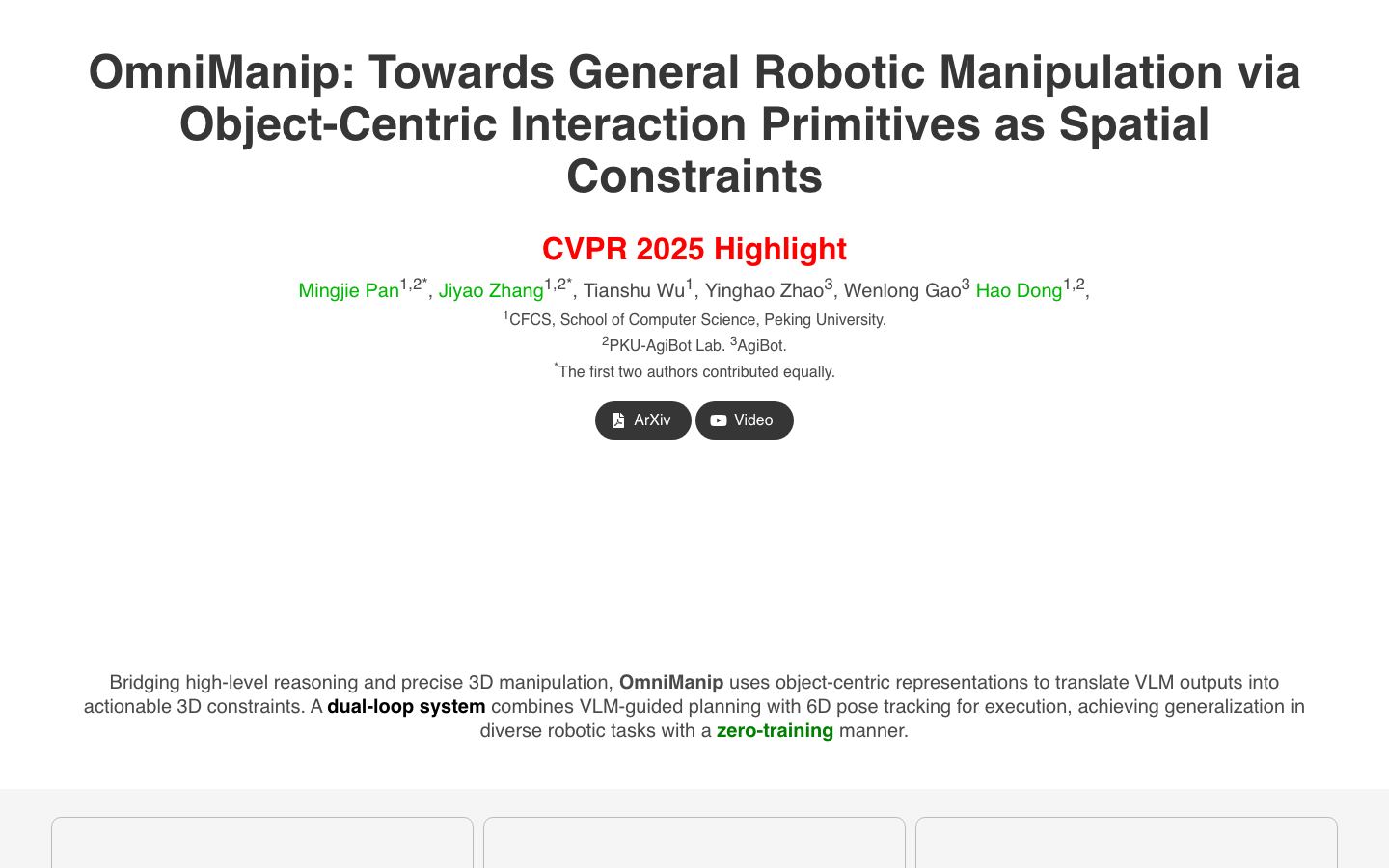
Full review of #OmniManip
Core parameters and statistics
| Project | Specifications |
|---|---|
| Product Positioning | General Robot Operation Methods |
| Development Agency | Peking University PKU-AgiBot Lab + Zhiyuan Robot |
| Core Technology | Object-centered task constraints + ViLA model |
| Operational tasks | Intensive contact operations (folding, wrapping, inserting, etc.) |
| Generalization ability | One-paradigm generalization (training on a task and then executing similar tasks with zero samples) |
| Public form | Research paper + project page |
User and market recognition
Gradually build user awareness in the field, and product capabilities are used by content creators and teams to improve work efficiency. Specific user scale and industry adoption data are subject to the official real-time page.
Cost advantage
| Dimensions | Description |
|---|---|
| Paper/Code | Free and open to the public |
| Reproduction Hardware | Robotic arm + camera + computing device, tens to hundreds of thousands |
| GPU computing power | Benchmarking ViLA model training/inference requirements |
| Ready-to-use product | None |
The truth about free: Papers and project pages are indeed free, but "free" does not mean "low cost". Replicating OmniManip’s experimental conditions—robot arms, camera calibration, and secure isolation of bounded GPU training resources—is the real cost driver. For teams that do not have the conditions for robot experiments, they can almost only stay at the stage of reading papers at this stage.
Hidden Costs: The costs of interdisciplinary collaboration are often overlooked. The collaborative debugging time of the algorithm team, control team, and hardware team may far exceed the investment in model training itself. But if the purpose is to study operational generalization methods, OmniManip’s public information can save time in building a framework from scratch.
Main functions
- Object Center Task Constraints: When defining an operation task, describe "the state that the object should reach" rather than "the movement trajectory of the robot". For example, the task constraint of "fold the towel in half" is "the opposite sides of the towel coincide" rather than "move the gripper to the X coordinate and rotate Y degrees". This approach makes it easier for the operation strategy to generalize to different robot ontologies and initial conditions.
- ViLA Model Architecture: The Vision-Language-Action (ViLA) model jointly understands the scene, task constraints, and robot capabilities. The model "sees" the state of the object, "understands" the task goal, and "plans" the operation actions.
- One-paradigm generalization: After training on one operation task, zero samples are transferred to similar tasks. After training on "folding towels", you can perform "folding clothes" or "folding tablecloths" without additional training.
Model and version evolution
| Stage | Time | Key changes | Current significance |
|---|---|---|---|
| Research Disclosure 1.0 | ~2026-06 | Proposed object-centered task constraints and universal operation framework for the first time | Establish methodology rather than consumer-grade products |
| Subsequent engineering phase | Subject to updates to the paper and project page | May continue to expand the task set, hardware adaptation and training data | Determine whether it can move from a paper to a platform baseline |
OmniManip currently still has a typical research version structure. What can be seen externally are paper nodes and project pages, rather than complete product releases. The value of its version is not in the UI or feature package, but in whether the method can be stably migrated to more intensive contact tasks.
The current version is positioned closer to a public prototype of the “Embodied Intelligent Operation Paradigm.” For the research team, it is more important than maturity; for those who want to purchase directly or go online, this also means bringing expectations back to engineering reality.
Technical advantages
| Technical points | Mechanism of action | Actual effects |
|---|---|---|
| Object Center Constraints | Use the target object state to define the task | There is no need to tie a certain set of manipulator trajectories when generalizing |
| ViLA Joint Modeling | Combines vision, language and action planning | More suitable for handling complex contacts and dynamic feedback |
| Intensive contact operation focus | Specifically for difficult tasks such as folding, wrapping, and inserting | Differentiating traditional grabbing methods |
| One-paradigm generalization | Train one task and then transfer similar tasks | Reduce the cost of retraining for each new task |
The technical highlight of OmniManip is not "another big robot model", but that it separates the task representation from the robot body. This abstraction is very critical, because many operation methods become invalid once the robot arm is changed or the object material is changed, and the object center constraint is precisely to solve this migration fragility.
Publicity Verification: The project emphasizes the generalization of a paradigm and the advantages of intensive contact with tasks. This direction is persuasive in the research presentation, but it is still necessary to distinguish between "experimental establishment" and "industrial stability". In a real production line or home environment, sensor noise, hardware errors, and task changes will raise the difficulty to another level, so it is more like a cutting-edge method worth tracking rather than an off-the-shelf commodity.
How to use
| Steps | Minimum requirements | Key points |
|---|---|---|
| Read the paper and project page | Just use the browser | Confirm the task definition, data settings and experimental boundaries first |
| Get code/configuration | Subject to official warehouse disclosures | Prioritize reproducing experiments rather than rushing to change tasks |
| Preparing robots and visual context | Requires robotic arms, cameras, and computing equipment | Ensure perception calibration and execution stability |
| Migrate to custom tasks | Ability to debug algorithms and robots | Start with similar tasks and gradually expand the constraint representation |
The threshold for getting started with OmniManip is not the software, but the robot experimental conditions. Without a robotic arm, camera calibration and safe isolation environment, it can only stay at the thesis reading stage; this is also the biggest difference between it and general AI SaaS.
The real entry sequence should be to reproduce the experiment first and then replace the tasks, not the other way around. Because its value comes from task representation and control coordination, if the basic reproduction is unstable, any subsequent migration conclusions will be unreliable.
Product Pricing
| Schema | Current public information | Usage boundaries |
|---|---|---|
| Paper/Project Page | Free to the public | Suitable for academic research and technology tracking |
| Code and Model | Subject to the official public warehouse | Suitable for algorithm teams with reproducibility conditions |
| Commercial product | Undisclosed | Not suitable as a ready-to-use solution |
The truth about free: The "free" of OmniManip mainly refers to the fact that papers and public information are free, which does not mean that the cost of reproduction is low. Robot hardware, collection context, computing power and security debugging are the real big numbers.
Hidden costs: It may reduce the duplication of training for similar tasks in the future, but it will increase the cost of experimental organization in the short term. The team needs to invest in algorithm, control, hardware and data annotation resources at the same time. This type of cross-disciplinary collaboration itself is the most easily underestimated cost item.
Application scenarios
- Service robot operation: Folding clothes, sorting items, arranging tables and other tasks in home scenes that require precise operations.
- Industrial precision operations: Intensive contact operations such as parts assembly, wire harness sorting, and software material handling.
- Scientific Research Verification Platform: An experimental platform to study the generalization of robot operations and the representation of task constraints.
Dissuade Scenarios: Not suitable for industrial scenarios that require extremely high speed and strength (such as welding and cutting). OmniManip is aimed at "fine operations" rather than "powerful operations".
Applicable people
- Robotics Operators: Academic researchers focused on task representation, generalization learning, and intensive contact manipulation. The object center constraint framework proposed by OmniManip provides a new experimental baseline for operation generalization research.
- Embodied Intelligence Algorithm Team: An engineering team that explores universal robot operation solutions. It should be noted that it is still in the methodology stage and is not a directly deployable product.
- Zhiyuan Robot Ecological Developer: Developers who use the Zhiyuan Robot platform to verify operating algorithms have relatively low integration costs.
- University Robotics Laboratory: equipped with robotic arms and visual perception equipment, suitable for reproducing and expanding the OmniManip method under existing experimental conditions.
Current Limitations: OmniManip’s current experimental validation focuses on specific intensive contact tasks, and the generalization effect to broader manipulation categories (e.g., rigid object manipulation, tool use) has yet to be verified. In addition, the experimental context in research papers is usually under controlled laboratory conditions, which differs from the deployment context in real scenarios.
Summary and Outlook
It provides competitive solutions in its field, and its core value lies in lowering the threshold for AI use in this field.
Current limitations: Some advanced features require paid subscription, and the free version has function or usage restrictions; specific technical details and performance benchmarks have not yet been fully disclosed.
Related tools:  Hugging Face, replicate
Technical advantages and capability boundaries
As an AI model and API product, OmniManip's core capabilities can be deeply understood through the following dimensions, which directly affect technology selection and implementation effects.
Inference Performance and Benchmark Performance The model’s reasoning performance is reflected in its performance on standard NLP tasks (text generation, code completion, semantic understanding, multi-turn dialogue, information extraction, etc.). It is recommended to conduct horizontal comparison through public benchmark test lists (such as MMLU, HumanEval, GSM8K, etc.), but please note that there may be a gap between benchmark test scores and actual business scenario performance. Key indicators that affect the actual user experience include: inference speed (Token/s or response delay, which directly determines the smoothness of the user experience), context window length (which determines the input size that can be processed at a time, affecting the complexity of the tasks that can be processed), and consistency of output quality (the stability of the results of multiple outputs of the same input, which affects the perception of reliability).
API Compatibility and Development Ecosystem The depth of API compatibility with mainstream development frameworks (LangChain, LlamaIndex, Semantic Kernel, etc.) directly affects the cost and cycle of integrated development. It is recommended to pay attention to the following integration dimensions: the coverage of language types supported by the SDK (whether mainstream languages such as Python, JavaScript, Go, and Java have official SDKs), streaming output support (SSE/WebSocket protocol compatibility), function calling and tool usage capabilities (whether it supports mapping model output to structured function calls), the flexibility of structured output (JSON mode), and the ability to integrate with enterprise-level infrastructure (VPC deployment, Private Link, unified identity authentication). Complete API documentation and rich code examples can significantly lower the entry barrier to development and reduce integration time and costs.
Deployment Flexibility vs. Cost Tradeoff Depending on data privacy requirements, latency sensitivity and usage scale, OmniManip can choose between cloud API calls or on-premises deployment options. The advantages of cloud deployment are zero operation and maintenance costs and elastic scalability, which is suitable for scenarios with large fluctuations in usage and rapid prototype development; local deployment provides complete data sovereignty and low latency (no network round-trip overhead), but you need to bear the cost of purchasing hardware such as GPUs and operation and maintenance manpower. It is recommended to use a monthly API call volume of 1 million times or a monthly fee of US$1,000 as a reference dividing line: below this threshold, cloud APIs have better cost-effectiveness and flexibility. After exceeding this threshold, the total cost of ownership of the self-deployment solution should be comprehensively evaluated, taking into account factors such as hardware depreciation, electricity, operation and maintenance manpower, etc.
Model selection and version strategy
For the selection of OmniManip series models, it is recommended to match the model capabilities of different versions according to specific usage scenarios. The large-parameter version performs better on complex reasoning and multi-step tasks, but has higher costs and longer delays; the small-parameter version can already provide satisfactory output quality in scenarios such as daily conversations and simple question and answer, and the cost is only a fraction of the large version. The recommended selection strategy is: use small and medium versions in standard scenarios to reduce costs, and only call large version models when complex inference tasks need to be processed. This hierarchical calling strategy can reduce the overall API cost by 40-60% without significantly affecting the output quality.
Version Info
- OmniManip :Publicly disclosed for the first time, a universal robot operation method with object center constraints is proposed.
- OmniManip :First public release, no official precise date yet.
User Reviews